Home
Class 11
PHYSICS
A highly rigid cubical block A of small ...

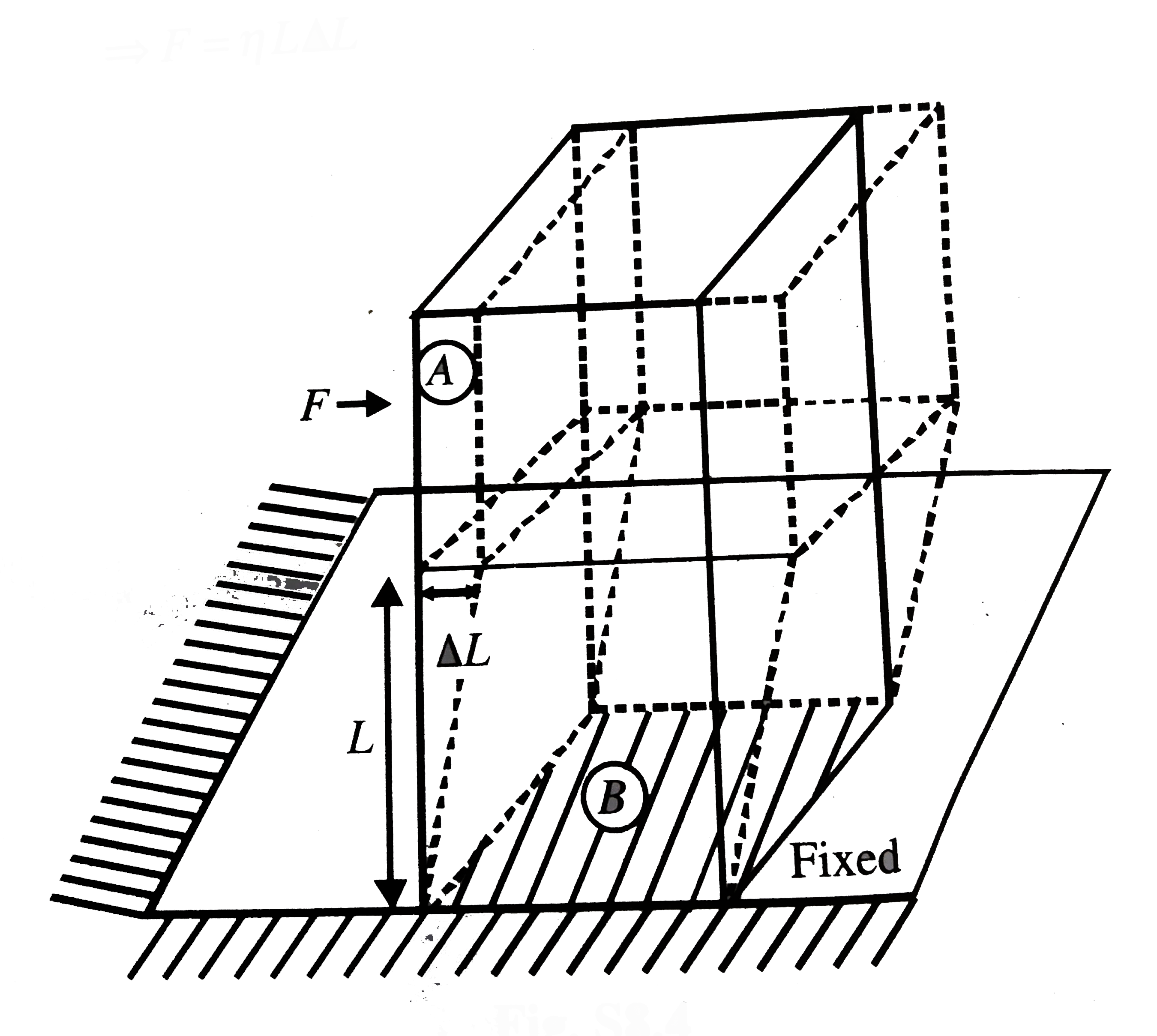
A highly rigid cubical block `A` of small mass `M` and side `L` is fixed rigidly on the other cubical block of same dimensions and of modulus of rigidity `eta` such that the lower face of `A` completely covers the upper face of `B`. The lower face of `B` is rigidly held on a horizontal surface . `A` small force `F` is applied perpendicular to one of the side faces of `A`. After the force is withdrawn , block `A` executes faces of `A`. After the force is withdrawn , block `A` exceutes small oscillations , the time period of which is given by

A

`2 pi sqrt(M eta L)`

B

`2 pi sqrt((M - eta)/(L))`

C

`2 pi sqrt((M - L)/(eta))`

D

2 pi sqrt((M - N)/(eta L))`

Text Solution

Verified by Experts

The correct Answer is:
D

When a force is applied on cubical block `A` in the horizontal direction, then the lower block `B` will get distorted as shown by the dotted lines and `A` will attain a new position (without distortion as `A` is a rigid body) as For cubical block `B`,
`eta = (F//A)/(Delta L//L) = (F)/(A) xx (L)/(Delta L) = (F)/(L^(2)) xx (L)/(Delta L) =(F)/(L xx Delta L)`
`rArr F= eta L Delta L`

`eta L` is a constant
`rArr F prop Delta L` and directed towards the mean position
`rArr` oscilation will be simple harmonic in nature. Here,
`M omega^(2) = eta L`
`rArr omega = sqrt((eta L)/(M)) = (2pi)/(T)`
`rArr T=2pi sqrt((M)/(eta L))`.
Promotional Banner

Topper's Solved these Questions

  • ARCHIVES 2 VOLUME 6

    CENGAGE PHYSICS|Exercise Multiple Correct|22 Videos
  • ARCHIVES 2 VOLUME 6

    CENGAGE PHYSICS|Exercise Comprehension|12 Videos
  • ARCHIVES 2 VOLUME 6

    CENGAGE PHYSICS|Exercise True/False|4 Videos
  • ARCHIVES 1 VOLUME 6

    CENGAGE PHYSICS|Exercise Integer|4 Videos
  • BASIC MATHEMATICS

    CENGAGE PHYSICS|Exercise Exercise 2.6|20 Videos

Similar Questions

Explore conceptually related problems

A highly rigid cubical block A of small mass M and slide L is fixed rigidly on to another cubical block B of the same dimensions and of low modulus of rigidity η such that the lower face of A completely covers the upper face of B. The lower face of B is rigidly held on a horizontal surface. A small force F is applied perpendicular to one of the sides faces of A. After the force is withdrawn, block A executes small oscillations the time period of which is given by.

A cubical block of side a and of mass m rests on a rough horizontal surface. A horizontal force F is applied to normal to one of the faces at height h above the base hgta//2 . What is the minimum value of F for which the cube begins to tip about an edge?

In previous question the gauge pressure at the lower face of the block is

A force Fis tangentially applied on the upper face of a cube of side b and whose lower face is fixed. If modulus of rigidity is n then upper surface of cube is shifted to

One of the square faces of a metal slab of side 50 cm and thickness 20 cm is rigidly fixed on a horizontal surface. If a tangential force of 30 N is applied to the top face and it is known that the shear modulus of the material is 4 xx 10^(10) N//m^(2) , then the displacement (in m) of the top face is

A cube is fixed at base and tangential force 'F' acting on the upper face of area 'A' and theta is shear strain in it, the modulus of rigidity is

A cubical block of side 10 cm floats at the interface of an oil and water. The pressure above that of atmosphere at the lower face of the block is

A cubical block of side 10cm floats at the interface of an oil and water as shown in the figure. The density of oil is 0.6g cm^(-3) and the lower face of ice cube is 2cm below the interface. The pressure above that of the atomosphere at the lower face of the block is

A uniform cube of side and mass m rests on a rough horizontal surface. A horizontal force F is applied normal to one face at point that is directly above the centre of the face at a height (a)/(4) above the centre. The minimum value of F for which the cube begins to topple above an edge without sliding is

CENGAGE PHYSICS-ARCHIVES 2 VOLUME 6-Single Correct
  1. Two bodies (M) and (N) of equal masses are suspended from two separate...

    Text Solution

    |

  2. A uniform cylinder of length (L) and mass (M) having cross sectional a...

    Text Solution

    |

  3. A highly rigid cubical block A of small mass M and side L is fixed rig...

    Text Solution

    |

  4. The displacement y of a particle executing periodic motion is given by...

    Text Solution

    |

  5. One end of a long metallic wire of length (L) is tied to the ceiling. ...

    Text Solution

    |

  6. An object of specific gravity rho is hung from a thin steel wire. The ...

    Text Solution

    |

  7. The extension in a string, obeying Hooke's law, is x. The speed of sou...

    Text Solution

    |

  8. An open pipe is suddenly closed at one end with the result that the fr...

    Text Solution

    |

  9. A whistle giving out 450 H(Z) approaches a stationary observer at a sp...

    Text Solution

    |

  10. A travelling wave in a stretched string is described by the equation y...

    Text Solution

    |

  11. A string of length 0.4 m and mass 10^(-2)kg is tightly clamped at its ...

    Text Solution

    |

  12. A particle of mass (m) is executing oscillations about the origin on t...

    Text Solution

    |

  13. A particle free to move along the (x - axis) hsd potential energy give...

    Text Solution

    |

  14. The ratio of the speed of sound in nitrogen gas to that in helium gas,...

    Text Solution

    |

  15. The period of oscillation of a simple pendulum of length (L) suspended...

    Text Solution

    |

  16. A train moves towards a stationary observer with speed 34 m//s. The tr...

    Text Solution

    |

  17. Two vibrating strings of the same material but lengths L and 2L have ...

    Text Solution

    |

  18. Two pulse in a stretched string whose centers are initially 8cm apart ...

    Text Solution

    |

  19. The ends of a stretched wire of length L are fixed at x = 0 and x = L....

    Text Solution

    |

  20. A particle executes simple harmonic motion between x = -A and x = + A....

    Text Solution

    |

