Home
Class 11
CHEMISTRY
Give reasons for the following (a) PF(...

Give reasons for the following
(a) `PF_(5)` is know but `NF_(3)` is not
(b) `H_(2)O` is a good solvent
(c ) `BF_(3)` is non- polar but planar
(e) Carbon -oxygen `(C-O)` bond lengths are equal in `Na_(2)CO_(3)`
(f) `MgF_(2)` is more soluble in water than `MgCI_(2)` .

Text Solution

Verified by Experts
Valence electronic configuration of `N =2s^(2) 2p^(3)` N-atom does not have vacant d-orbitals, so it cannot form five bonds with `F` (although `EN` of `F` is very high) So `NH_(3)` is not know
(ii) Valence electronic configuration of `P=3s^(2) 3p^(3) 3d^(0)` P-atom have vacant 3d-orbitals and `EN` of `F` is very high so F-atom can excite `3se^(-)s` to 3d orbitals thus forming five bonds with `F.So PF_(5)` is known
(b) `H_(2)O` is a good solvent because
(i) It is highly polar
(ii) It is capable of forming H-bonds among their molecules
(iii) For ionic solutes, it acts as a dielectric (substances which lower the strenght of eletric field)
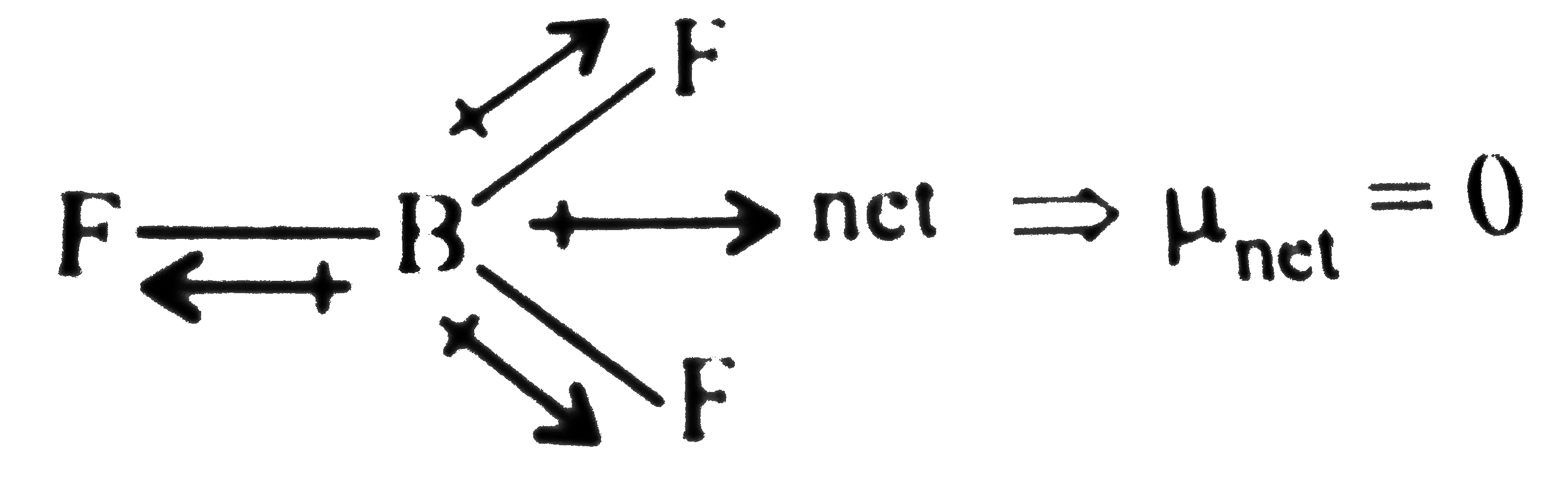
(c) In `BF_(3)` B-atom is `sp^(2)` hybridised hence the shape of molecule is (triangular) planar But due symmertic structure `mu_("net") =0`
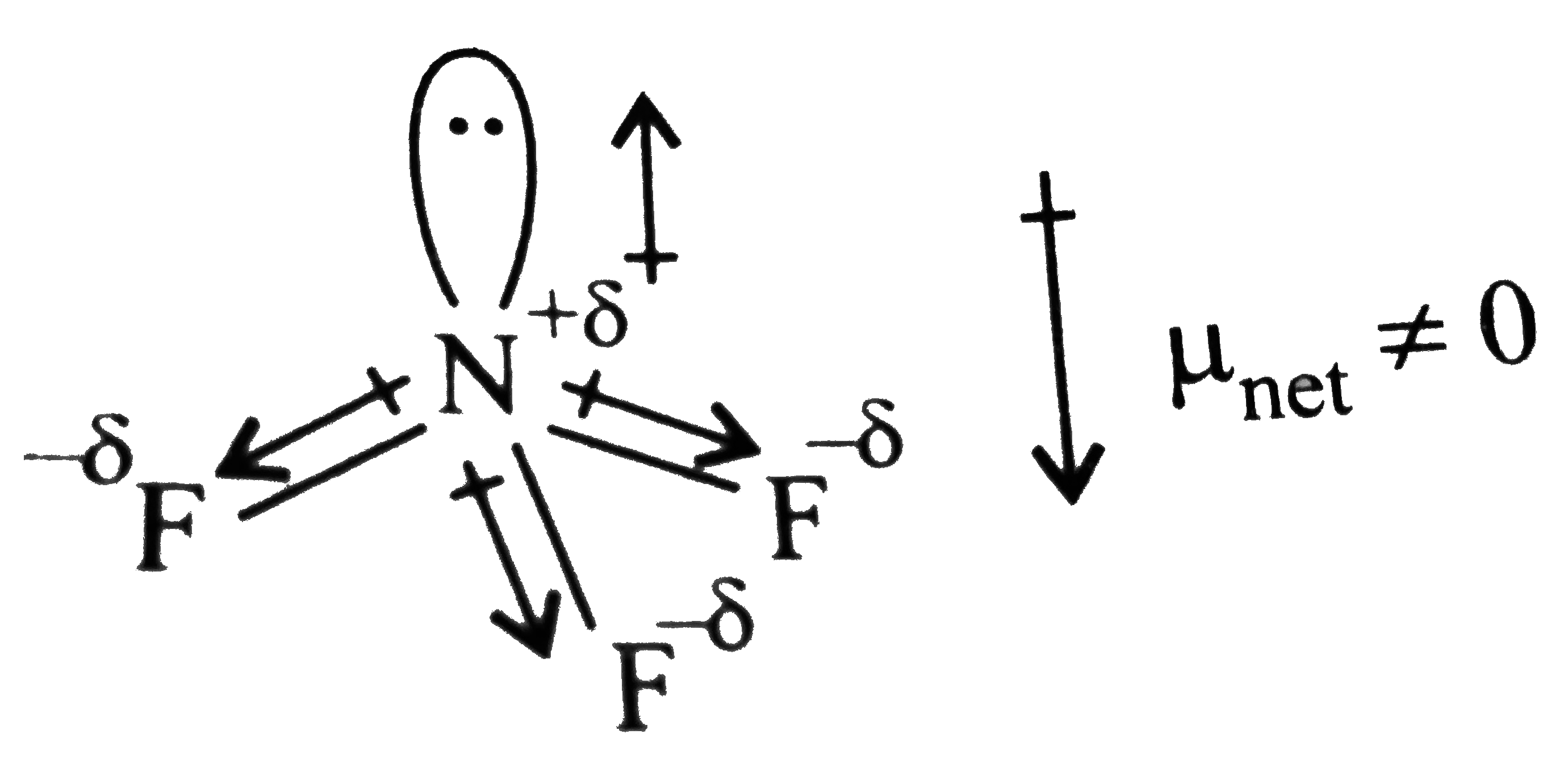
(d) N-atom in `overset(..)NF_(3)` is `sp^(3)` hybridised and the strure is pyramidal due to the presence of one lp of N-atom which gives a net `mu` (dipole moment) to molecule i.e `mu_("net") ne 0` which results in a polar molecule
(e) `na_(2) CO_(3) rarr 2Na^(o+) + CO_(3)^(2-)`
The `CO_(3)^(2-)` ion shows resonance as follows Due to delocalisation of `,'pi' e^(-') s` all `C-O` bonds are of similar nature and hence they have equal bond lenghts
(f) `MgFI_(2)` is more ionic than `MgCI_(2)` (Fajans' rule) hence `MgF_(2)` is more soluble in `H_(2)O` than `MgCI_(2)`
[Small cation, large anion `implies` more covalent `implies` less soluble in `H_(2)O)]`


.
Promotional Banner

Topper's Solved these Questions

  • CHEMICAL BONDING AND MOLECULAR STRUCTURE

    CENGAGE CHEMISTRY|Exercise Ex 2 .2 Objective|34 Videos
  • CHEMICAL BONDING AND MOLECULAR STRUCTURE

    CENGAGE CHEMISTRY|Exercise Exercises Linked Comprehension|43 Videos
  • CHEMICAL BONDING AND MOLECULAR STRUCTURE

    CENGAGE CHEMISTRY|Exercise Ex 2 .2 Subjective (Intermolecular Forces And H-Bonding)|7 Videos
  • ATOMIC STRUCTURE

    CENGAGE CHEMISTRY|Exercise Concept Applicationexercise(4.3)|19 Videos
  • CHEMICAL EQUILIBRIUM

    CENGAGE CHEMISTRY|Exercise Archives (Subjective)|11 Videos

Similar Questions

Explore conceptually related problems

Give reasons for the following (a) CO_(2) has no dipole moment but SO_(2) and H_(2)O have considerable dipole moments (b) Carbon has two unpaired electrons in the outermost orbit, but it is tetravalent in organic compound (c ) CaF_(2) is more ionic than CaI_(2) (d )Sigma bonds are stronger than pi bonds (e) C_(2)H_(4) is planar while C_(2)H_(2 is linear (f) H_(2)O is more polar than H_(2)S (g) Ionic compounds do not canduct electricity in solid state, but they conduct electricity in solution or in molten state .

Assertion :H_(0)O_(2) is non - ionic compound. Reason : The O-O bond length in H_(2)O_(2) is shorter than that of O_(2)F_(2) .

The correct roder o fincreasing C-O bond lengths in CO, CO_3^(2-) and CO_2 is :

Given the correct order of initials T or F for following statements. Use T if statements is true and F it it is false: (I) (CH_(3))_(2)P(CF_(3))_(3) is non-palar and (CH_(3))_(3)P(CF_(3))_(2) is polar molecule (II) CH_(3)hat(P)CH_(3) bond angle are equal in (CH_(3))_(3)P(CF_(3))_(2) molecule (III) PF_(3) will be more soluble in polar solvent than SiF_(4)

Bond angle in NH_(3) is more than in H_(2)O. Discuss

All the C-O bonds in carbonate in (CO_(3)^(2-)) are equal in length. Explain.

CH_(3)COO^(-) ion is more stable than C_(2)H_(5)O^(-) ion. Assign reason.

Assertion: C Cl_(4) and H_(2)O are immiscible . Reason : C Cl_(4) is a polar solvent.