Home
Class 11
CHEMISTRY
Most of the polyatomic molecules except ...

Most of the polyatomic molecules except a few such as `CO_(2)` and `CS_(2)` are linear or angular with a bond angle generally somewhat greater than `90^(@)` A bond angle is defined as the angle between the direction of two covalent bonds Since the atoms in molecules are in constant motion with respect to each other they are not expected to have a fixed value of bond angle Repulsion between non-bonded atoms alone does not provide an adequate explanation Hybridisation of bonding orbitals an adequate explanation Hybridisation of bonding orbitals also plays a very important role in detrmining the value of bond angle It has been observed that in hybridisation as the s-character of hybrid orbital increases the bond angle increases
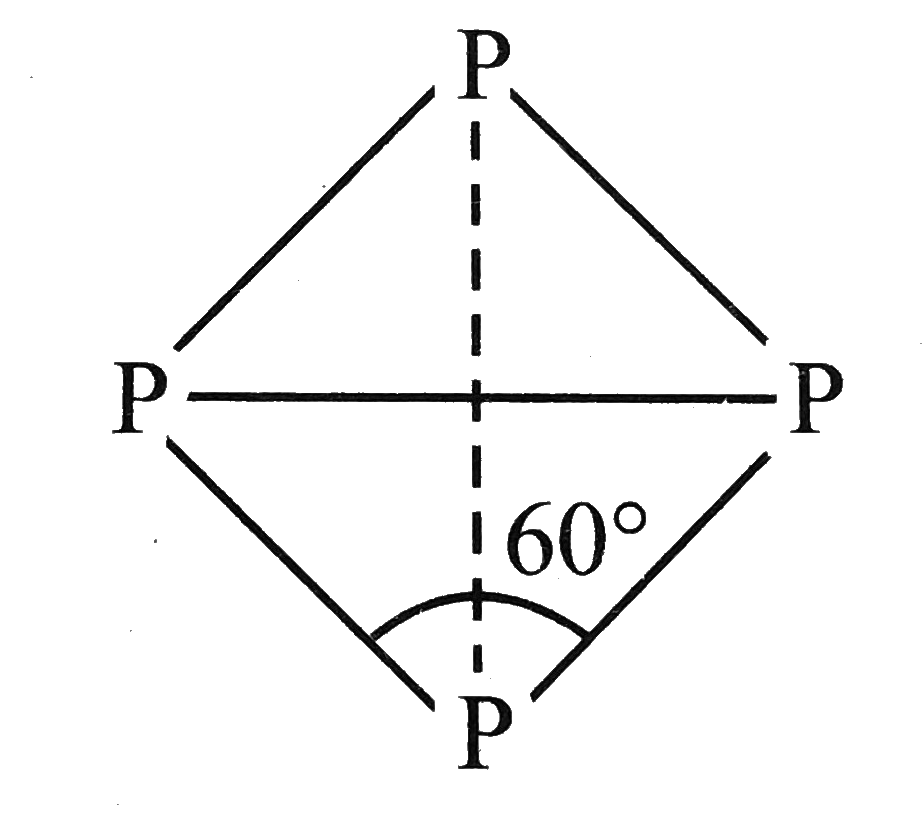
In `P_(4)` molecule phosphorous atoms are tetrahedrally arranged The angle `P-P-P` in the molecule is .

A

`108^(@)`

B

`120^(@)`

C

`60^(@)`

D

`180^(@)`

Text Solution

Verified by Experts

The correct Answer is:
C

The structure of `P_(4)` molecules is
Therefore the `P-P-P` bond angle is `60^(@)`
.
Promotional Banner

Topper's Solved these Questions

  • CHEMICAL BONDING AND MOLECULAR STRUCTURE

    CENGAGE CHEMISTRY|Exercise Exercises Multiple Correct(Chemical Bonding )|7 Videos
  • CHEMICAL BONDING AND MOLECULAR STRUCTURE

    CENGAGE CHEMISTRY|Exercise Exercises Multiple Correct (Dipole Moment)|3 Videos
  • CHEMICAL BONDING AND MOLECULAR STRUCTURE

    CENGAGE CHEMISTRY|Exercise Ex 2 .2 Objective|34 Videos
  • ATOMIC STRUCTURE

    CENGAGE CHEMISTRY|Exercise Concept Applicationexercise(4.3)|19 Videos
  • CHEMICAL EQUILIBRIUM

    CENGAGE CHEMISTRY|Exercise Archives (Subjective)|11 Videos

Similar Questions

Explore conceptually related problems

Most of the polyatomic molecules except a few such as CO_(2) and CS_(2) are linear or angular with a bond angle generally somewhat greater than 90^(@) A bond angle is defined as the angle between the direction of two covalent bonds Since the atoms in molecules are in constant motion with respect to each other they are not expected to have a fixed value of bond angle Repulsion between non-bonded atoms alone does not provide an adequate explanation Hybridisation of bonding orbitals an adequate explanation Hybridisation of bonding orbitals also plays a very important role in detrmining the value of bond angle It has been observed that in hybridisation as the s-character of hybrid orbital increases the bond angle increases Which of the following have highest bond angle ? .

Most of the polyatomic molecules except a few such as CO_(2) and CS_(2) are linear or angular with a bond angle generally somewhat greater than 90^(@) A bond angle is defined as the angle between the direction of two covalent bonds Since the atoms in molecules are in constant motion with respect to each other they are not expected to have a fixed value of bond angle Repulsion between non-bonded atoms alone does not provide an adequate explanation Hybridisation of bonding orbitals an adequate explanation Hybridisation of bonding orbitals also plays a very important role in detrmining the value of bond angle It has been observed that in hybridisation as the s-character of hybrid orbital increases the bond angle increases Which of the following hybridisation may have more than one type of bond angle ? .

The bond angle in XeF_(2) molecule is

In Which of the following is the angle between the two covalent bonds is the greatest?

In which of the following is the angle between the two covalent bonds greatest

The angle between the covalent bonds is maximum in :

The H-H-H bond angle in NH_3 is greater than the H-As-H bond angle in AsH_3 .

CENGAGE CHEMISTRY-CHEMICAL BONDING AND MOLECULAR STRUCTURE-Exercises Linked Comprehension
  1. The HF(2)^(Θ) ion solid state and in liquid HF but not in the dilute a...

    Text Solution

    |

  2. The HF(2)^(Θ) ion solid state and in liquid HF but not in the dilute a...

    Text Solution

    |

  3. The HF(2)^(Θ) ion solid state and in liquid HF but not in the dilute a...

    Text Solution

    |

  4. The HF(2)^(Θ) ion solid state and in liquid HF but not in the dilute a...

    Text Solution

    |

  5. Valence-bond theory is one of the two quantum mechanical approaches th...

    Text Solution

    |

  6. Valence-bond theory is one of the two quantum mechanical approaches th...

    Text Solution

    |

  7. Valence-bond theory is one of the two quantum mechanical approaches th...

    Text Solution

    |

  8. Valence-bond theory is one of the two quantum mechanical approaches th...

    Text Solution

    |

  9. Valence-bond theory is one of the two quantum mechanical approaches th...

    Text Solution

    |

  10. According to the moleular orbital theory, all atomic orbitals combine ...

    Text Solution

    |

  11. According to the moleular orbital theory, all atomic orbitals combine ...

    Text Solution

    |

  12. According to the moleular orbital theory, all atomic orbitals combine ...

    Text Solution

    |

  13. Most of the polyatomic molecules except a few such as CO(2) and CS(2) ...

    Text Solution

    |

  14. Most of the polyatomic molecules except a few such as CO(2) and CS(2) ...

    Text Solution

    |

  15. Most of the polyatomic molecules except a few such as CO(2) and CS(2) ...

    Text Solution

    |

  16. MO' s are formed by the overlap of A'O s Two AO's combine to form two ...

    Text Solution

    |

  17. MO' s are formed by the overlap of A'O s Two AO's combine to form two ...

    Text Solution

    |

  18. MO' s are formed by the overlap of A'O s Two AO's combine to form two ...

    Text Solution

    |

  19. MO' s are formed by the overlap of A'O s Two AO's combine to form two ...

    Text Solution

    |

  20. MO' s are formed by the overlap of A'O s Two AO's combine to form two ...

    Text Solution

    |

