Home
Class 11
CHEMISTRY
Explain the following : (a) Aluminium ...

Explain the following :
(a) Aluminium vessel can be used to store `conc HNO_(3)`.
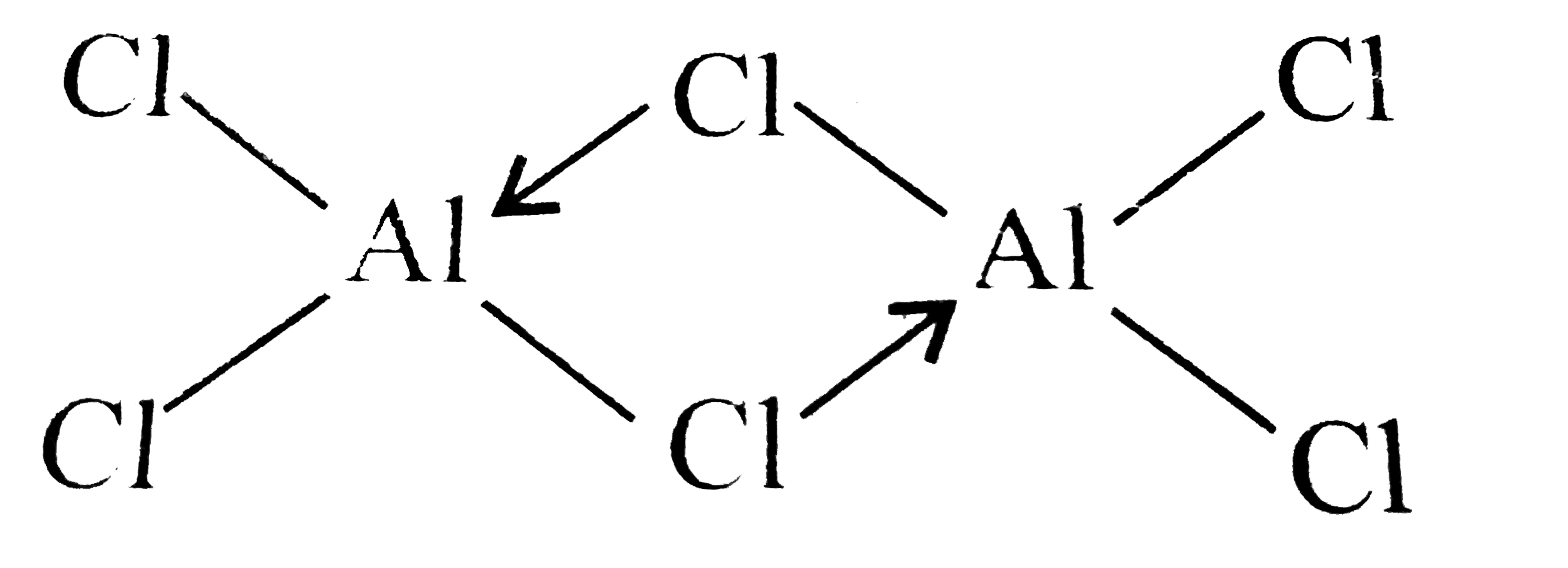
(b) `AlCl_(3)` forms a dimer, but `BCl_(3)` does not.
( c) `Al` metal is frequency used as a reducing agent for the extraction of metal such as `Cr`, etc.
(d) `Al` cannot be prepared by the electrolysis of aqueous solution of its salt.
( e) The `B-X` distance is shorter than what is expected theoretically in `BX_(3)` molecule `(X = F, Cl, Br, I)`.
(f) Althrough the ionisation potential of `B(8.30 eV)` is less than gold `(9.22 eV)`, yet `B` is a non-metal while gold is a metal.

Text Solution

Verified by Experts
(a) Aluminium metal is rendered passive by nitric acid `(HNO_(3))` due to the formation of an oxide layer `(Al_(2) O_(3))` on its surface. Hence, `Al` vessel is not atteacked by `conc HNO_(3)` and `concHNO_(3)` can be easily stored in aluminium vessel.
(b) Both `BCl_(3)` and `AlCl_(3)` are electron-deficient compounds as both `B` and `Al` have only six electrons around them in `BCl_(3)` and `AlCl_(3)`, respectively and hence their octet is incomplete. To complete their octet, `p pi- p pi` back bonding is not possible in `AlCl_(3)` due to increase in size of `Al`. Hence `Al` completes its octet by forming dimer in which `Cl` atom of one `AlCl_(3)`, donates an electron pair in the vacant `3p` orbital of `Al` by forming a coordinate bond, whereas in `BCl_(3), p pi- p pi` back occurs and `BCl_(3)` exists as a monomer and not as a dimer.

( c) Aluminium gas great affinity for oxygen. Aluminium thus removes oxygen from the oxides of less electropositive metals and as a good reducing agent.
`Cr_(2) O_(3) + 2Al rarr Al_(2) O_(3) + 2 Cr`
(d) Aluminium cannot be prepared by the electrolysis of aqueous solution of its salt, as discharge potential of aluminium is higher than the discharge potential of hydrogen. Thus, the aqueous solution containing `Al^(3+)` ions and `H^(oplus)` ions, when electrolysed, the `H^(oplus)` ions rather than `Al^(3+)` ions are discharge at cathode and hydrogen is liberated.
At cathode : `2H^(oplus) + 2e^(Ө) rarr H_(2) uarr`
( e) Due to `p pi - p pi` back bonding in `BX_(3)`, the molecule has double bond character, which results in shortening of `B-X` bond distance in `BX_(3)`.

(f) Despite the fact that ionsation potential of boron `(8.30 eV)` is less than gold `(9.22 eV)`, boron is a non-metal. This is due to difference is structure in the solid state. In general, metals have large number of atoms as neighbours as compared to non-metal. Gold has `12` atoms as neighbours, whereas boron has `6` or less atoms as neighbours in the solid state.
Promotional Banner

Topper's Solved these Questions

  • P-BLOCK GROUP 13 - BORON FAMILY

    CENGAGE CHEMISTRY|Exercise Solved Examples|16 Videos
  • P-BLOCK GROUP 13 - BORON FAMILY

    CENGAGE CHEMISTRY|Exercise Ex 6.1 (Subjective)|17 Videos
  • ORGANIC REACTION MECHANISM

    CENGAGE CHEMISTRY|Exercise Analytical and Descriptive|6 Videos
  • P-BLOCK GROUP 14 - CARBON FAMILY

    CENGAGE CHEMISTRY|Exercise Exercises Archives (Subjective)|9 Videos

Similar Questions

Explore conceptually related problems

Aluminium metal is frequently used as a reducing agent for the extraction of metals like Cr,Mn,Fe etc. Explain.

The metal which cannot be obtained by electrolysis of aqueous solution of its salts is

The metal that cannot obtained by electrolysis of an aqueous solution of its salts is :


