Home
Class 11
CHEMISTRY
An inorganic compound (X) shows the foll...

An inorganic compound `(X)` shows the following reactions :
(a) It is white solid, exists as dimer and fumes in moist air.
(b) It sublimes at `180^@ C` and forms monomer on heating to `400^@ C`.
( c) Its aqueous solution turns blue litmus red and gives a white precipitate with `AgNO_(3)` solution which is soluble in excess of `NH_(4) OH`.
(d) Addition of `NaOH` to the solution of `(A)` gives a white gelatinous precipitate which is, however, soluble on excess of `NaOH`.
Identify the compound `(A)`.

Text Solution

Verified by Experts
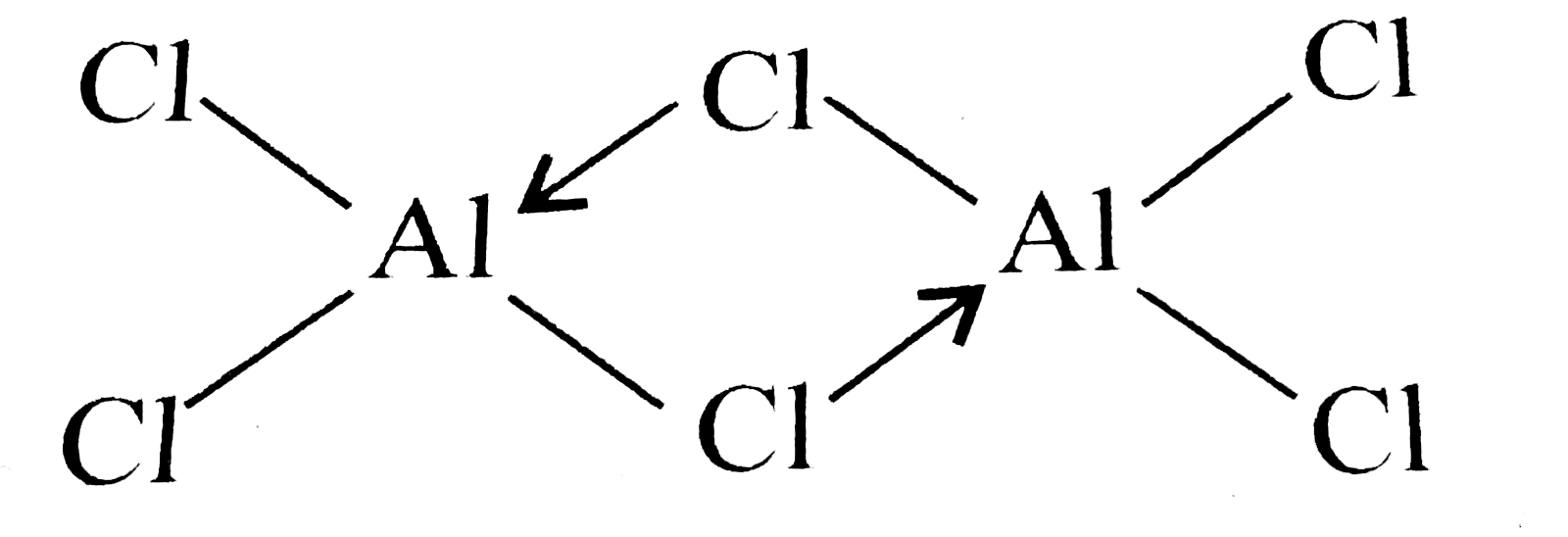
`(A)` is `Al_(2)Cl_(6)`.
(a) `Al_(2)Cl_(6)` is a white solid and exists as dimer.

`Al_(2) Cl_(6)` fumes in moist air due to evolution of `HCl` gas.
`Al_(2) Cl_(6) + 6H_(2) O rarr 2Al(OH)_(3) + 6HCl uarr`.
(b) `Al_(2)Cl_(6(s)) overset(180^@ C)rarr Al_(\2) Cl_(6(g)) overset (400^@ C)rarr 2AlCl_(3)`
( c) Aqueous solution of `Al_(@) Cl_(6)` contains hydrated aluminium chloride, `Al_(2)Cl_(6)`, which is ionic in nature.
`Al_(2)Cl_(6)+ 6H_(2) O rarr Al_(2) Cl_(6).6H_(2) O` or `2AlCl_(3).6H_(2)O`
`AlCl_(3(aq)) hArr Al_((aq))^(3+) + 3Cl_((aq))^(Ө)`
Since the above solution is acidic, it turns blue litmus red.
`AlCl_(3) + 3H_(2)O rarr underset("Weak base")(Al(OH)_(3)) + underset("Strong acid")(3HCl)`
On addition of `AgNO_(3)` solution in aqueous solution of aluminium chloride, white precipitate of `AgCl` is formed.
`Cl_((aq))^(Ө) + Ag_((aq))^(oplus) rarr underset(("White ppt.")) (AgCl darr)`
`AgCl` is soluble in excess of `NH_(4)OH` due to the formation of soluble complex, `[Ag(NH_(3))_(2)] Cl`.
`AgCl +2NH_(4)OH rarr underset("Diamminesilver(I)chloride")([Ag(NH_(3))_(2)]Cl + 2 overset(Ө)O H)`
(d) Aqueous solution of `(A) + NaOH rarr underset("Whiteppt. dissolves")underset(darr"Excess "NaOH)underset("gelatinous ppt.")(White)`
`Al^(3+)+NaOH rarr underset("White ppt.") (Al(OH)_(3) darr) + Na^(oplus)`
`Al(OH)_(3) + underset("Excess")(NaOH) rarr underset("Sodium metaluminate") (NaAlO_(2)) + 2H_(2) O`
Due to the formation of `Al(OH)_(3)` initially, white gela-tionous precipitate is obtained, which dissolves on excess of `NaOH` due to the formation of sodium meta-aluminate.
Promotional Banner

Topper's Solved these Questions

  • P-BLOCK GROUP 13 - BORON FAMILY

    CENGAGE CHEMISTRY|Exercise Ex 6.1 (Subjective)|17 Videos
  • P-BLOCK GROUP 13 - BORON FAMILY

    CENGAGE CHEMISTRY|Exercise Ex 6.1 (Objective)|14 Videos
  • P-BLOCK GROUP 13 - BORON FAMILY

    CENGAGE CHEMISTRY|Exercise Exercise Archives (Subjecive)|9 Videos
  • ORGANIC REACTION MECHANISM

    CENGAGE CHEMISTRY|Exercise Analytical and Descriptive|6 Videos
  • P-BLOCK GROUP 14 - CARBON FAMILY

    CENGAGE CHEMISTRY|Exercise Exercises Archives (Subjective)|9 Videos

Similar Questions

Explore conceptually related problems

Group 13 element reacts with halogen and forms a compound P shows the following properties: (i) It is white solid and exist as dimer, gives fumes of Q with moist air (ii) It sublimes on 180^(0)C and forms monomer if heated to 400^(@)C (iii) Its aq solution turns blue litmus to red (iv) Addition of NH_(4)OH and NaOH separately to a solution of P gives white precipitate which is however soluble in excess of NaOH solution to form a solution R What is compound P

Group 13 element reacts with halogen and forms a compound P shows the following properties: (i) It is white solid and exist as dimer, gives fumes of Q with moist air (ii) It sublimes on 180^(0)C and forms monomer if heated to 400^(@)C (iii) Its aq solution turns blue litmus to red (iv) Addition of NH_(4)OH and NaOH separately to a solution of P gives white precipitate which is however soluble in excess of NaOH solution to form a solution R Anionic formula of solution R is :

On addition of aqueous NaOH to a salt solution, a white gelatinous precipitate is formed, which dissolves in excess of alkali. The salt solution contains

An aqueous solution of colourless metal sulphate M , gives a white precipitate with NH_(4)OH .This was soluble in excess of NH_(4)OH . On passing H_(2)S through this solution a white precipitate is formed.The metal M in the salt is:

A colourless solid A dissolves in water. The aqueous solution gives a white precipitate B when NaOH or NH_4 OH is added. B dissolves in excess of NaOH but not in excess of NH,OH. BaCl2 solution added to a solution of A gives a white precipitate C which is insoluble in dilute HCI. A may be

Aqueous solution of a salt when treated with AgNO_(3) solution gives a white precipitate , white dissolves in NH_(4)OH . Radical present in the salt is

An inorganic Lewis acid (X) shows the following reactions : (a) It fumes in moist air. (b) The intensity of fumes increase when a rod dippod in NH_(4) OH is brought near it. ( c) To an aqueous solution of (X) , addition of NH_(4)Cl and NH_(4)OH gives a precipitate which dissolves in NaOH solution. (d) An acidic solution of (X) does not give a precipitate with H_(2) S . Identify (X) and gives chemical reactions for (a) to (d) .

