Text Solution
Verified by Experts



Topper's Solved these Questions
COORDINATION COMPOUNDS
CENGAGE CHEMISTRY|Exercise Ex 7.2 Objective|8 VideosCOORDINATION COMPOUNDS
CENGAGE CHEMISTRY|Exercise Exercises Linked Comprehension|39 VideosCOORDINATION COMPOUNDS
CENGAGE CHEMISTRY|Exercise Ex 7.1 Objective (Isomerism)|12 VideosCHEMICAL KINETICS
CENGAGE CHEMISTRY|Exercise Archives Subjective|23 VideosD AND F BLOCK ELEMENTS
CENGAGE CHEMISTRY|Exercise Archives Subjective|29 Videos
Similar Questions
Explore conceptually related problems
CENGAGE CHEMISTRY-COORDINATION COMPOUNDS-Ex 7.2 Subjective
- One the basis of VBT answer the following complex ions (i) [Ti(bpy)(...
Text Solution
|
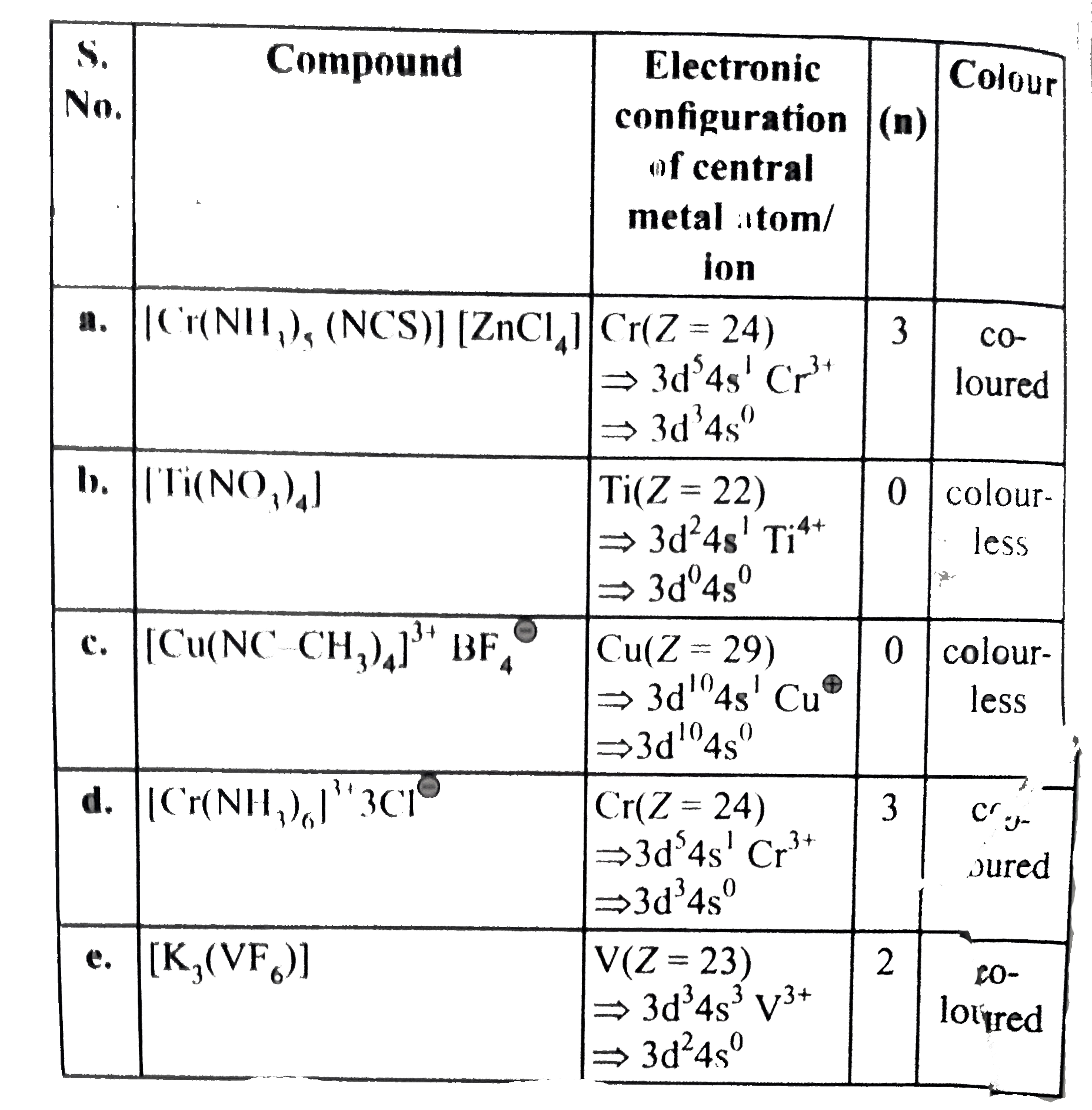
- Identify the complex which are coloured and which are colourless Expla...
Text Solution
|
- Write the IUPAC nomenclature of the given complex along with its hybri...
Text Solution
|
- On the basic of CET explaine the following complex of Co^(3+) like [Co...
Text Solution
|