Home
Class 11
CHEMISTRY
Arrange the following in the decreasing ...

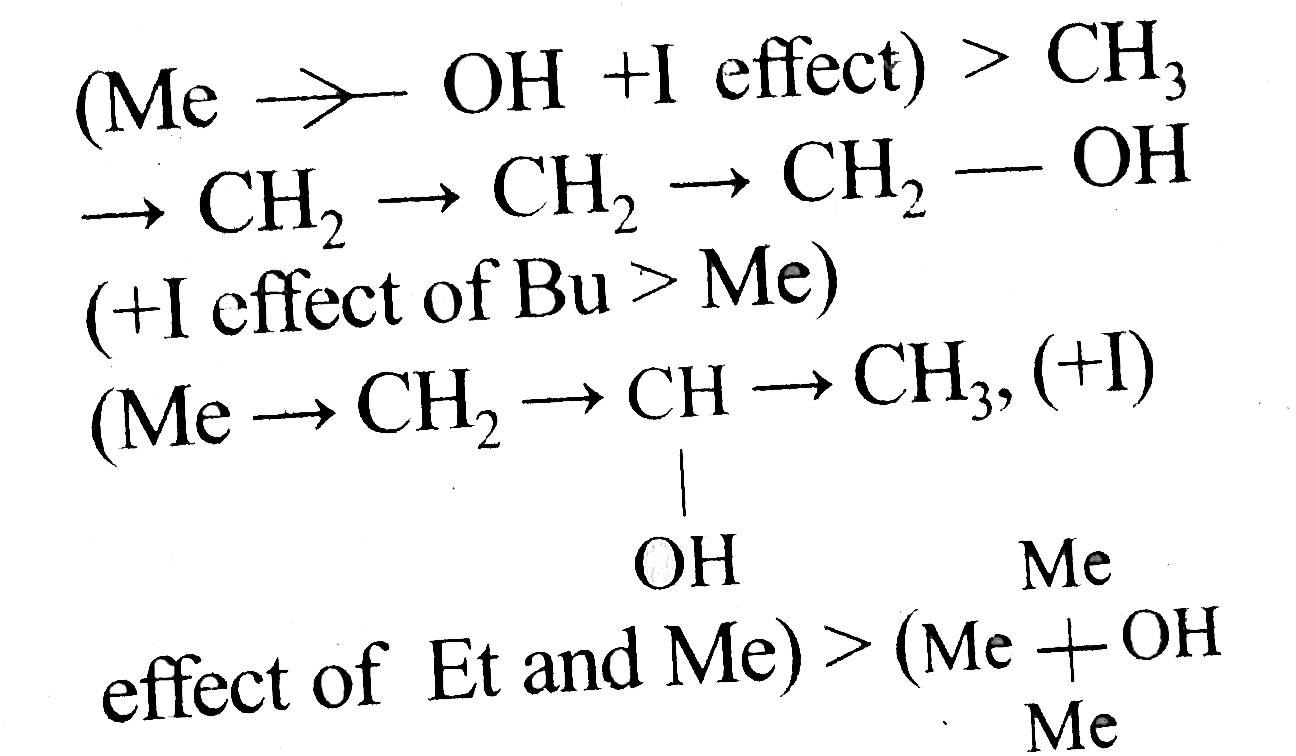
Arrange the following in the decreasing order of acidity :
(i) (1) `n-`Butanol
(2) Methy1 alcohol
(3) sec-Butanol
(4) rert-Butanol
(ii) (1) `HCOOH`
(2) `CH_3 COOH`
(3) `C_2H_5COOH`
(4) `C_6H_5 COOH`
(5) `(CH_3)_2CHCOOH`
(6) `CH_2 C1COOH`
(iii) (1) `CH_3 CH_2CH_2COOH`
(2) `CH_3 CH_2 CHC1COOH`
(3) `CH_3 CHC1CH_2COOH`
(4) `CH_2 C1CH_2 CH_2 COOH`
(iv) (1) `CH_3COOH`
(2) `CH_2C1COOH`
(3) `CHC1_2 COOH`
(4) `C C1_3 COOH`
(v) (1) `CH_3BrCOOH`
(2) `CH_2C1COOH`
(3) `CH_2 FCOOH`
(4) `CH_2 ICOOH`
(vi) (1) `C_6H_5 COOH`
(2) `p-OHC_6 H_4COOH`
(3) `p-CH_3C_6H_4COOH`
(4) `p-C1C_6H_4COOH`
(5) `p-Br C_6H_4COOH`
(6) `p-BO_2C_6 H_4 COOH`
(vii) (1) o-Hydroxybenzoic acid
(2) p-Hydroxybenzoic acid
(3) `2,6-`Dihydroxybenzoic acid.
(viii) (1) `HCOOH`
(2) `C_6 H_5 COOH`
(3) `C_6H_5OH`
(4) `HC1`
(ix) `RCOOH`
(2) `ROH`
(3) `RH`
(4) `NH_3`
(5) `HOH`
(6) `CH -= CH`
(x) (1) Phenol
(2) p-Chlorophenol
(3) p-Nitrophenol
(4) m-Cresol
(xi) (1) Phenol
(2) m-Chlorophenol
(3) m-Nitrophenol
(4) m-Cresol
(xii) (1) Phenol
(2) Benzoic acid
(3) p-Nitrophenol
(4) Carbonic acid
(xiii) (1) Phenol
(2) Benzyl alcohol
(3) Benzene sulphonic acid
(4) Benzoic acid
(xiv) (1) Phenol
(2) p-Chlorophenol
(3) 2,4,-Dichlorophenol
(4) 2,4,6-Trichlorophenol
(xv) (1) Nitroform `HC(NO_2)_3`
(2) Cyanoform `HC(CN)_3`
(3) `CHC1_3`
(xvi) (1) `CH_3 SO_2CH_3`
(2) `CH_3NO_2`
(xvii) (1) `CH_3 BO - O^(Ө)`
(2) `CH_3CHO`
(3) `CH_3 COOR`.

Text Solution

Verified by Experts
(i)
(ii) `6 gt 1 gt 4 gt 2 gt 3 gt 5` (In `(6) -I` effect of `C1 gt (1)` (standard) `gt (4)+R gt -I` of `Ph gt (2) + I`effect of `Me gt (3) + I` effect of `Et gt (5) + I` effect of two `Me` groups) .
(iii) `2 gt 3 gt 4 gt1` (2) `- I` effect of `C1` at `alpha-C gt (3) - I` effect of `C1` at `beta - C gt (4) - I` effect of `C1` at `gamma-C gt (1) + I` effect of `CH_3 CH_2 CH_2`.
(iv) `4 gt 3 gt 2 gt 1` (4) `-I` effect of `3 C1` at `alpha-C gt` (2) `-I` effect of `1 C1` at `alpha-C gt (1) + I` effect of `(CH_3 - )` group
(v) `3 gt 2 gt 1 gt 4 ` (3) `- I` effect of `F = (2) - I` effect of `C1 gt (1) - I` effect of `Br gt (4) - I` effect of `I`
(vi) `6 gt 4 gt 5 gt 1 gt 3 gt 2` (6) `-1` and `-R` effect of `(-NO_2)` group `gt (4) - I` effect of `C1 gt (5) - I` effect of `Br gt (1)` standard `gt (3) + I` and `H.C` effect of `CH_3- at p- gt`
(2) `- I` and `-R` effect of `OH` group at `p-` However, the net effect is more `overline e-`donating than the net effect of `(3)`, since `+R gt + I` and `H.C` effects.
(vii) `3 gt 1 gt 2` (3) Intramolecular H-bonding from two sides `gt (I)` Intramolecular H-bonding from one sides `gt (2) - I` and `+R` effects of `OH` group at `p-`position , net effect is `overline e-`donating.
(viii) `4 gt 1 gt 2 gt 3` (4) Inorganic acid `gt (1)` Formic acid (standard) `gt (2)` Benzonic acid, `- I` and `+R` of `Ph` group, net `overline e-`donating `gt (3)` Phenol.
(ix) `1 gt 5 gt 2 gt 6 gt 4 gt 3 gt ` (I) Acid `gt (5) H_2 O gt (2)` Alcohol `gt (6) HC -= CH`
(sp character) `gt (4) nH_3 gt (3)` Alkane (`sp^3` character)
(x) `3 gt 2 gt 1 gt 4` (3) `- NO_2(- I` and `-R` effects of `C1` at `p-) gt (2) - C1 - I` effects of `C1` at `p- gt (1)` Standard (phenol) `gt(4) CH_3 + I` effected of `CH_3` at `m-`position.
(xi) `3 gt 2 gt 1 gt 4` (3) `(-NO_2)` (only `-I` effect of `(-NO_2)` at `m-) gt (2) - C1 (-I` effected of `C1` at `m-) gt (1)` Standard (phenol) gt
`(4) Ch_3` (only `+1` effect of `CH_3` at `m-`position.
(xi) `2 gt 4 gt 3 gt 1` (2) Benzoic acid `gt (4)` Weak inorganic acid `gt (3)` Nitro phenol `(-NO_2) (-I` and `-R` effect of `(-NO_2)` at `p- ) gt (1)` phenol.
(xiii) `3 gt 4 gt 1 gt 2` (3) Sulphonic acid, `-I` and `-R` effects of `(-SO_3 H)` group `gt (4)`, Benzoic acid, `- I` and `-R` effects of `(-COOH)` group, but `(-SO_3 H)` effect `gt (-COOH)` effect `gt (1) `Phenol `gt (2)` Alcohol)
(xiv) `4 gt 3 gt 2 gt 1` (4) `- I` effect of `3 C1 gt (3) - I` effect of `2 C1 gt (2) - I` effect of `1 C1 gt (1)` Phenol, standard
(xv) `1 gt 2 gt 3` (1) `-I` effect of three `NO_2` groups `gt (2) - I` effects of three `CN` groups `gt (3) - I` effect of three `C1` groups , ` - I` effect of : `-NO_2 gt - CN gt - C1`.
(xvi) ` 2 gt 1 (2) -NO_2 (-I` effect of `NO_2 ) gt (1) - I` effect `SO_2` and `+ I` effect of two `CH_3` groups.
(xvii) `1 gt 2 gt 3` (1) `-I` effect of `-NO_2 gt (2) -I` effect of `- CHO gt (3) - I` effect of `(- COOR)` group) , `-I` effect of : `- NO_2 gt -CHO gt -COOR`.
Promotional Banner

Topper's Solved these Questions

  • GENERAL ORGANIC CHEMISTRY

    CENGAGE CHEMISTRY|Exercise Subjective|11 Videos
  • GENERAL ORGANIC CHEMISTRY

    CENGAGE CHEMISTRY|Exercise Concept|16 Videos
  • GENERAL ORGANIC CHEMISTRY

    CENGAGE CHEMISTRY|Exercise Analytical and Descriptive|1 Videos
  • CLASSIFICATION AND NOMENCLATURE OF ORGANIC COMPOUNDS

    CENGAGE CHEMISTRY|Exercise Analytical and Descriptive Type|3 Videos
  • HYDROGEN, WATER AND HYDROGEN PEROXIDE

    CENGAGE CHEMISTRY|Exercise Subjective Archive (Subjective)|3 Videos

Similar Questions

Explore conceptually related problems

CH_(3)CH(OH)CH_(2)CH_(2)COOH

Arrange the following in the increasing order of acidic strength : (i) ClCH_2 COOH (ii) CH_2 ClCH_2 COOH (iii ) FCH_2 COOH (iv) CH_3 COOH

Write the IUPAC names of the following : (i) CH_3 CH= CHCOOH " "(ii ) CH_3CH_2 CH_2 COOH " " (iii ) C_6 H_5 CH_2 COOH " "(iv ) (CH_3 )_3 C COOH (v ) CH_3 CH_2 COCH_2 COOH (vi ) (CH_3)_3 C CH_2 COOH " "(vii ) CH_3 - underset(OH) underset(|)CH-CH_2 COOH

Place the following in the correct order of acidity 1. CH -= C COOH 2. CH_(2) -= CHCOOH 3. CH_(3)CH_(2)COOH

Which of the following is a stronger acid in each of the following pairs ? (a) CH_2 (Cl ) COOH,CH_2 (F ) COOH " " (b ) CH_2 (Cl) CH_2 CH_2 COOH ,CH_3 COOH , CH_3CH(Cl) CH_2 COOH (c ) CH_3 COOH ,C_6 H_5 CH_2 COOH " " (d ) m-NO_2 C_6 H_4 COOH ,p -NO_2 C_6 H_4 COOH (e ) p-NO_2 C_6 H_4 COOH ,C_6 H_5 COOH " " ( f ) m- OHC_6 H_4 COOH,p- OHC _6 H_4 COOH

Arrange the following in the increasing order of pK_a values: CH_3 COOH ,CICH_2 COOH ,Cl_2 CHCOOH ,Cl_3 C COOH

Arrange the following in the decresing order of acidic strength : (a) H_2 O , CH_3 OH , C_6 H_5 ,OH ,CH _2 COOH (b) CH_3 CH_2 COOH ,HOCH, C_6 H_5COOH ,ClCH_2 COOH

Arrange the following compounds in decreasing order of acidity. (i) ClCH_(2)CH_(2)CH_(2)COOH (ii) CH_(3)CHClCH_(2)COOH (iii) CH_(3)CH_(2)CHClCOOH

CENGAGE CHEMISTRY-GENERAL ORGANIC CHEMISTRY-Solved Example
  1. Which of the following is the most stable resonance structure ?

    Text Solution

    |

  2. Which of the following is a most likely product from the reaction as s...

    Text Solution

    |

  3. Give the stability of the following resonance structures (a) H(2)C =...

    Text Solution

    |

  4. Write the correct resonance structure of the given compound. .

    Text Solution

    |

  5. Give the correct stability order of the following species :

    Text Solution

    |

  6. Explain the following : (a) Why MeNH overset (oplus) CH2 (I) is more...

    Text Solution

    |

  7. Give decreasing order of the stabilities of the following :

    Text Solution

    |

  8. Arrange the following compounds in the order of increasing boiling poi...

    Text Solution

    |

  9. Arrange the compounds of each of the following sub-questions : (a) ...

    Text Solution

    |

  10. Arrange the following in the decreasing order of boiling points : (i...

    Text Solution

    |

  11. Arrange the following alcohols : (a) In the decreasing order of thei...

    Text Solution

    |

  12. Arrange the following alcohols in the decreasing order of reactivity t...

    Text Solution

    |

  13. Arrange the following alchols in the decreasing order of their reactiv...

    Text Solution

    |

  14. Arrange the following in the decreasing order of acidity : (i) (1) n...

    Text Solution

    |

  15. Arrange the following in the order of decreasing basic character : (...

    Text Solution

    |

  16. Arrange in decreasing order of basicity. (1) m-BO2-C6H4-NH2 (2) C6...

    Text Solution

    |

  17. Compare the acidities of amide (R-underset(O)underset(||)(C)-NH(2)) an...

    Text Solution

    |

  18. Which of the following pairs would have higher boiling points ?

    Text Solution

    |

