
Home
Class 11
CHEMISTRY
An organic reaction occurs by using reag...

An organic reaction occurs by using reagents called electrophiles and nucleophiles via the formation of some reactive intermediates called carbocations, carbanions, free radicals, carbenes, nitrenes, radical cations, and radical anions.
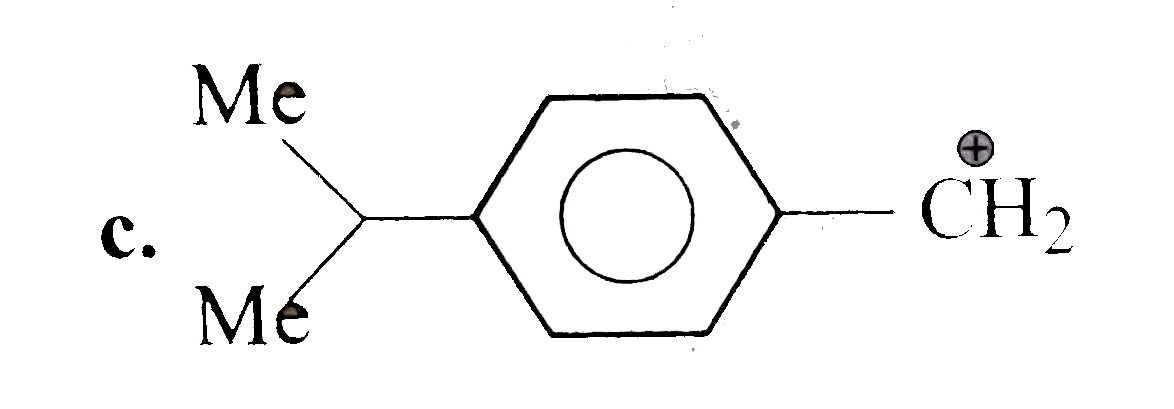
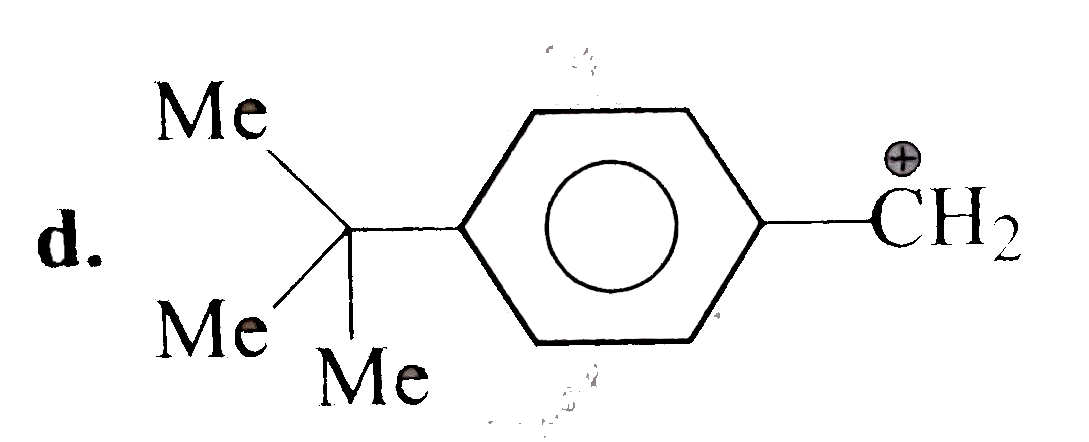
The most stable carbocation is :

A

`Ph overset (oplus) CH_2`

B

C

D

Text Solution

Verified by Experts

The correct Answer is:

B

(b) Due to hyperconjugation of `Me` group (three `H.C` structure), `(b)` is more stable.
Promotional Banner

Topper's Solved these Questions

  • GENERAL ORGANIC CHEMISTRY

    CENGAGE CHEMISTRY|Exercise Multiple Correct|22 Videos
  • GENERAL ORGANIC CHEMISTRY

    CENGAGE CHEMISTRY|Exercise Single Correct|25 Videos
  • GENERAL ORGANIC CHEMISTRY

    CENGAGE CHEMISTRY|Exercise Concept|16 Videos
  • CLASSIFICATION AND NOMENCLATURE OF ORGANIC COMPOUNDS

    CENGAGE CHEMISTRY|Exercise Analytical and Descriptive Type|3 Videos
  • HYDROGEN, WATER AND HYDROGEN PEROXIDE

    CENGAGE CHEMISTRY|Exercise Subjective Archive (Subjective)|3 Videos

Similar Questions

Explore conceptually related problems

An organic reaction occurs by using reagents called electrophiles and nucleophiles via the formation of some reactive intermediates called carbocations, carbanions, free radicals, carbenes, nitrenes, radical cations, and radical anions. The most stable carbanion is :

An organic reaction occurs by using reagents called electrophiles and nucleophiles via the formation of some reactive intermediates called carbocations, carbanions, free radicals, carbenes, nitrenes, radical cations, and radical anions. The least stable carbocation is :

An organic reaction occurs by using reagents called electrophiles and nucleophiles via the formation of some reactive intermediates called carbocations, carbanions, free radicals, carbenes, nitrenes, radical cations, and radical anions. The most stable free radical is :

An organic reaction occurs by using reagents called electrophiles and nucleophiles via the formation of some reactive intermediates called carbocations, carbanions, free radicals, carbenes, nitrenes, radical cations, and radical anions. Which of the following contains electrophiles only ?

An organic reaction occurs by using reagents called electrophiles and nucleophiles via the formation of some reactive intermediates called carbocations, carbanions, free radicals, carbenes, nitrenes, radical cations, and radical anions. Which of the following contains nucleophiles only ?

1.correlation OF lone pairs and formal charges, 2.reaction intermediates a) carbocation, b)carbanion,c) free radicals

The most Carbocations, carbanions, free radicals and radical cation are reactive carbon intermediates. Their hybrid orbitals respectively are

Organic reactions take place through the formations of reactive carbon intermediates formed by cleavage of covalent bonds. Formation of these intermediates depends upon the dissociation energies of covalent bonds. Which is most stable carbocation ?

Passage Organic compounds mainly consist of covalent bonds. The electron pair in these covalent bonds may undergo displacement either of their own or under the influence of other species. The cleavage of covalent bond between two atoms takes place in homolytic or heterolytic fashion. The homolytic fission results into free radicals while heterolytic fission results into carbocations and carbanions. These are also called reaction intermediates and are attacked by electrophiles and nucleophiles. The electrophiles seek electron rich sites while nucleophiles seek electron deficient sites. Answer the followings Questions : The most stable carbocation is :

CENGAGE CHEMISTRY-GENERAL ORGANIC CHEMISTRY-Comprehension
  1. An organic reaction occurs by using reagents called electrophiles and ...

    Text Solution

    |

  2. An organic reaction occurs by using reagents called electrophiles and ...

    Text Solution

    |

  3. An organic reaction occurs by using reagents called electrophiles and ...

    Text Solution

    |

  4. An organic reaction occurs by using reagents called electrophiles and ...

    Text Solution

    |

  5. An organic reaction occurs by using reagents called electrophiles and ...

    Text Solution

    |

  6. An organic reaction occurs by using reagents called electrophiles and ...

    Text Solution

    |

  7. Carbene intermediates are produced by the photolysis of diazomethane (...

    Text Solution

    |

  8. Carbene intermediates are produced by the photolysis of diazomethane (...

    Text Solution

    |

  9. Carbene intermediates are produced by the photolysis of diazomethane (...

    Text Solution

    |

  10. Carbene intermediates are produced by the photolysis of diazomethane (...

    Text Solution

    |

  11. Carbene intermediates are produced by the photolysis of diazomethane (...

    Text Solution

    |

  12. Consider the following reaction : , . The compound D is an ortho...

    Text Solution

    |

  13. Consider the following reaction : , . The m-isomer of D and E i...

    Text Solution

    |

  14. Consider the following reaction : , . The decreasing order of a...

    Text Solution

    |

  15. Consider the following reaction : , . Which of the above three ...

    Text Solution

    |

  16. Consider the Hofmann ammonolysis reaction : R-X +ddotNH(3)rarr under...

    Text Solution

    |

  17. Consider the Hofmann ammonolysis reaction : R-X +ddotNH(3)rarr under...

    Text Solution

    |

  18. Consider the Hofmann ammonolysis reaction : R-X +ddotNH(3)rarr under...

    Text Solution

    |

  19. Consider the Hofmann ammonolysis reaction : R-X +ddotNH(3)rarr under...

    Text Solution

    |

  20. Consider the Hofmann ammonolysis reaction : R-X +ddotNH(3)rarr under...

    Text Solution

    |
