Home
Class 11
CHEMISTRY
Explain the effect of SN^2 rates for the...

Explain the effect of `SN^2` rates for the following reactions :
(a) Increasing the polarity of solvent.
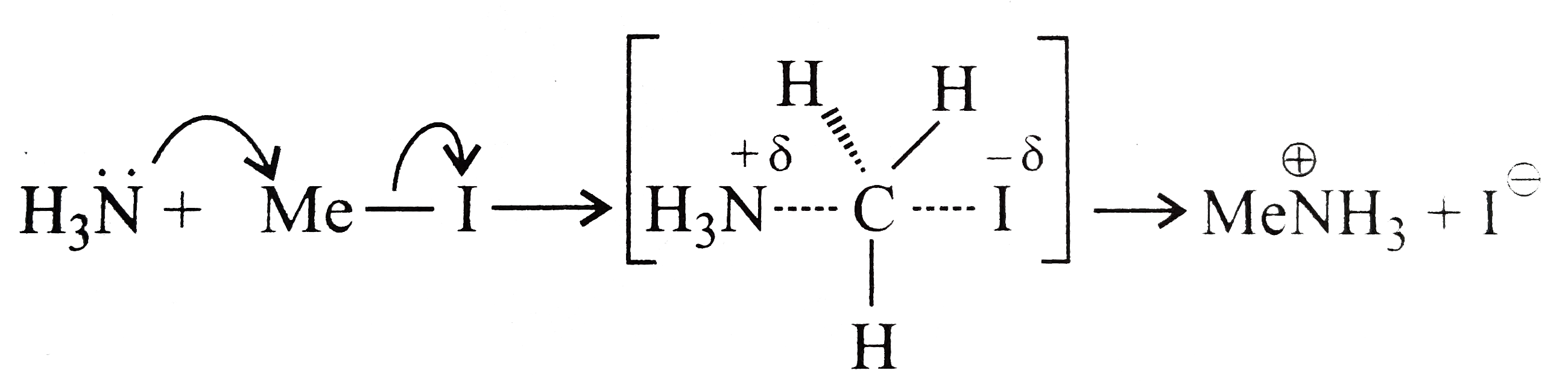
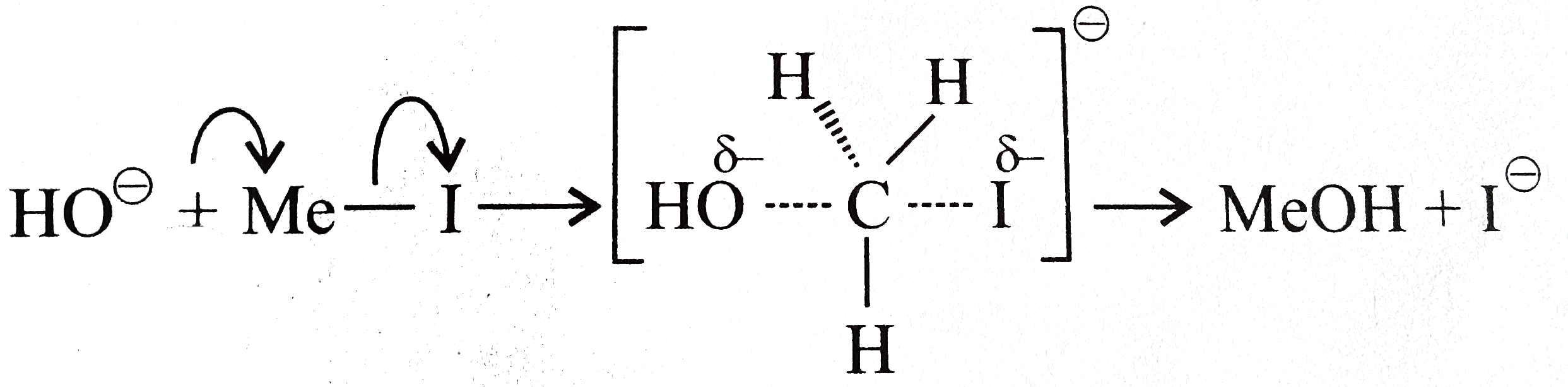
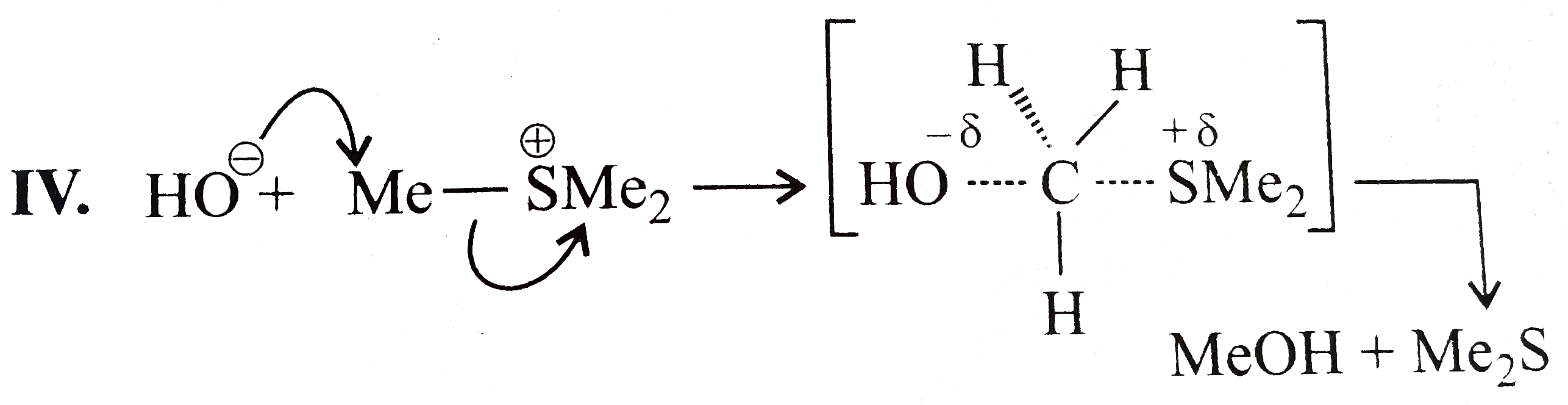
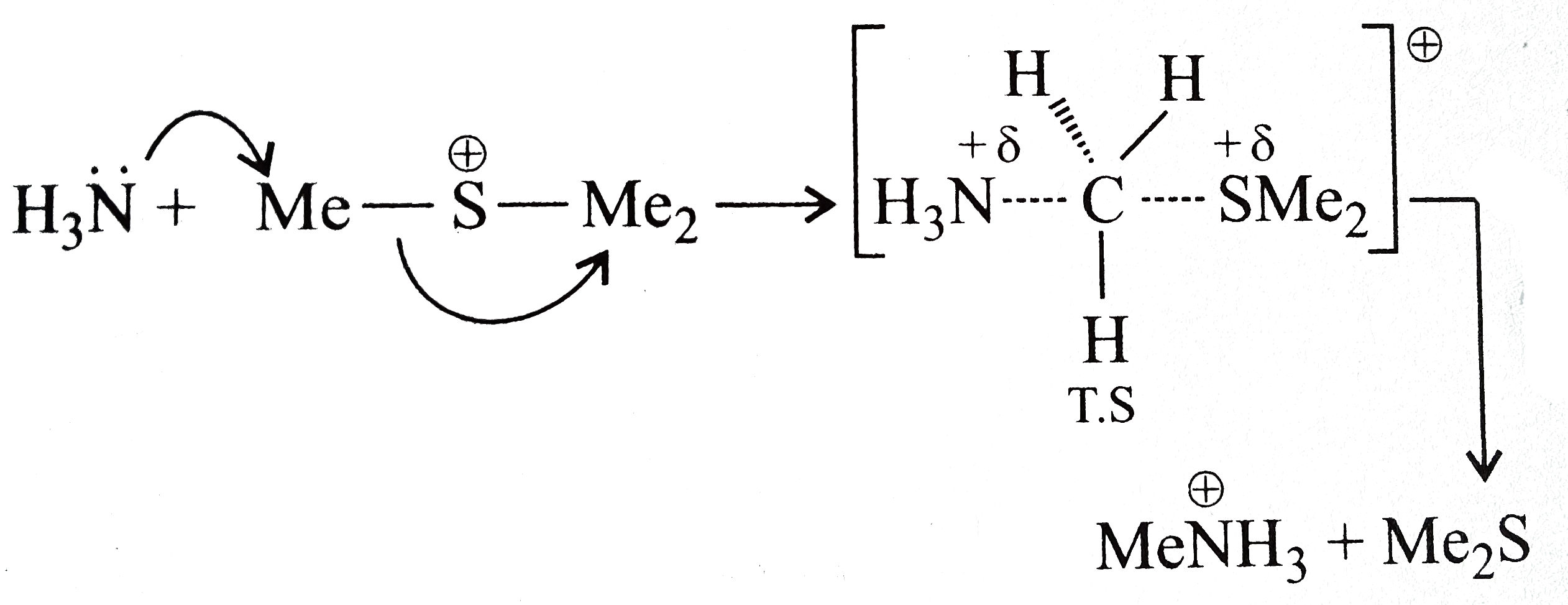
(b) Show the `T.S` with all partial charges for each reaction type.
(I) `Me_2 overset (oplus) S - Me + NH_3 rarr Me overset (oplus)N H_3 + Me_2 S`
(II) `Me I + NH_3 rarr Me overset (oplus)N H_3 + I^(Ө)`
(III) `Me I + overset (Ө) O H rarr Me OH + I^(Ө)`
(IV) `Me_2 S^(oplus) - Me + overset (Ө) OH rarr Me OH + Me_2 S`.

Text Solution

Verified by Experts
(I)
The charge in the `T.S` is more diffused than the charge in the reactant `(Me_2 S^(oplus) Me)`, hence the increase in solvent polarity stabilises the reactant more than the `T.S` So the rate decrease.
(II)
There is no charge either on the reactant or nucleophile, but `T.S` has `delta` -charges. Hence, an increase in solvent polarity stabilises the `T.S`., lowers `E_(act)`, and increase the rate.
(III)
This case is similar to (I). Therefore is a changed nucleophile and diffused charge `T.S`., and the rate is decreased.
(IV)
Both the reactant and nucleophile are charge. These are more stabilised by increasing solvent polarity than the `T.S` whose charge is much more diffused and hence there is a sharp decrease in the rate of `SN^2` reaction.
Promotional Banner

Topper's Solved these Questions

  • ORGANIC REACTION MECHANISM

    CENGAGE CHEMISTRY|Exercise Solved Example|33 Videos
  • ORGANIC REACTION MECHANISM

    CENGAGE CHEMISTRY|Exercise Subjective|19 Videos
  • NCERT BASED EXERCISE

    CENGAGE CHEMISTRY|Exercise Chemical Equilibrium|72 Videos
  • P-BLOCK GROUP 13 - BORON FAMILY

    CENGAGE CHEMISTRY|Exercise Exercise Archives (Subjecive)|9 Videos

Similar Questions

Explore conceptually related problems

The correct order of stabilities of the following resonance structures is : (I) H_2 C = overset (oplus) N = overset (Ө) N (II) H_2 overset (oplus) C - N = overset (Ө) N (III) H_2 overset (Ө) C - overset (oplus) N -= N (IV) H_2 overset (Ө) C - N = overset (oplus) N .

What is the correct order of decreasing stability of the following cations I. CH_(3) - overset(oplus)(C) H - CH_(3) II. CH_(3) - overset(oplus)(C)H - OCH_(3) III. CH_(3) - overset(oplus)(C)H - CH_(2) - OCH_(3)

Me_3 overset (Ӫ) C is more stable than overset (Ӫ) C H_3 . The + I effect of the three Me groups in Me_3 overset (Ӫ) C tends to make it more stable than overset (Ӫ) C H_3 .

Consider the following reactions : I Me- underset((A))(-=)-Me overset(Na+Liq. NH_(3))underset(EtOH)to (B) . Which statement is wrong about the reactions (i) and (ii) ?

Consider the following reactions : I Me- underset((A))(-=)-Me overset(Na+Liq. NH_(3))underset(EtOH)to (B) . Which statement is wrong about the reactions (ix) and (x) ?

Which of the compound in each of the following pairs will react faster in SN^2 reaction with overset (Ө) O H (A) MeBr (I) and MeI (II) (B) Me_3 C - Cl (III) and MeCl (IV) .

Consider the following reactions : I Me- underset((A))(-=)-Me overset(Na+Liq. NH_(3))underset(EtOH)to (B) . Which statement is wrong about the reactions (iii) and (iv) ?

Consider the following reactions : I Me- underset((A))(-=)-Me overset(Na+Liq. NH_(3))underset(EtOH)to (B) . Which statement is wrong about the reaction (v) and (vi) ?

Identify the final product (Z) in the following sequence of reactions : Me_2C=O+HCNrarr(X) overset(H_3O^+)rarr(Y)overset(H_2SO_4)rarr