Home
Class 11
CHEMISTRY
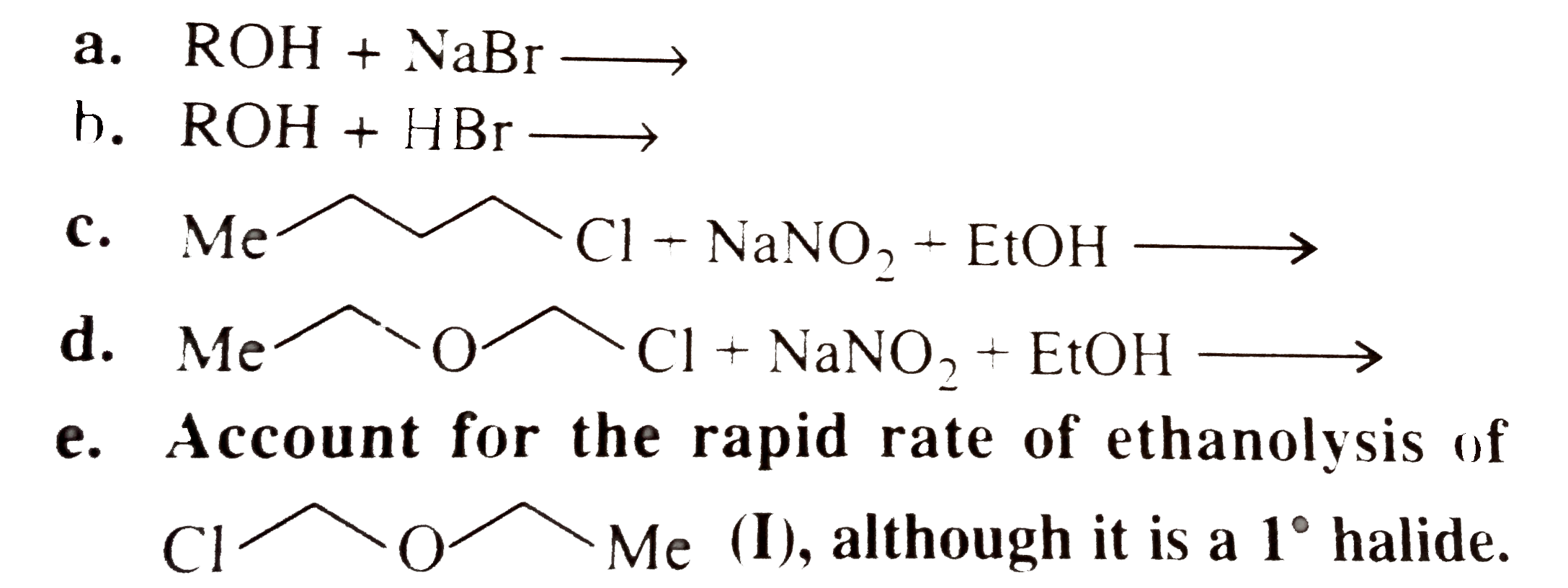
Explain the reaction : (a) ROH + NaBr ...

Explain the reaction :
(a) `ROH + NaBr rarr`
(b) `ROH + HBr rarr`
(c)

Text Solution

Verified by Experts
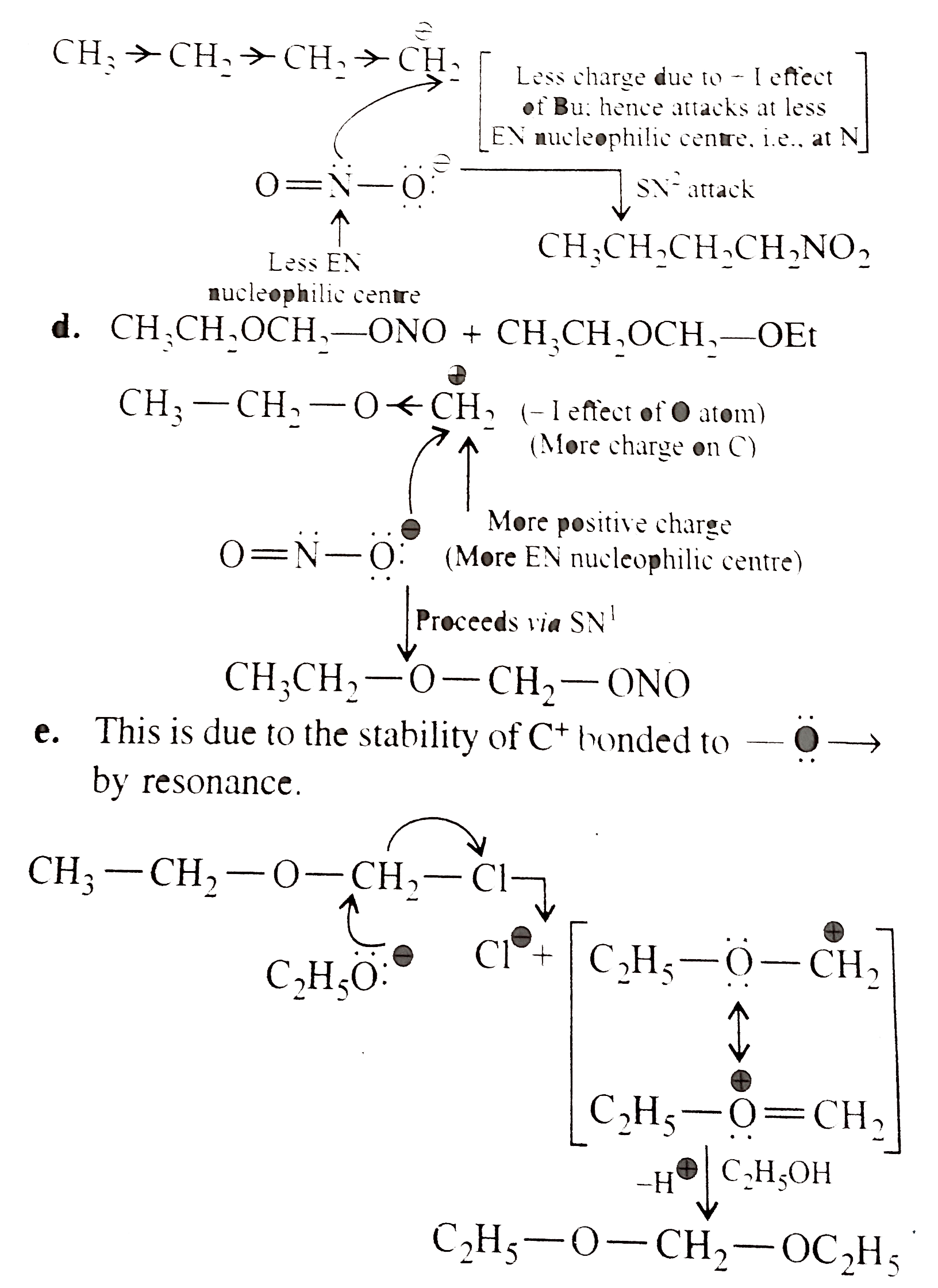
(a) No reaction. Extremely weak base `Br^(Ө)` cannot displace very strong base `overset (Ө) O H`.
(b) This reaction occurs in two steps.
`ROH + HRr rarr ROH_2^(oplus) + Br^(Ө) rarr RBr + H_2 O`
Displacement is on the onium ion of `ROH` whose good leaving group property is due to the weekly basic `H_2 O`.
`{:(underset(ddot)overset(overset(O)(||))(N)--,underset(ddot)overset(ddot)(O): ,,("Ambident nucleophile"),("Two nucleophilic centres N and O")),(underset(underset("centre")("nucleophilic"))("Less EN"),underset(underset("centre")("nucleophilic"))("More EN"),,["EN of O gt N"],):}`
Rule : If there is more positive charge on the carbonium formed, it will attack at the more `EN` nucleophilic centre and vice versa.
Promotional Banner

Topper's Solved these Questions

  • ORGANIC REACTION MECHANISM

    CENGAGE CHEMISTRY|Exercise Solved Example|33 Videos
  • ORGANIC REACTION MECHANISM

    CENGAGE CHEMISTRY|Exercise Subjective|19 Videos
  • NCERT BASED EXERCISE

    CENGAGE CHEMISTRY|Exercise Chemical Equilibrium|72 Videos
  • P-BLOCK GROUP 13 - BORON FAMILY

    CENGAGE CHEMISTRY|Exercise Exercise Archives (Subjecive)|9 Videos

Similar Questions

Explore conceptually related problems

Complete reaction : RMgX+ROH ?

The rate law for the reaction, RCl + Na (a) rarr ROH + NaCl is given by, rate = K_(1) [RCl]. The rate of the reaction will be -

The reaction 2ROH + 2Na rarr 2RONa + H_(2) suggests that alcohols are

On the basis of given reactions,the correct order of increasing oxidising of A,B,C & D is. [ (a) A^- + B rarr A + B^- , (b) C + D^- rarr no reaction , (c) C^- + B rarr no reaction , (d) D + A^- rarr D^- + A]

The rate law for the reaction RCl + NaOH(aq) rarr ROH + NaCl is given by Rate = k[RCl] . The rate of the reaction will be

Assertion (A): For the reaction RCl + NaOH(g) rarr ROH + NaCl , the rate of reaction is reduced to half on reducing the cocentration of RCl to half. Reason (R ): The rate of the reaction is represented by k[RCl] , i.e., it is a first order reaction.

Compare the following displacement reactions and account for any difference (a) ROH+NaBrto (b) ROH+HBrto

