Home
Class 11
CHEMISTRY
(a) Why does 3^@ RX rarely undergo E1 re...

(a) Why does `3^@ RX` rarely undergo `E1` reaction ?
(b) How can `E1` be promoted ?
(c) Give the products in the following reaction.

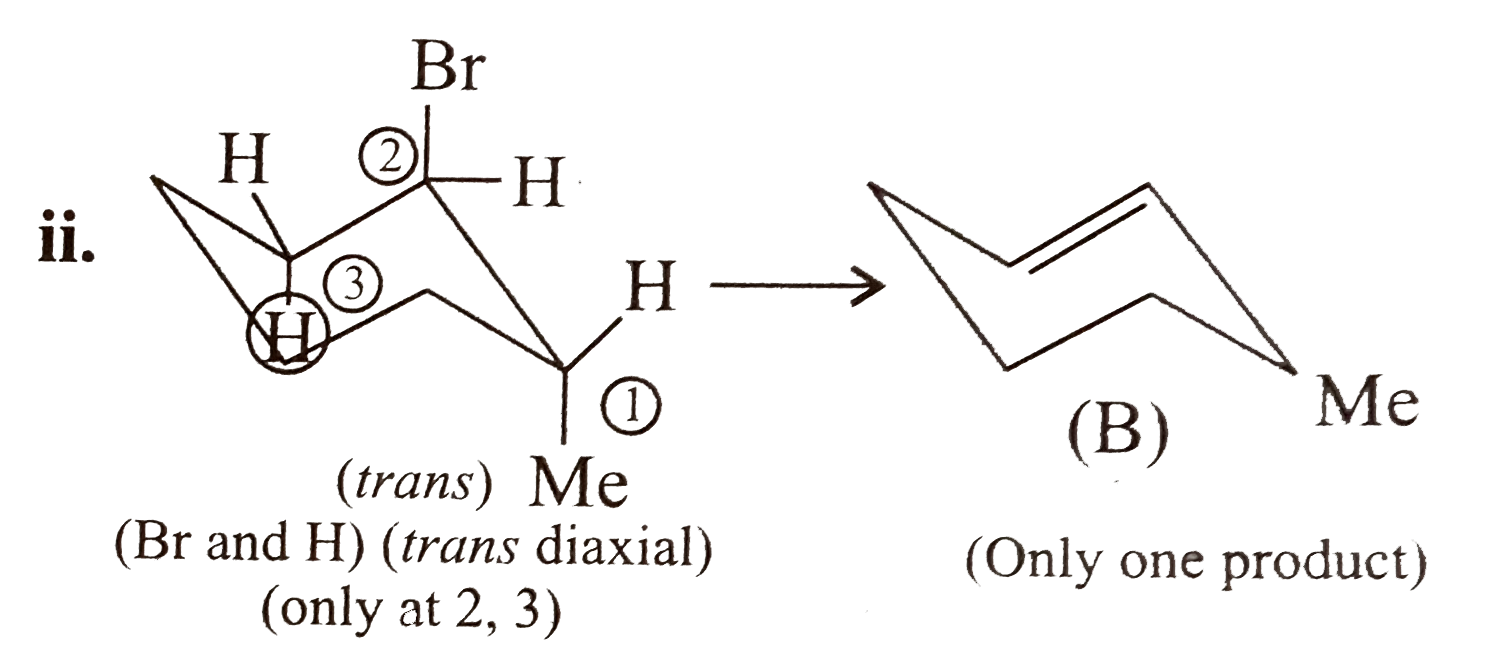
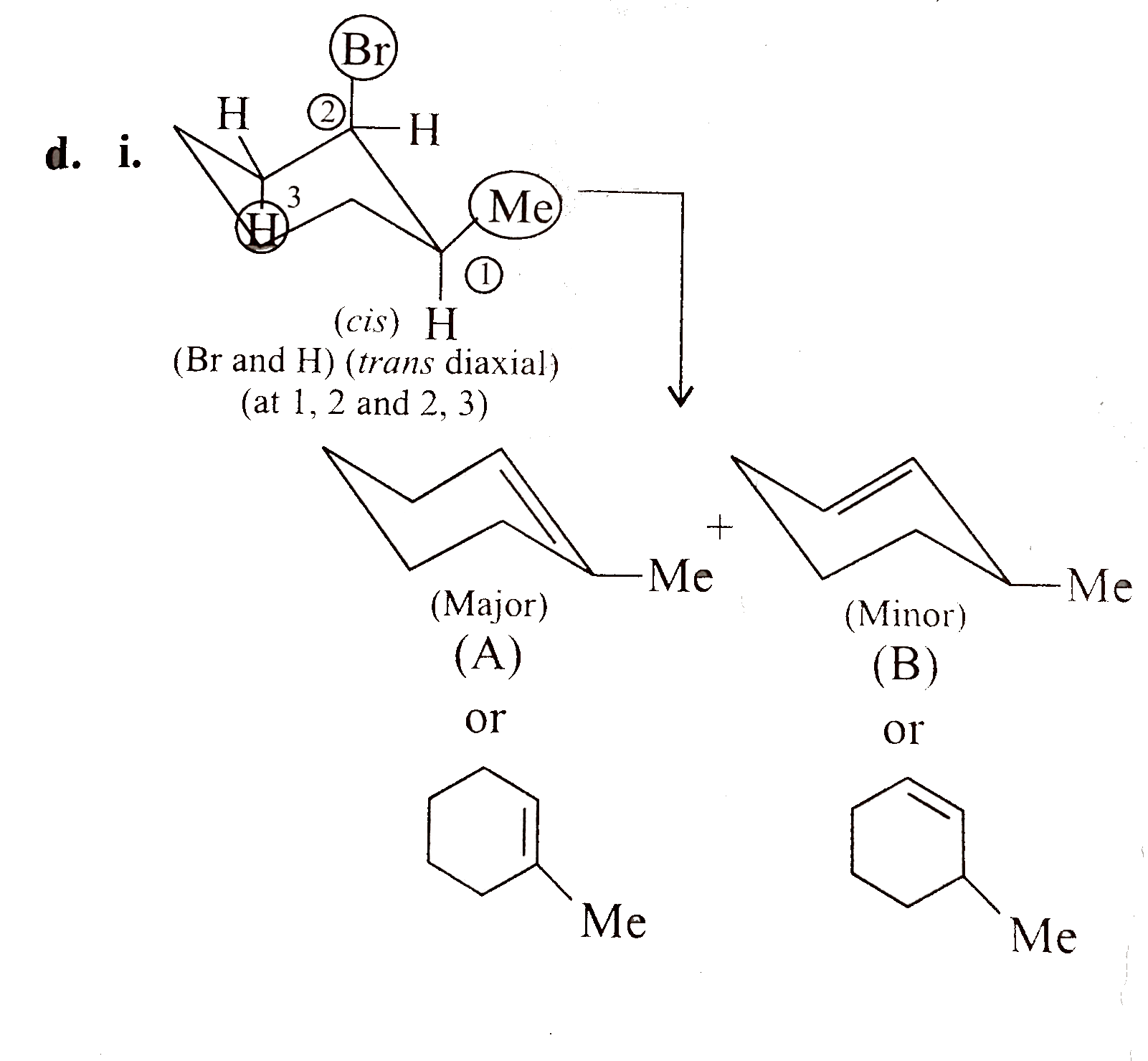
(d) Give the products of `MeONa` with
(i) cis and
(ii) trans-2-Bromomethy1 cyclohexane.

Text Solution

Verified by Experts
(a) `3^@` reacts by `E1` only when the base is weak, or
(i) Has a very low concentration.
(ii) As the base gets stronger or more concentrated `E2` prevails
(iii) If base is too weak or too dilute, `R^+` reacts with the nucleophilic solvent to give `SN^1` product.
(iv) In non-polar solvent, `RX` does not react.
(b) By using electrophilic catalysis, `e.g.,` with `Ag^(oplus)` or `Pb^(2 +)` aids in ionisation of `(C-X)` bond.
(c) (A) `CH_3CH = CH_2 (EtO^(Ө)` is a strong base , `E2` takes place with `2^@ RX` over `SN^2`).
(B) `CH_3CH(OEt)CH_3 (EtOH` is a weaker base but stronger nucleophile, so `SN^1` is favoured.)
(i)
(ii) .
Promotional Banner

Topper's Solved these Questions

  • ORGANIC REACTION MECHANISM

    CENGAGE CHEMISTRY|Exercise Solved Example|33 Videos
  • ORGANIC REACTION MECHANISM

    CENGAGE CHEMISTRY|Exercise Subjective|19 Videos
  • NCERT BASED EXERCISE

    CENGAGE CHEMISTRY|Exercise Chemical Equilibrium|72 Videos
  • P-BLOCK GROUP 13 - BORON FAMILY

    CENGAGE CHEMISTRY|Exercise Exercise Archives (Subjecive)|9 Videos

Similar Questions

Explore conceptually related problems

Give the structure of each of the products in the following reactions: (i) (ii)

Give the product of the following reaction. Me_(2)C=CH_(2)+IC1rarr ?

Give the majore and minor products of the following reactions. a. b. c. d. e. f.

What are the product A, B, C, D and E in the following reactions?

Give the products of the reactions given below. a. b. c. d. e. f. g. Three products

Find out numbers of possible E_(1) products from following reaction .

Give the products of the reaction with conc. H_(2)SO_(4) of : a. b. c. d. 1- Methyl cyclohexanol

Give the product of each of the following reactions Phthalic acid + NH_3 to D overset(300^(@)C) to E

(A) and ( C) are isomers, (B) can be obtainedn by the products of the reactions of EtMgBr and acetone . Give the structures of (A), (B) , and ( C) .