Home
Class 11
CHEMISTRY
The leaving group is that functional gro...

The leaving group is that functional group which is ejected with `overline e^, s` of the `sigma` -bond in a reaction. Better the leaving group, faster is the reaction. The relative leaving ability of the leaving group `X` in `(R - X)` is increased by :
(i) The polarisability of `(R - X)` bond.
(ii) The stability of `X^(Ө)`.
(iii) The degree of stabilisation through solvation of `X`.
(iv) The strength of `(R - X)` bond.
The leaving group tendency is also called fugacity.
Which of the following undergoes `SN` reaction easily ?

A

Vinyl bromide

B

Bromobenzene

C

p-Nitro bromobenzene

D

Text Solution

Verified by Experts

The correct Answer is:

C

(a) Vinyl halide does not undergo either `SN^1` or `SN^2` reaction.
(b) Aryl halide does not undergo `SN` reaction unless benzene ring is activated by `EWG` [e.g., `NO_2` group].
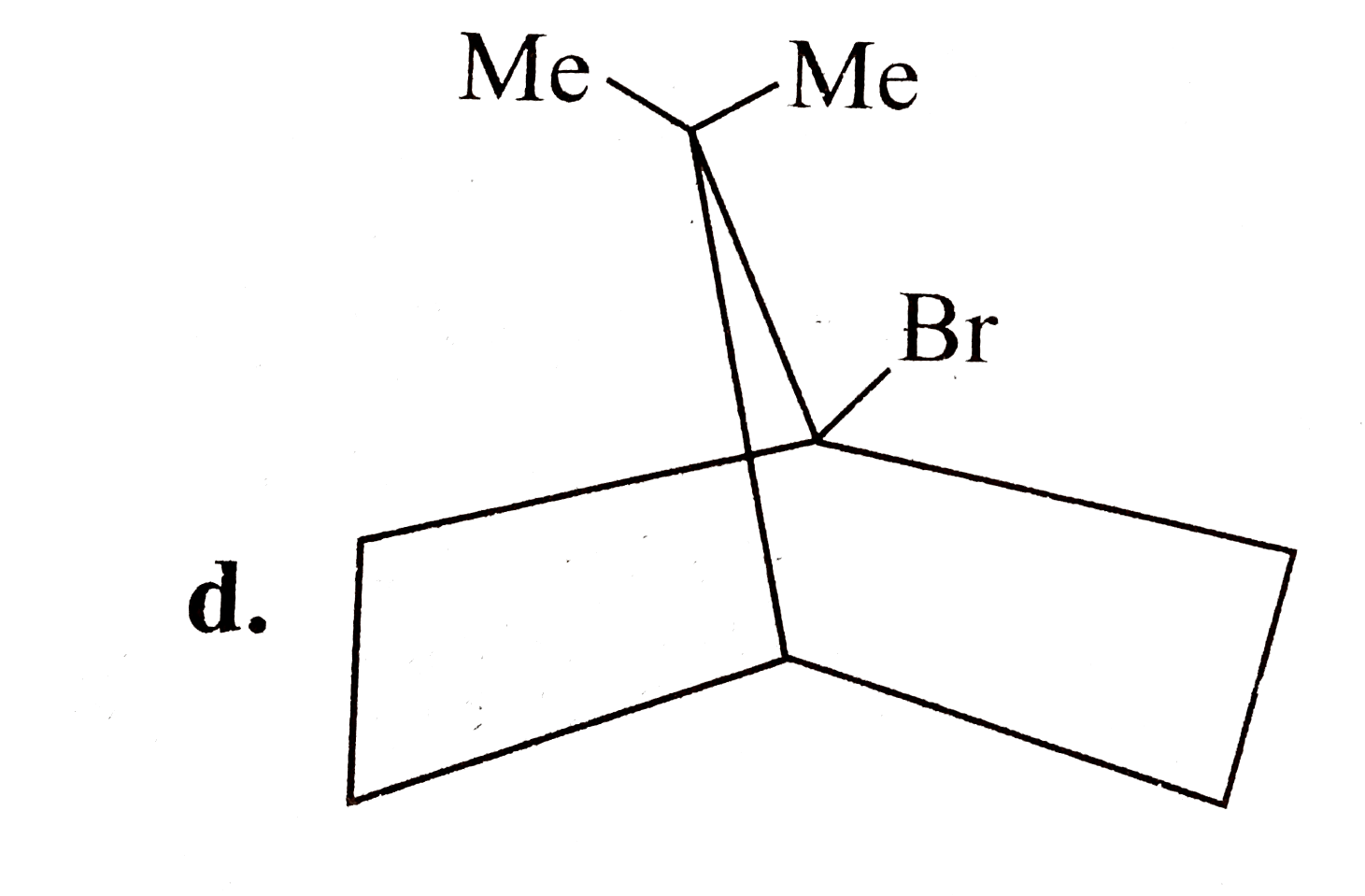
(d) Bridge-head halides are inert to both `SN^1` and `SN^2` reactions.
Promotional Banner

Topper's Solved these Questions

  • ORGANIC REACTION MECHANISM

    CENGAGE CHEMISTRY|Exercise Multiple Correct|30 Videos
  • ORGANIC REACTION MECHANISM

    CENGAGE CHEMISTRY|Exercise Single correct|50 Videos
  • ORGANIC REACTION MECHANISM

    CENGAGE CHEMISTRY|Exercise Subjective|19 Videos
  • NCERT BASED EXERCISE

    CENGAGE CHEMISTRY|Exercise Chemical Equilibrium|72 Videos
  • P-BLOCK GROUP 13 - BORON FAMILY

    CENGAGE CHEMISTRY|Exercise Exercise Archives (Subjecive)|9 Videos

Similar Questions

Explore conceptually related problems

The leaving group is that functional group which is ejected with overline e^, s of the sigma -bond in a reaction. Better the leaving group, faster is the reaction. The relative leaving ability of the leaving group X in (R - X) is increased by : (i) The polarisability of (R - X) bond. (ii) The stability of X^(Ө) . (iii) The degree of stabilisation through solvation of X . (iv) The strength of (R - X) bond. The leaving group tendency is also called fugacity. Which one of the followingd has the highest fugacity ?

The leaving group is that functional group which is ejected with overline e^, s of the sigma -bond in a reaction. Better the leaving group, faster is the reaction. The relative leaving ability of the leaving group X in (R - X) is increased by : (i) The polarisability of (R - X) bond. (ii) The stability of X^(Ө) . (iii) The degree of stabilisation through solvation of X . (iv) The strength of (R - X) bond. The leaving group tendency is also called fugacity. Which of the following is the wrong order of fugacity ?

The leaving group is that functional group which is ejected with overline e^, s of the sigma -bond in a reaction. Better the leaving group, faster is the reaction. The relative leaving ability of the leaving group X in (R - X) is increased by : (i) The polarisability of (R - X) bond. (ii) The stability of X^(Ө) . (iii) The degree of stabilisation through solvation of X . (iv) The strength of (R - X) bond. The leaving group tendency is also called fugacity. Which statement is wrong ?

The leaving group is that functional group which is ejected with overline e^, s of the sigma -bond in a reaction. Better the leaving group, faster is the reaction. The relative leaving ability of the leaving group X in (R - X) is increased by : (i) The polarisability of (R - X) bond. (ii) The stability of X^(Ө) . (iii) The degree of stabilisation through solvation of X . (iv) The strength of (R - X) bond. The leaving group tendency is also called fugacity. Which statement is correct ?

The leaving group is that functional group which is ejected with overline e^, s of the sigma -bond in a reaction. Better the leaving group, faster is the reaction. The relative leaving ability of the leaving group X in (R - X) is increased by : (i) The polarisability of (R - X) bond. (ii) The stability of X^(Ө) . (iii) The degree of stabilisation through solvation of X . (iv) The strength of (R - X) bond. The leaving group tendency is also called fugacity. Which statement is correct ?

The correct order of the ability of the leaving group is

Correct order of leaving group tendency is :

Which is the best leaving group ?

CENGAGE CHEMISTRY-ORGANIC REACTION MECHANISM-Comprehension
  1. The leaving group is that functional group which is ejected with overl...

    Text Solution

    |

  2. The leaving group is that functional group which is ejected with overl...

    Text Solution

    |

  3. The leaving group is that functional group which is ejected with overl...

    Text Solution

    |

  4. The leaving group is that functional group which is ejected with overl...

    Text Solution

    |

  5. The leaving group is that functional group which is ejected with overl...

    Text Solution

    |

  6. The rate of SN^2 reaction depends on the effectiveness of the nucleoph...

    Text Solution

    |

  7. The rate of SN^2 reaction depends on the effectiveness of the nucleoph...

    Text Solution

    |

  8. The rate of SN^2 reaction depends on the effectiveness of the nucleoph...

    Text Solution

    |

  9. The rate of SN^2 reaction depends on the effectiveness of the nucleoph...

    Text Solution

    |

  10. Which statement is wrong in the formation of (B) from (A).

    Text Solution

    |

  11. Which is correct in the formation of (c) from (A) ?

    Text Solution

    |

  12. Which statement is wrong in the formation of (c) from (A) ?

    Text Solution

    |

  13. In elimination reaction, the major product is either Saytzeff (more-su...

    Text Solution

    |

  14. In elimination reaction, the major product is either Saytzeff (more-su...

    Text Solution

    |

  15. In elimination reaction, the major product is either Saytzeff (more-su...

    Text Solution

    |

  16. In elimination reaction, the major product is either Saytzeff (more-su...

    Text Solution

    |

  17. In elimination reaction, the major product is either Saytzeff (more-su...

    Text Solution

    |

  18. Consider the following reactions : Which of the following are ste...

    Text Solution

    |

  19. Consider the following reactions : Which of the following regiose...

    Text Solution

    |

  20. Consider the following reactions : Syn-addition takes place in :

    Text Solution

    |
