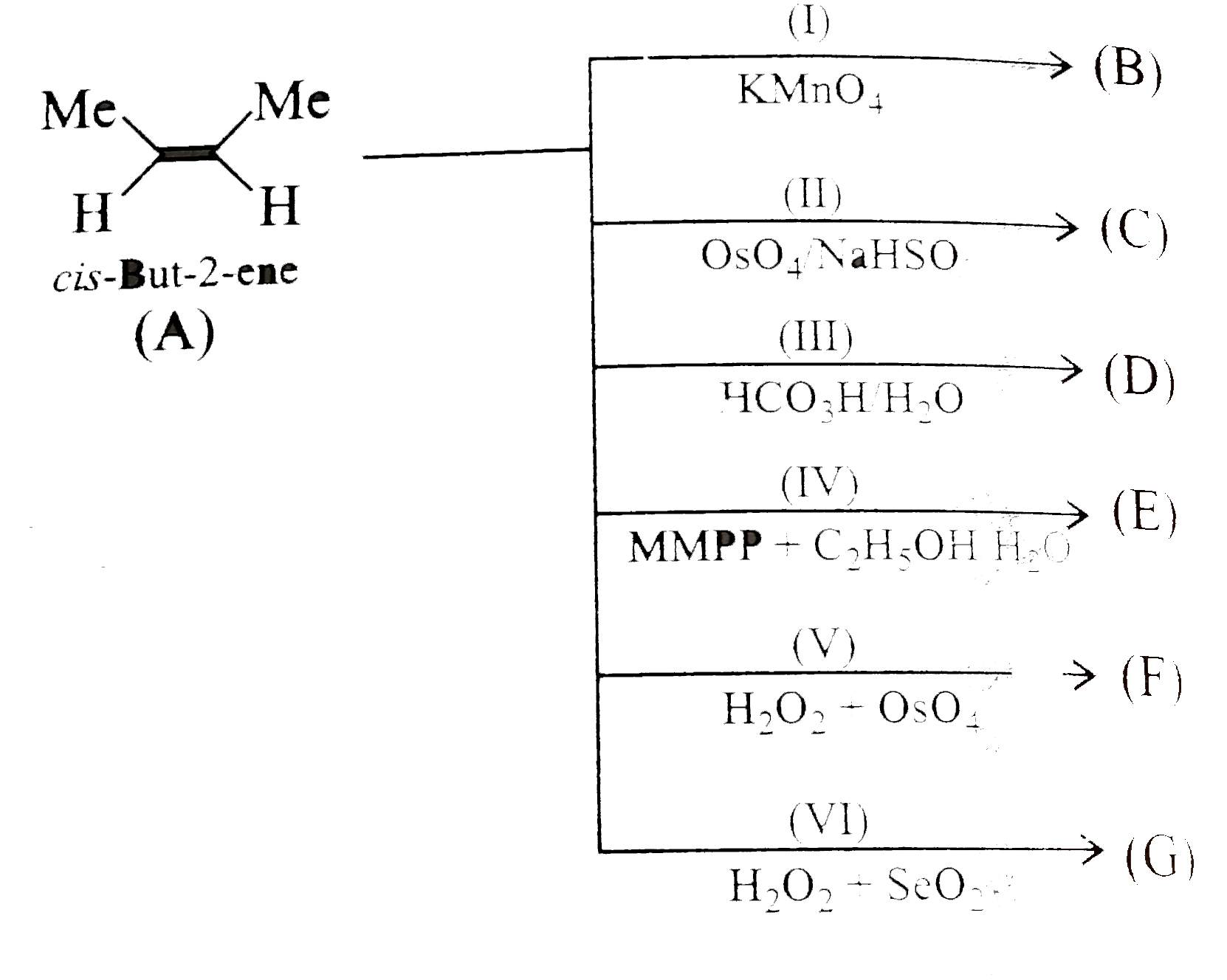
A
B
C
D
Text Solution
Verified by Experts
The correct Answer is:



Topper's Solved these Questions
ORGANIC REACTION MECHANISM
CENGAGE CHEMISTRY|Exercise Multiple Correct|30 VideosORGANIC REACTION MECHANISM
CENGAGE CHEMISTRY|Exercise Single correct|50 VideosORGANIC REACTION MECHANISM
CENGAGE CHEMISTRY|Exercise Subjective|19 VideosNCERT BASED EXERCISE
CENGAGE CHEMISTRY|Exercise Chemical Equilibrium|72 VideosP-BLOCK GROUP 13 - BORON FAMILY
CENGAGE CHEMISTRY|Exercise Exercise Archives (Subjecive)|9 Videos
Similar Questions
Explore conceptually related problems
CENGAGE CHEMISTRY-ORGANIC REACTION MECHANISM-Comprehension
- In elimination reaction, the major product is either Saytzeff (more-su...
Text Solution
|
- In elimination reaction, the major product is either Saytzeff (more-su...
Text Solution
|
- Consider the following reactions : Which of the following are ste...
Text Solution
|
- Consider the following reactions : Which of the following regiose...
Text Solution
|
- Consider the following reactions : Syn-addition takes place in :
Text Solution
|
- Consider the following reactions : Anti-addition takes place in :
Text Solution
|
- Consider the following reactions : Meso-butan-2,3-diol is formed ...
Text Solution
|
- Consider the following reactions : Racemic-butan-2,3-diol is form...
Text Solution
|
- Consider the following reactions : The name of structure of MMPP ...
Text Solution
|
- Consider the following reactions : Which of the following are ste...
Text Solution
|
- Consider the following reactions : Which of the following regiose...
Text Solution
|
- Consider the following reactions : Syn-addition takes place in :
Text Solution
|
- Consider the following reactions : Syn-addition takes place in :
Text Solution
|
- Meso-tartaric acid is formed in :
Text Solution
|
- (+-) -Tartaric acid is formed in :
Text Solution
|
- Consider the following reactions : I Me- underset((A))(-=)-Me overse...
Text Solution
|
- Consider the following reactions : I Me- underset((A))(-=)-Me overse...
Text Solution
|
- Consider the following reactions : I Me- underset((A))(-=)-Me overse...
Text Solution
|
- Consider the following reactions : I Me- underset((A))(-=)-Me overse...
Text Solution
|
- Consider the following reactions : I Me- underset((A))(-=)-Me overse...
Text Solution
|