Home
Class 12
CHEMISTRY
Arrange the following compounds in the i...

Arrange the following compounds in the increasing order of their property as indicated:
i. Acetaldehyde, acetone, di-tert-butyl ketone, methyl tert-butyl ketone (reactivity towards HCN).
ii. `CH_(3)CH_(2)CH(Br)COOH, CH_(3)CH(Br)CH_(2)COOH, (CH_(3))_(2)CHCOOH, CH_(3)CH_(2)CH_(2)COOH` (acidic strength).
iii. Benzoic acid, 4-nitrobenzoic acid, 3,4-dinitro-benzoic acid, 4-methoxybenzoic acid (acidic strength).

Text Solution

Verified by Experts
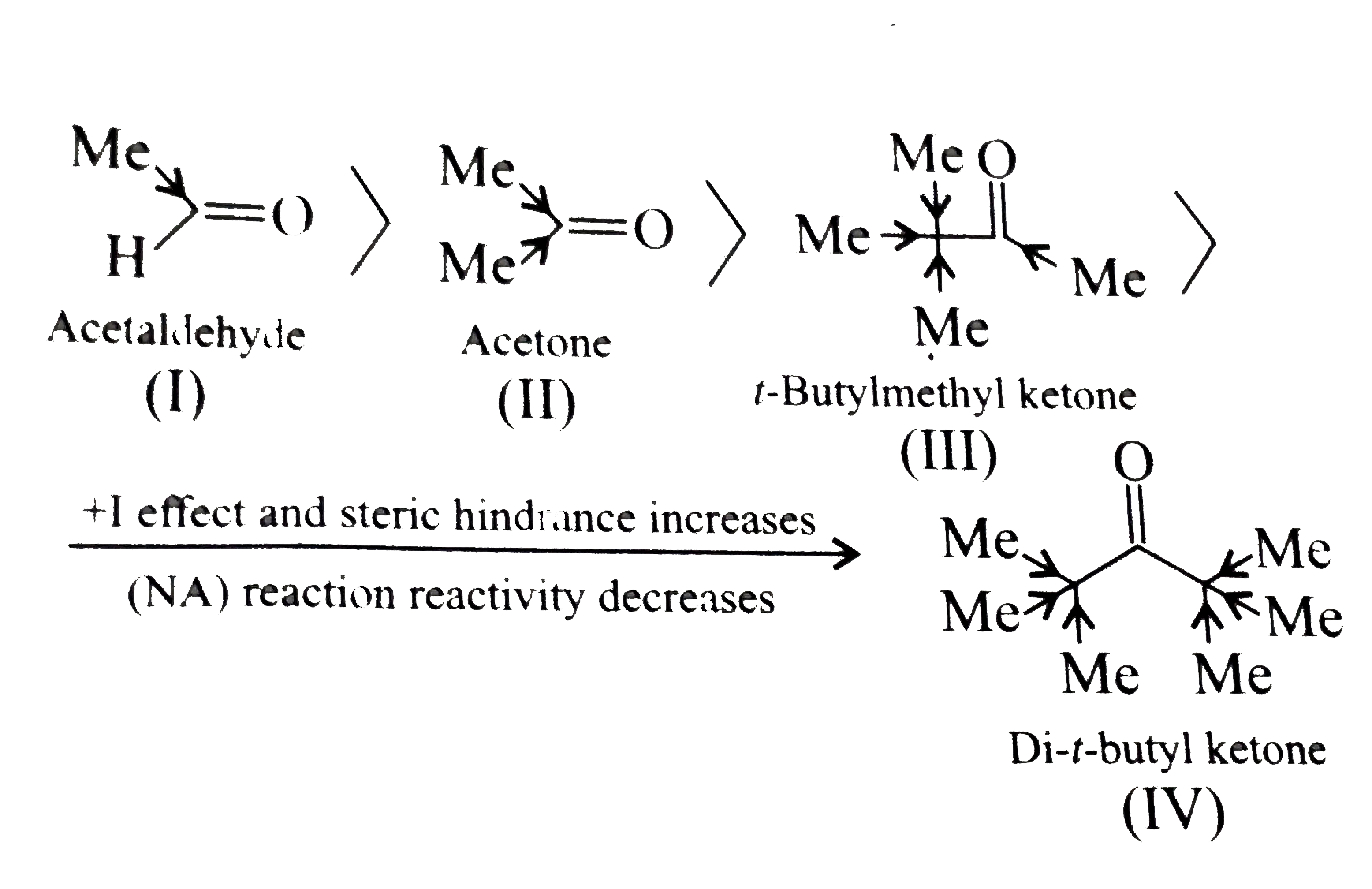
i. More `bar e`-withdrowing group favours NA reaction (nucleophilic addition reaction), whereas `bar e`-donating group decreases reactivity towards NA reaction or reactivity towards HCN.
Decreasing order of NA reactivity:

So, Increasing order of reactivity towards HCN:
(IV)lt(III)lt(II)lt(I).
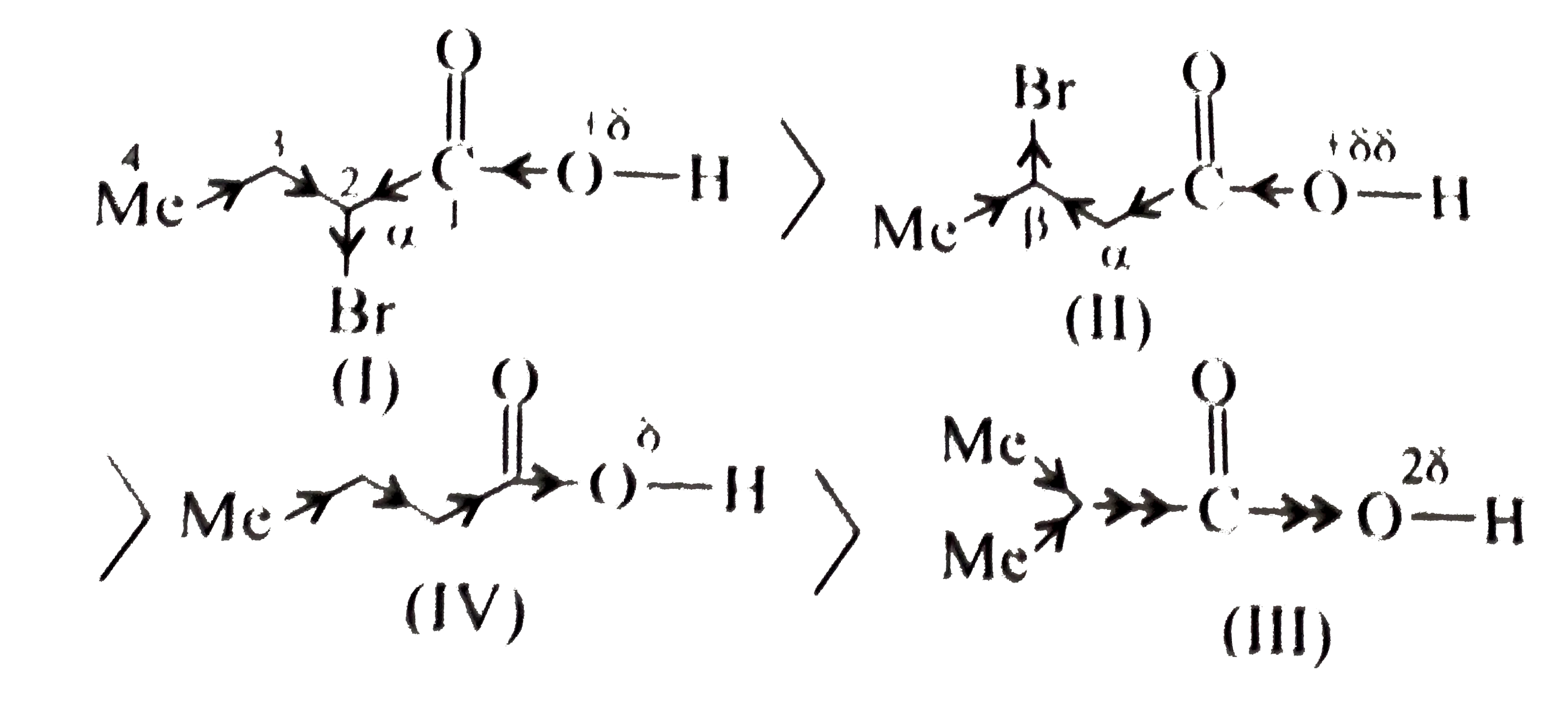
ii. a. EWG (`bar e`-withdrawing groups) increases the acidic strength, whereas EDG (`bar e`-donating groups) decreases the acidic strength.
b. Nearer is the EWG to the source `[(-COOH)` group], stronger is the acid, i.e., `alpha`-substituted halo acid stronger than `beta`- or `gamma`-substituted halo acid.
Decreasing order of acidic strength:

Increasing order of acidic strength:
(III)lt(IV)lt(II)lt(I).
iii. Decreasing order of acidic strength:

So, Increasing order of acidic strength:
(IV)lt(I)lt(II)lt(III).
Promotional Banner

Topper's Solved these Questions

  • ALIPHATIC AND AROMATIC ALDEHYDES AND KETONES

    CENGAGE CHEMISTRY|Exercise Exercises Linked Comprehension|59 Videos
  • ALIPHATIC AND AROMATIC ALDEHYDES AND KETONES

    CENGAGE CHEMISTRY|Exercise Exercises Multiple Correct|40 Videos
  • ALIPHATIC AND AROMATIC ALDEHYDES AND KETONES

    CENGAGE CHEMISTRY|Exercise Exercises Subjective|52 Videos
  • ALCOHOL,PHENOL AND ETHERS

    CENGAGE CHEMISTRY|Exercise Archives Analytical And Descriptive|15 Videos
  • AMINES

    CENGAGE CHEMISTRY|Exercise QUESTION BANK|1 Videos

Similar Questions

Explore conceptually related problems

Arrange the following compounds in decreasing order of acidity : CH_(3)CH_(2)OH H_(2)C=CH_(2)

Give chemical tests to distinguish between (i) Propanal and propanone (ii) Benzaldehyde and acetophenone (b) Arrange the following compounds in an increasing order of their property as indicated : (i) Acetaldehyde, Acetone , Methyl tert-butyl ketone (reactivity towards HCN) (ii) Benzoic acid ,3,4-Dinitrobenzoic acid , 4-Metthoxybenzoic acid (acid strength) (iii) CH_(3)CH_(2)CH(Br)(COOH), CH_(3)CH(Br)CH_(2)COOH, (CH_(3))_(2)CH COOH (acid strength)

Arrange the following compounds in increasing order of their property as indicated : (i) underset("(reactivity toward nucleophilic addition reaction)")underset()(CH_(3)COCH_(3),C_(6)H_(5)COCH_(3),CH_(3)CHO ) (ii) Cl-CH_(2)-COOH, F-CH_(2)-COOH,CH_(3)-COOH ( acidic character)

Arrange the following compounds in the increasing of their acid strength : (I ) (a) CH_3 CH_2 CH (Br ) COOH (b ) CH_3 CH (Br) CH_2 COOH ( c ) (CH_3)_2 CHCOOH , (d) CH_3CH_2 COOH (ii ) (a) Benzonic acid ( b ) p-nitrobenzonic acid ( c ) 3,4- dinitrobenzoic acid ( d ) 4- methoxybenzoic acid

(a) Arrange the following in an increasing order of their indicated property. (i) Benzoic acid ,4- Nitrobenzoc acid ,3,4 - Dinitrobenzoic acid, 4- Methoxybenzoic acid (acid strength) (ii) CH_(3)CH_(2)CH(Br)COOH,CH_(3)CH(Br)CH_(2)COOH , (CH_(3))_(2)CHCOOH,CH_(3)CH_(2)CH_(2)COOH (acid strength) (b) How would you bring about the following conversions : (i) Propanone to propene (ii) Benzoic acid to Benzaldehyde (iii) Bromobenzene to 1- phenylethanol

Arrange the following in order of decreasing of acid strenth indicated ? (i) Benzoic acid, 3, 4-Dinitrobenzoic acid, 4-Methylbenzoic acid ltbgt (ii) CH_(3)CH_(2)CH(Br)COOH,CH_(3)CH(Br)CH_(2)COOH,(CH_(3))_(2)CHCOOH

Arrange the following in increasing order of acid strength : (i) CH_(3)CH_(2)CH(Br)COOH , (ii) CH_(3)CH(Br)CH_(2)COOH , (iii) CH_(3)COOH

CENGAGE CHEMISTRY-ALIPHATIC AND AROMATIC ALDEHYDES AND KETONES-Exercises Concept Application
  1. What is meant by the following terms ? Give an example of the reaction...

    Text Solution

    |

  2. Name the following compounds according to the IUPAC system of nomencla...

    Text Solution

    |

  3. Draw the structures of following compound: i. 3-Methylbutanal ii. ...

    Text Solution

    |

  4. Write the IUPAC names of following ketones and aldehydes. Wherever pos...

    Text Solution

    |

  5. Draw the structure of following derivatives: i. 2,4-Dinitrophylhydra...

    Text Solution

    |

  6. Predict the products formed when cyclohexane carbaldehyde reacts with ...

    Text Solution

    |

  7. Which of the following compounds would undergo aldol condensation or t...

    Text Solution

    |

  8. How will you convert ethnal into the following compounds ? i. Butane...

    Text Solution

    |

  9. Write structure formulae and names of four possible aldol condensation...

    Text Solution

    |

  10. An organic compound with the molecular folmula C(9)H(10)O form 2,4-DNP...

    Text Solution

    |

  11. An organic compound (A) (molecular formula C(8)H(16)O(2)) was hydrolys...

    Text Solution

    |

  12. Arrange the following compounds in the increasing order of their prope...

    Text Solution

    |

  13. Give simple chemical test to distinguish between the following pairs o...

    Text Solution

    |

  14. How will you prapare the following compounds from benzene ? You may us...

    Text Solution

    |

  15. How will you bring about the following conversions in not more than tw...

    Text Solution

    |

  16. Describe the following i. Acetylation ii. Cannizzaro reaction i...

    Text Solution

    |

  17. Complete each synthesis by giving the missing starting material, reage...

    Text Solution

    |

  18. Giving plausible explanation for each of the following: i. Cyclohexa...

    Text Solution

    |

  19. An organic compound contains 69.77% carbon, 11.63% hydrogen, and rest ...

    Text Solution

    |

  20. Although phenoxide ion has more number of resonating structures than c...

    Text Solution

    |