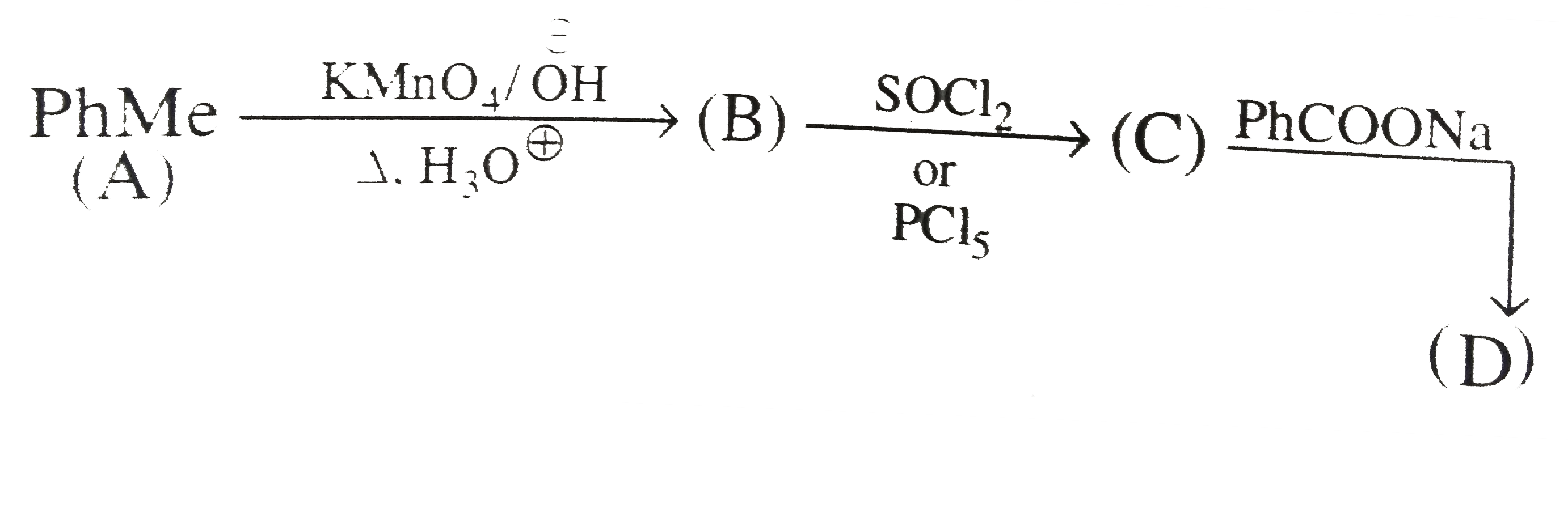
A
B
C
D
Text Solution
Verified by Experts
The correct Answer is:



Topper's Solved these Questions
CARBOXYLIC ACIDS AND THEIR DERIVATIVES
CENGAGE CHEMISTRY|Exercise Exercises (Assertion-Reasoning)|10 VideosCARBOXYLIC ACIDS AND THEIR DERIVATIVES
CENGAGE CHEMISTRY|Exercise Exercises Archives (Single Correct)|10 VideosCARBOXYLIC ACIDS AND THEIR DERIVATIVES
CENGAGE CHEMISTRY|Exercise Exercises (Multiple Correct)|35 VideosBIOMOLECULES, POLYMERS AND CHEMISTRY IN EVERYDAY LIFE
CENGAGE CHEMISTRY|Exercise QUESTION BANK|8 VideosCHEMICAL KINETICS
CENGAGE CHEMISTRY|Exercise Archives Subjective|23 Videos
Similar Questions
Explore conceptually related problems
CENGAGE CHEMISTRY-CARBOXYLIC ACIDS AND THEIR DERIVATIVES-Exercises (Singlecorrect)
- Which reagent can distinguish between pentanoic acid and pentanamide ?
Text Solution
|
- The compound (D) is :
Text Solution
|
- Compound (D) is :
Text Solution
|
- Which H atom in the following ester is most acidic ? overset(1)(CH(3...
Text Solution
|
- Product (B) in the reaction is : .
Text Solution
|
- The reactant (A) is the reaction is : .
Text Solution
|
- Product ( C) is :
Text Solution
|
- Product ( C) is :
Text Solution
|
- and find out the reagent (A) from the following :
Text Solution
|
- The decreasing order of ease of hydrolysis of the following esters is ...
Text Solution
|
- The boiling points of ethyl acetate and CH3 OH, respectively, are 77^@...
Text Solution
|
- Carboxylic acid, although unreactive to alcohols, reacts in the presen...
Text Solution
|
- The major product ( C) in the reaction is : .
Text Solution
|
- Which of the following is the best method for the synthesis of ester (...
Text Solution
|
- Which of the following is the best method for the synthesis of alpha-h...
Text Solution
|
- Which of the following statements is wrong about the transesterificati...
Text Solution
|
- The molecular weight of benzoic acid in benzene as determined by depre...
Text Solution
|
- Which of the following reactions would give a good yield of hydrocarbo...
Text Solution
|
- Which of the following reactions is not possible ?
Text Solution
|
- underset((A)) (PhCONH2) underset(KOBr)rarr (B) underset(MeOH)rarr (C) ...
Text Solution
|