Home
Class 12
PHYSICS
A helicopter is moving to the right at a...

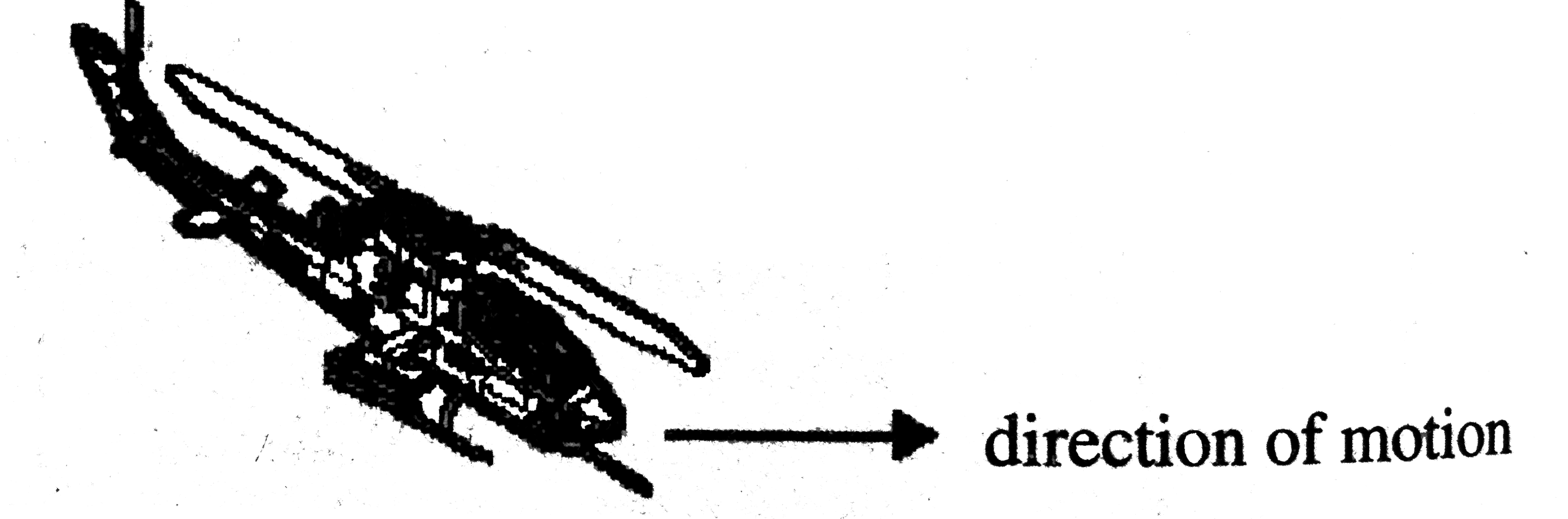
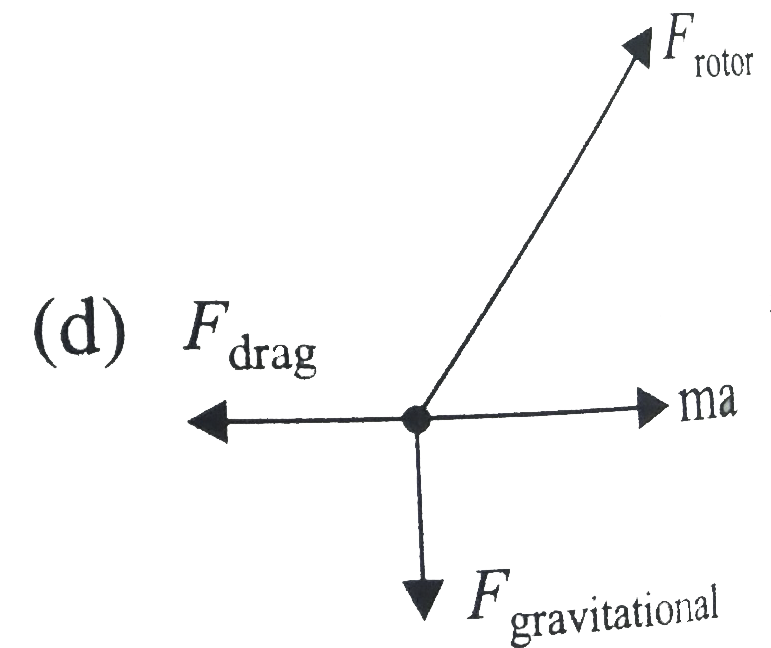
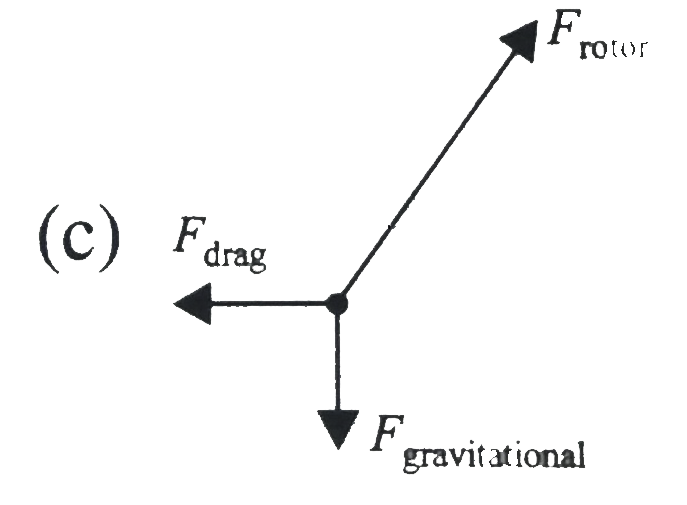
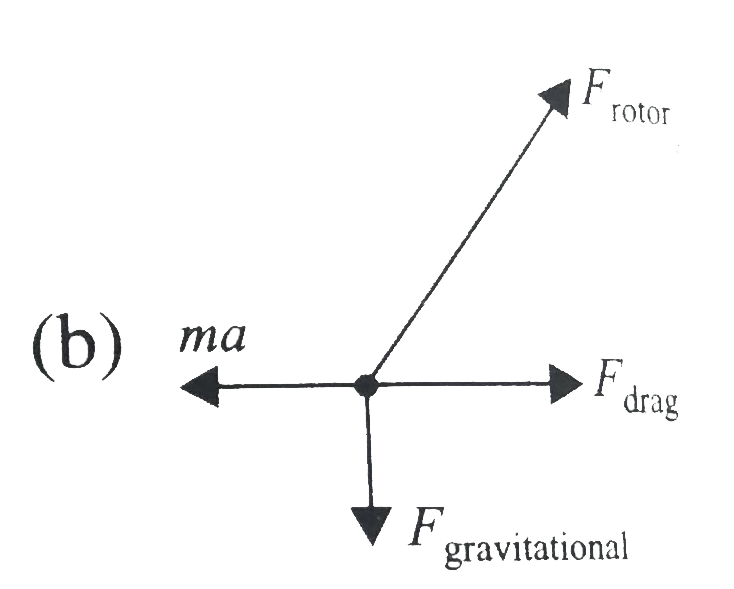
A helicopter is moving to the right at a constant horizontal velocity. It experiences thre forces `vecF_("gravitational"), vecF_("drag")` force on it caused by rotor `vecF_("rotor")`. Which of the following diagrams can be a correct free body diagram represents forces on the helicopter?

A

B

C

D

Text Solution

Verified by Experts

The correct Answer is:
C


`vecF_(gravitational)` acts downwards.
`vecF_(drag)` acts opposite to the direction of motion.
Now let us see how `vecF_(rotor)` acts.
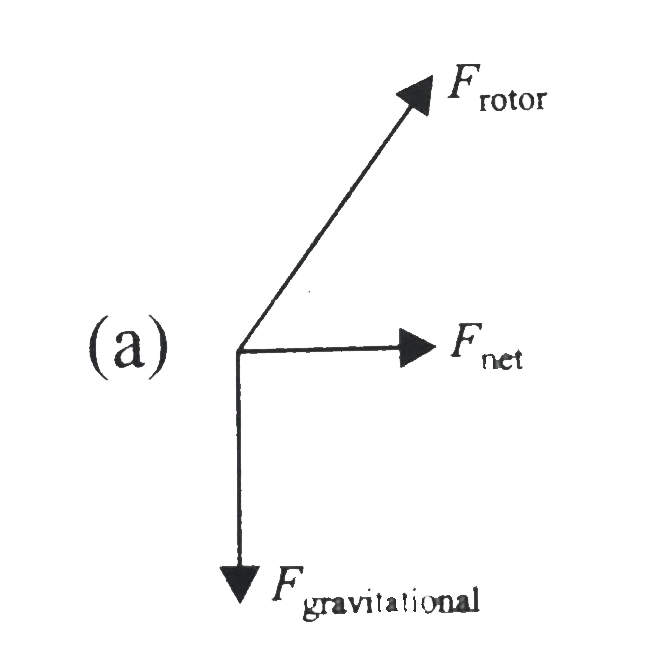
Wings of helicopter will push the air perpendicular to their plane or rotation as shown is figure (a). From third law, air will apply force `vecF_(rotor)` on the wings as shown in figure (b).
There is no force ma. Basically ma is the resultant of all the forces acting on a body. moreover, here a is zero because velocity of helicopter is constant.
Promotional Banner

Topper's Solved these Questions

  • CENGAGE PHYSICS DPP

    CENGAGE PHYSICS|Exercise Fill in the blanks type|26 Videos
  • CENGAGE PHYSICS DPP

    CENGAGE PHYSICS|Exercise Comprehension Type|31 Videos
  • CENGAGE PHYSICS DPP

    CENGAGE PHYSICS|Exercise Multiple Correct Answer Type|54 Videos
  • CAPACITOR AND CAPACITANCE

    CENGAGE PHYSICS|Exercise Integer|5 Videos
  • CENTRE OF MASS CONVERSATION OF MOMENTUM AND COLLISION

    CENGAGE PHYSICS|Exercise Question Bank|38 Videos

Similar Questions

Explore conceptually related problems

Which one of the following diagrams shows the correct lines of force ?

The helicopter in the drawing is moving horizontally to the right at a constant velocity. The weight of the helicopter is W = 53 800 N. The lift force vec(L) generated by the rotating blade makes an angle of 21.0^(@) with respect to the vertical as shown in the following figure. What is the magnitude of the lift force ?

A body is at rest under the action of three forces, two of which are vecF_(1)=4hati, vecF_(2)=6hatj , the third force is

A ball of mass m kept at the corner as shown in the figure, is acted by a horizontal force F. The correct free body diagram of ball is

A frame of reference that is accelerated with respect to an inertial frame of reference is called a non-inertial frame of reference. A coordinate system fixed on a circular disc rotating about a fixed axis with a constant angular velocity omega is an example of non=inertial frame of reference. The relationship between the force vecF_(rot) experienced by a particle of mass m moving on the rotating disc and the force vecF_(in) experienced by the particle in an inertial frame of reference is vecF_(rot)=vecF_(i n)+2m(vecv_(rot)xxvec omega)+m(vec omegaxx vec r)xxvec omega . where vecv_(rot) is the velocity of the particle in the rotating frame of reference and vecr is the position vector of the particle with respect to the centre of the disc. Now consider a smooth slot along a diameter fo a disc of radius R rotating counter-clockwise with a constant angular speed omega about its vertical axis through its center. We assign a coordinate system with the origin at the center of the disc, the x-axis along the slot, the y-axis perpendicular to the slot and the z-axis along the rotation axis (vecomega=omegahatk) . A small block of mass m is gently placed in the slot at vecr(R//2)hati at t=0 and is constrained to move only along the slot. The distance r of the block at time is

A frame of reference that is accelerated with respect to an inertial frame of reference is called a non-inertial frame of reference. A coordinate system fixed on a circular disc rotating about a fixed axis with a constant angular velocity omega is an example of non=inertial frame of reference. The relationship between the force vecF_(rot) experienced by a particle of mass m moving on the rotating disc and the force vecF_(in) experienced by the particle in an inertial frame of reference is vecF_(rot)=vecF_(i n)+2m(vecv_(rot)xxvec omega)+m(vec omegaxx vec r)xxvec omega . where vecv_(rot) is the velocity of the particle in the rotating frame of reference and vecr is the position vector of the particle with respect to the centre of the disc. Now consider a smooth slot along a diameter fo a disc of radius R rotating counter-clockwise with a constant angular speed omega about its vertical axis through its center. We assign a coordinate system with the origin at the center of the disc, the x-axis along the slot, the y-axis perpendicular to the slot and the z-axis along the rotation axis (vecomega=omegahatk) . A small block of mass m is gently placed in the slot at vecr(R//2)hati at t=0 and is constrained to move only along the slot. The net reaction of the disc on the block is

An electron moving with velocity vecv_(1)=1hati m//s at a point in a magnetic field experiences a force vecF_(1)=-ehatjN where e is the charge of electron.If the electron is moving with a velocity vecv_(2)=hati-hatj m//s at the same point, it experiences a force vecF_(2)=-e(hati+hatj)N . Find the magnetic field and the force the electron would experience if it were moving with a velocity vecv_(3)=vecv_(1)xxvecv_(2) at the same point.

An object is being pushed at constant speed on an inclined plane. The free body diagram of the object is shown with the gravitational force represented by W, the friction force by f, the applied external push parallel to the incline by F, ad the normal force with surface by N. Which one of the following choices represents correct relationships between the forces?

CENGAGE PHYSICS-CENGAGE PHYSICS DPP-Single Correct Answer type
  1. A particle of m=5kg is momentarily at rest at time t=0. It is acted up...

    Text Solution

    |

  2. Three forces start acting simultaneously on a particle moving with vel...

    Text Solution

    |

  3. A helicopter is moving to the right at a constant horizontal velocity....

    Text Solution

    |

  4. As shown to the right, two blocks with masses m and M (Mgtm) are pushe...

    Text Solution

    |

  5. Consider the three cases given in figures shown. Assume the friction t...

    Text Solution

    |

  6. Consider the system as shown in the figure. The pulley and the string ...

    Text Solution

    |

  7. In the shown mass pulley system, pulleys and string are massless. The ...

    Text Solution

    |

  8. A weight w is supported by two strings anclined at 60^(@) and 30^(@) t...

    Text Solution

    |

  9. Which of the following sets of concurrent force may be in equilibrium?

    Text Solution

    |

  10. A uniform sphere of weight W and radius 3 m is being held by a frictio...

    Text Solution

    |

  11. Two weights W1 and W2 in equilibrius and at rest are suspended as show...

    Text Solution

    |

  12. Four identical metal butterflies are hanging from a light string of le...

    Text Solution

    |

  13. Two smooth sphere each of radius 5cm and weight W rest one on the othe...

    Text Solution

    |

  14. A 50 kg person stand on a 25 kg platform. He pulls on the rope which ...

    Text Solution

    |

  15. Find the tension in the string AB loaded with weight W at the middlw, ...

    Text Solution

    |

  16. In the figure, at the free end of the light string, a force F is sppli...

    Text Solution

    |

  17. A car is moving on a plane inclined at 30^(@) to the horizontal with a...

    Text Solution

    |

  18. A wedge of height 'h' is released from rest with a light particle P pl...

    Text Solution

    |

  19. A cylinder rests in a supporting carriage as shown. The side AB of car...

    Text Solution

    |

  20. A ball is suspended on a thread from the ceiling of a car. The breakes...

    Text Solution

    |

