Home
Class 11
PHYSICS
If a particles of mass m is projected wi...

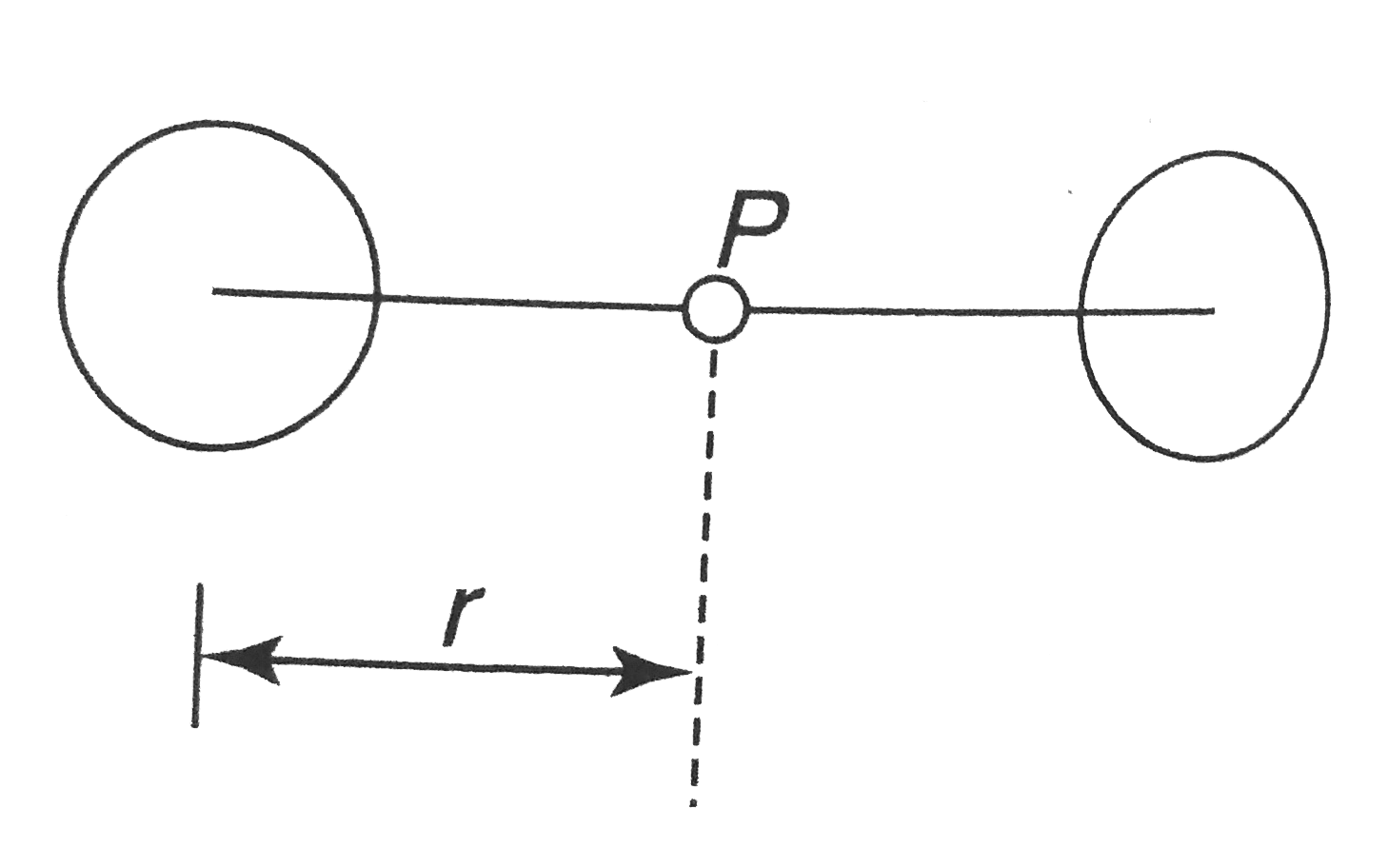
If a particles of mass `m` is projected with minimum velocity form the surface of a star with kinetic energy `(K_(1)GMm)/a` and potential energy at surface of the star `(K_(2)GMm)/a` towards the star of same mass `m` and radius `a` (`K_(1)` and `K_(2)` are constant) to reach the other star. Find the distance between the centre of the two stars:

A

`(2a)/((K_(2)-K_(1)))`

B

`(4a)/((K_(2)-K_(1)))`

C

`(2a)/((K_(1)-K_(2)))`

D

`(a)/((K_(1)-K_(2)))`

Text Solution

Verified by Experts

The correct Answer is:
B

Since the mass and radius of two stars are same, point `P` at which gravitational force will be equal, will be at equal distance (say `r`) from centre of each star. The particle should be projected to cross `P`, beyond which the particle will be attracted towards the other star.
`KE=PE` of body at `P` -PE at surface of the star
`(K_(1)GMm)/a=[-(GMm)/r-(GMm)/r]-[-K_(2) (GMm)/a]`
On solving, `r=(2a)/((K_(2)-K_(1)))2r=(4a)/((K_(2)-K_(1)))`
Promotional Banner

Topper's Solved these Questions

  • GRAVITATION

    A2Z|Exercise Assertion Reasoning|16 Videos
  • GRAVITATION

    A2Z|Exercise NEET Questions|42 Videos
  • GRAVITATION

    A2Z|Exercise Motion Of Satellite|33 Videos
  • GENERAL KINEMATICS AND MOTION IN ONE DIMENSION

    A2Z|Exercise Chapter Test|30 Videos
  • KINETIC THEORY OF GASES AND THERMODYNAMICS

    A2Z|Exercise Chapter Test|29 Videos

Similar Questions

Explore conceptually related problems

A particle of mass 'm' is projected with a velocity v = k V_e (k <1) from the surface of the earth.(Ve = escape velocity)The maximum height above the surface reached by the particle is:

A particle is projected from the surface of one star towards other star of same radius a and mass with such a minimum velocity Ksqrt((GM)/a) , so that it is attracted towards other star. Find the value of K if two stars are 2r distance apart:

If a particle of mass 'm' is projected from a surface of bigger sphere of mass '16M' and radius '2a' then find out the minimum velocity of the particle such that the particle reaches the surface of the smaller sphere of mass M and radius 'a'. Given that the distance between the centres of two spheres is 10 a.

Two stars bound together by gravity orbit othe because of their mutual attraction. Such a pair of stars is referred to as a binary star system. One type of binary system is that of a black hole and a companion star. The black hole is a star that has cullapsed on itself and is so missive that not even light rays can escape its gravitational pull therefore when describing the relative motion of a black hole and companion star, the motion of the black hole can be assumed negligible compared to that of the companion. The orbit of the companion star is either elliptical with the black hole at one of the foci or circular with the black hole at the centre. The gravitational potential energy is given by U=-GmM//r where G is the universal gravitational constant, m is the mass of the companion star, M is the mass of the black hole, and r is the distance between the centre of the companion star and the centre of the black hole. Since the gravitational force is conservative. The companion star and the centre of the black hole, since the gravitational force is conservative the companion star's total mechanical energy is a constant. Because of the periodic nature of of orbit there is a simple relation between the average kinetic energy ltKgt of the companion star Two special points along the orbit are single out by astronomers. Parigee isthe point at which the companion star is closest to the black hole, and apogee is the point at which is the farthest from the black hole. Q. For circular orbits the potential energy of the companion star is constant throughout the orbit. if the radius of the orbit doubles, what is the new value of the velocity of the companion star?

A particle of mass 'm' describes circular path of radius 'r' such that its kinetic energy is given by K = "as"^(2) . 's' is the distance travelled, 'a' is constant :

A particle of mass m_(0) is projected from the surface of body (1) with initial velocity v_(0) towards the body (2). As shown in figure find the minimum value of v_(0) so that the particle reaches the surface of body (2). Radius of body (1) is R_(1) and mass of body (1) is M_(1) . Radius body (2) is R_(2) and mass of the body (2) is M_(2) distance between te center the center of two bodies is D.

In a double star system, two stars of masses m_1 and m_2 separated by a distance x rotate about their centre of mass. Find the common angular velocity and Time period of revolution.

Two stars of masses m_(1) and m_(2) distance r apart, revolve about their centre of mass. The period of revolution is :

A2Z-GRAVITATION-Problems Based On Mixed Concepts
  1. If radius of the earth contracts to half of its present value without ...

    Text Solution

    |

  2. Find the escape velocity of particle of mass m which is situated at a ...

    Text Solution

    |

  3. If a particles of mass m is projected with minimum velocity form the s...

    Text Solution

    |

  4. The mass of a satellite is M//81 and radius is R//4 where M and R are ...

    Text Solution

    |

  5. The orbital velocity of a satellite at point B with radius r(B) and n....

    Text Solution

    |

  6. An asteroid of mass m is approaching earth, initially at a distance 10...

    Text Solution

    |

  7. A projectile rises upto a maximum height of R//(1-K^(2)) where K is a ...

    Text Solution

    |

  8. A particle is projected from the surface of one star towards other sta...

    Text Solution

    |

  9. Two stars of mass m(1) and m(2) are parts of a binary star system. Th...

    Text Solution

    |

  10. Binary stars of comparable masses rotates under the influence of each ...

    Text Solution

    |

  11. The ratio of cube of circumferences of the orbit of a satellite to th...

    Text Solution

    |

  12. Two planets revolve with same angular velocity about a star. The radiu...

    Text Solution

    |

  13. What would be the projections velocity of a satellite so that interste...

    Text Solution

    |

  14. A satellite in equatorial plane is rotating in the direction of earth'...

    Text Solution

    |

  15. A satellite is orbiting with areal velocity v(a). At what height form ...

    Text Solution

    |

  16. The magnitude of the gravitational field at distance r(1) and r(2) fro...

    Text Solution

    |

  17. A spherical planet has uniform density pi/2xx10^(4)kg//m^(3). Find out...

    Text Solution

    |

  18. A particle is projected from point A, that is at a distance 4R form th...

    Text Solution

    |

  19. Three identical stars, each of mass M, from an equilateral triangle (s...

    Text Solution

    |

  20. A satellite can be in a geostationary orbit around earth in an orbit o...

    Text Solution

    |

