Home
Class 11
PHYSICS
Two solid bodies of equal mass m initial...

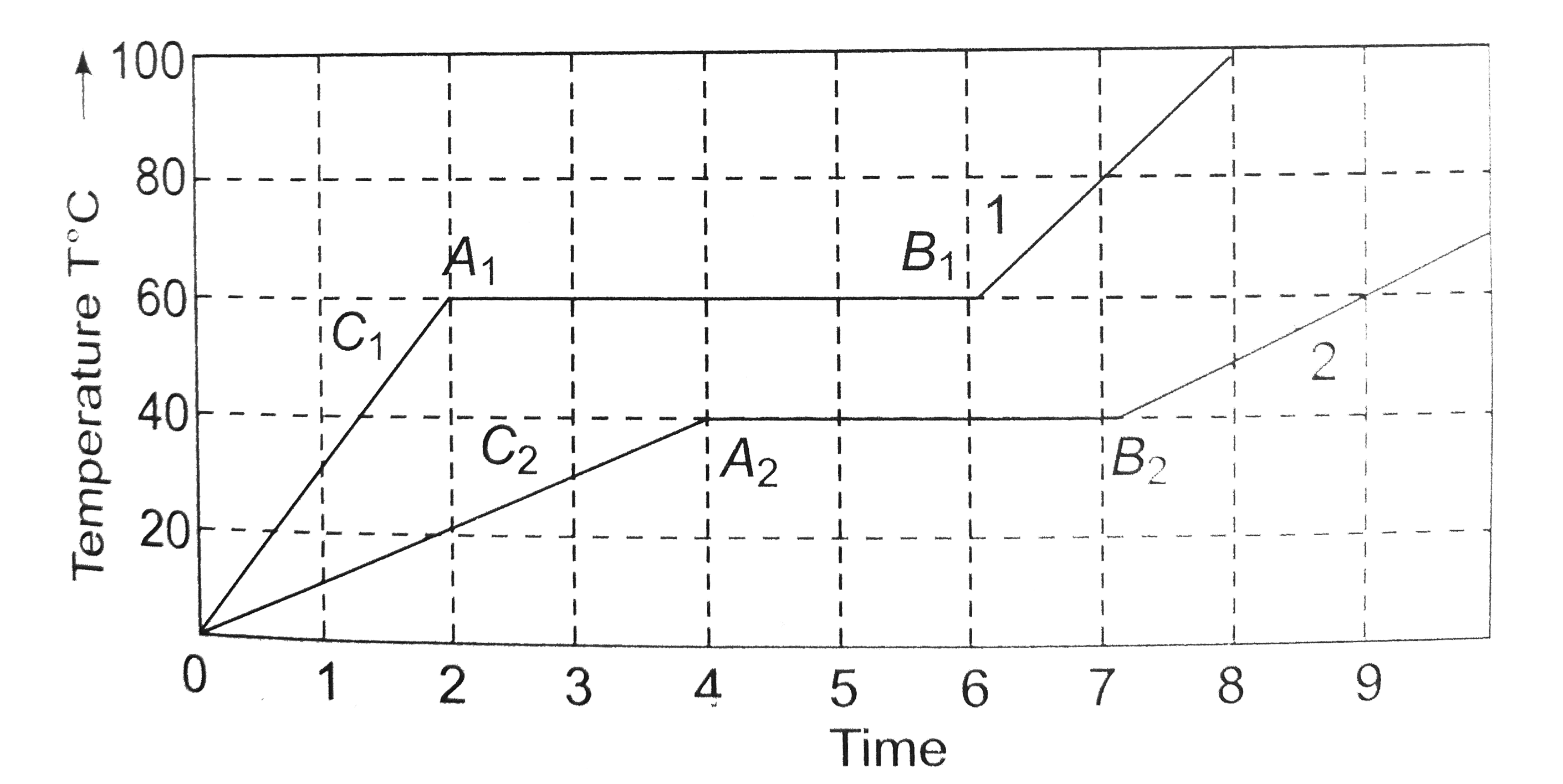
Two solid bodies of equal mass m initially at `T = 0^(@)C` are heated at a uniform and same rate under identical conditions. The temperature of the first object with latent heat `L_(1)` and specific heat capacity in solid state `C_(1)` changes according to graph `1` on the diagram. the temperature of the second object withe latent heat `L_(2)` and specific heat capacity in solid state `C_(2)` changes according to graph `2` on the diagram. based on what is shown on the graph, the latent heat `L_(1) and L_(2)` and the specific heat capacities `C_(1) and C_(2)` in solid state obey which of the following relationships?

A

`L_(1) gt L_(2), C_(1) lt C_(2)`

B

`L_(1) lt L_(2), C_(1) lt C_(2)`

C

`L_(1) gt L_(2), C_(1) gt C_(2)`

D

`L_(1) lt L_(2), C_(1) gt C_(2)`

Text Solution

Verified by Experts

The correct Answer is:

A

If heat is supplied at constant rate `P`, then `Q = P Delta tau` and as during change of state `Q = mL, so,mL = P Delta t`
i.e., `L = [P/m] Delta t = P/m` (length of line `AB`)
Hence `L_(1) gt L_(2)`
i.e., the ratio of latent heat of fusion of the two substances are in the ratio `3:4`
In the portion `OA` the substance is in solid state and its temperature is changing.
`Delta Q = mCDelta T` and ` Delta Q = P Delta t`
so, `(Deltat)/(Delta t) = (P)/(mC)` or slope = `(P)/(mS) = [ "as" (Delta T)/(Delta t)="slope" ]`
Hence, `C_(1) lt C_(2)`.
Promotional Banner

Topper's Solved these Questions

  • THERMAL PROPERTIES OF MATTER

    A2Z|Exercise Transmission Of Heat : Conduction|28 Videos
  • THERMAL PROPERTIES OF MATTER

    A2Z|Exercise Transmission Of Heat : Radiation|28 Videos
  • THERMAL PROPERTIES OF MATTER

    A2Z|Exercise Chapter Test|30 Videos
  • ROTATIONAL DYNAMICS

    A2Z|Exercise Chapter Test|29 Videos
  • UNIT, DIMENSION AND ERROR ANALYSIS

    A2Z|Exercise Chapter Test|28 Videos

Similar Questions

Explore conceptually related problems

Two bodies of equal masses are heated at a uniform rate under identical conditions. The change in temperature in the two cases is shown graphically. The ratio of their specific heats in the solid state is

Two bodies of equal masses are heated at a uniform rate under identical conditions. The change in temperature in the two cases in shown graphically. What are their melting points? Find the ratio of their specific heats and latent heats.

Two different metal bodies A and B of equal mass are heated at a uniform rate under similar conditions. The variation of temperature of the bodies is graphically represented as shown in the figure. The ratio of specific heat capacities is :

Write the symbol for specific heat capacity . State the units of specific heat capacity.

Two bodies of equal mass m are heated at a uniform rate under identical condition. Their change in temperature are shown. Then (i) The ratio of melting point of the substances is 1.5 (ii) the ratio of their latent heats is 0.75 (iii) the ratio of specific heat of two substances is 0.33 in solid state (iv) the ratio of specific heat of two substances is 2 in liquid state.

Define specific latent heat of melting and specific latent heat of vaporization.

Victoria falls is 68m high wht is the change in temperature of a drop if it falls that height if specific heat capacity is 1 cal/g deg C.

Two bodies of different materials but of equal mass are heated at uniform rate under identical conditions from 0^(@)C one body start melting at 60^(@)C after heating for 2 minutes while the other start melting at 40^(@)C after heating for 4 minutes. the ratio of their specific heats is

A2Z-THERMAL PROPERTIES OF MATTER-Calorimetry
  1. Equal masses of ice and water with temperature equally below and above...

    Text Solution

    |

  2. A thermal insulated vessel contains some water at 0^(@)C. The vessel i...

    Text Solution

    |

  3. Two solid bodies of equal mass m initially at T = 0^(@)C are heated at...

    Text Solution

    |

  4. A solid ball of mass 10 kg at 40^(@)C is gently placed in a liquid of ...

    Text Solution

    |

  5. An ice block at 0^(@)C is dropped from height 'h' above the ground. Wh...

    Text Solution

    |

  6. The mass, specific heat capacity and the temperature of a solid are 10...

    Text Solution

    |

  7. Four cubes of ice at -10^(@)C each one gm is taken out from the refrig...

    Text Solution

    |

  8. 20 gm ice at -10^(@)C is mixed with m gm steam at 100^(@)C. The minimu...

    Text Solution

    |

  9. The amount of heat supplied to decrease the volume of an ice water mix...

    Text Solution

    |

  10. Water of mass m(2) = 1 kg is contained in a copper calorimeter of mass...

    Text Solution

    |

  11. An ice block at 0^(@)C and of mass m is dropped from height 'h' such t...

    Text Solution

    |

  12. 4 gm of steam at 100^(@)C is added to 20 gm of water at 46^(@)C in a c...

    Text Solution

    |

  13. What is the change in potential energy (in calories) of a 10 kg mass a...

    Text Solution

    |

  14. 1 kg ice at -20^(@)C is mixed with 1 kg steam at 200^(@)C. The equilib...

    Text Solution

    |

  15. The ratio of the densities of the two bodies is 3:4 and the ratio of s...

    Text Solution

    |

  16. A 10 kW drilling machine is used to drill a bore in a small aluminium ...

    Text Solution

    |

  17. A geyser heats water flowing at the rate of 3.0 liter per minute from ...

    Text Solution

    |

  18. When 0.400 kg of water at 30^(@)C is mixed with 0.150 kg of water at 2...

    Text Solution

    |

  19. A copper calorimeter of mass 1.5 kg has 200 g of water at 25^(@)C. How...

    Text Solution

    |

  20. A copper block of mass 2.5 kg is heated in a furnace to a temperature ...

    Text Solution

    |
