Home
Class 11
PHYSICS
Two circular disc A and B with equal rad...

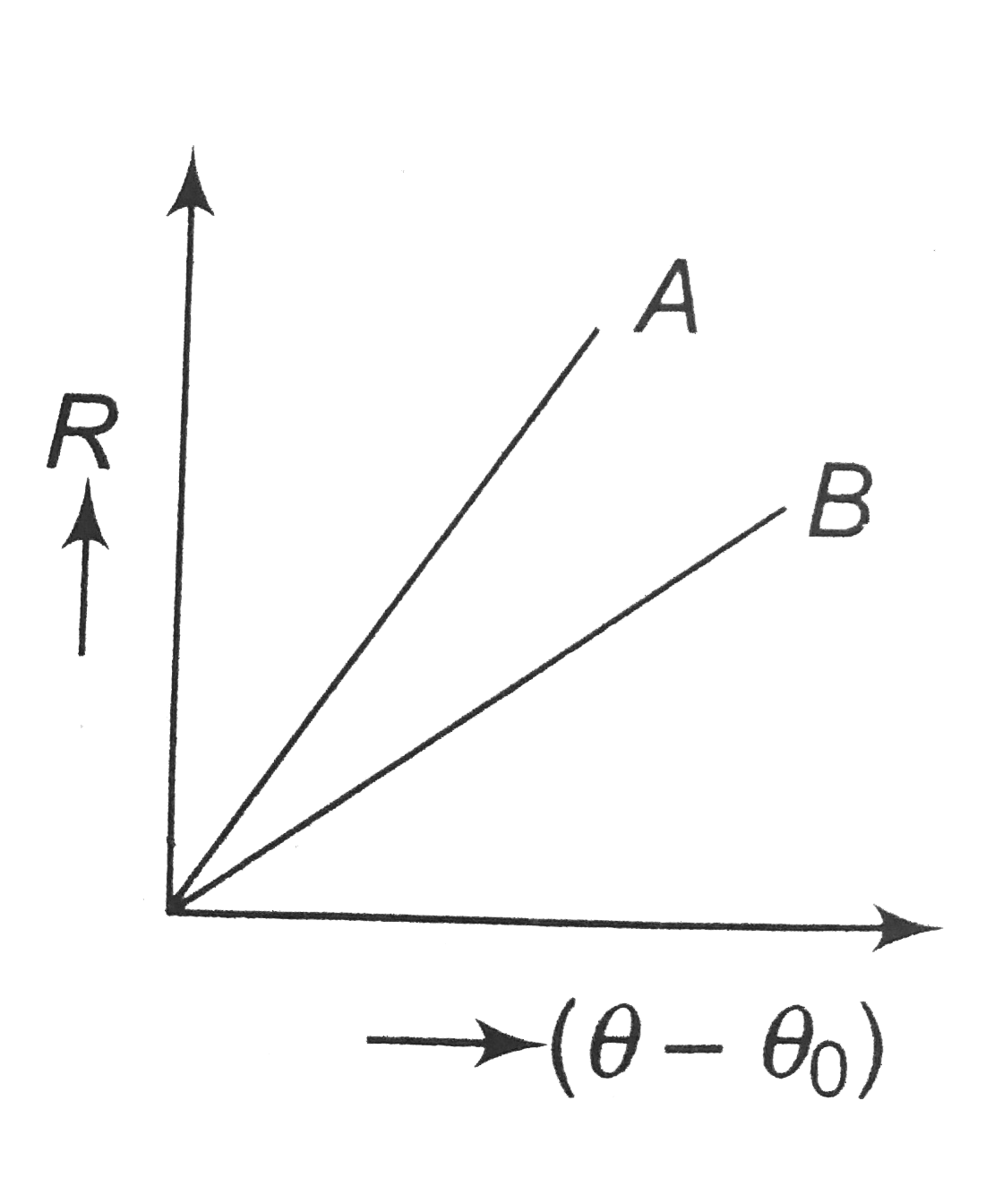
Two circular disc `A` and `B` with equal radii are blackened. They are heated to same temperature and are cooled under identical conditions. What inference do your draw from their cooling curves?

A

A and B specific heat

B

Specific heat of A is less

C

Specific heat of B is less

D

Nothing can be said

Text Solution

Verified by Experts

The correct Answer is:

B

When a body cools by radiation, the rate of cooling is given by:
`(d theta)/(dt) = (eAsigma)/(ms) (theta^(4)-theta_(0)^(4))`
`-ve` sign shown that temperature decreases, i.e., the body cools, is the specific heat of materail and `theta_(0)` is teh surrounding temperature
or, `(d theta)/(dt) prop 1/s`
i.e., rate of cooling `(R = d theta//dt)` is inversely proportional to the specific heat of material. for a, rate of cooling is large, therefore, specific heat of `A` is smaller.
Promotional Banner

Topper's Solved these Questions

  • THERMAL PROPERTIES OF MATTER

    A2Z|Exercise Problems Baesd On Mixed Concepts|18 Videos
  • THERMAL PROPERTIES OF MATTER

    A2Z|Exercise Assertion Reasoning|21 Videos
  • THERMAL PROPERTIES OF MATTER

    A2Z|Exercise Transmission Of Heat : Conduction|28 Videos
  • ROTATIONAL DYNAMICS

    A2Z|Exercise Chapter Test|29 Videos
  • UNIT, DIMENSION AND ERROR ANALYSIS

    A2Z|Exercise Chapter Test|28 Videos

Similar Questions

Explore conceptually related problems

Two solid spheres of radii R_(1) and R_(2) are made of the same material and have similar surfaces. These are raised to the same temperature and then allowed to cool under identical conditions. The ratio of their initial rates of loss of heat are

Two solid spheres of radii 5cm and 3cm are made of same material and have similar surface. The spheres are raised to the same temperature and then allowed to cool under identical conditions. The ratio of rate of fall of temperature is

Two solid spheres of radii R_(1) and R_(2) are made of same material and have similar surface. The spheres are raised to the same temperature and then allowed to cool under identical conditions. Assuming spheres to be perfect conductors of heat, their initial ratio of rates of loss of heat is:

A solid copper cube and sphere, both of same mass & emissivity are heated to same initial temperature and kept under identical conditions. What is the ratio of their initial rate of fall of temperature ?

A cube and a sphere of equal edge and radius, made of the same substance are allowed to cool under identical conditions. Determine which of the two will cool at a faster rate.

Two solid spheres, one of aluminium and the other of copper, of twice the radius are heated to the same temperature and are allowed to cool under the identical conditions. Given that specific heat of aluminium is 900 J//kg K and that ofcopper is 390 J//kg K. Specific gravity of aluminium and copper are 2.7 and 8.9 respectively. initial rates of fall of temperature, and the initial rates of loss of heat

A cube, sphere and a cylinder made of same material shown in figure are allowed to cool under identical conditions. Determine which of these will cool at a faster rate? .

A sphere, a cube and a circular disc, made of same material and of same mass are heated to same temperature and placed in same surrounding. Which one will have fastest rate of cooling and which one will have slowest ?

A2Z-THERMAL PROPERTIES OF MATTER-Transmission Of Heat : Radiation
  1. The emission spectrum of a black body at two different temperatures ar...

    Text Solution

    |

  2. By virtue of some internal mechanism, temperature of spherical shell i...

    Text Solution

    |

  3. A calorimeter of mass 0.2 kg and specific heat 900 J//kg-K. Containing...

    Text Solution

    |

  4. It takes 10 min to cool a liquid from 61^(@)C to 59^(@)C. If room temp...

    Text Solution

    |

  5. The initial temperature of a body is 80^(@)C. If its temperature falls...

    Text Solution

    |

  6. Two circular disc A and B with equal radii are blackened. They are hea...

    Text Solution

    |

  7. A blackbody is at a temperature of 2880K. The energy of radiation emi...

    Text Solution

    |

  8. The radiation emitted by a star A is 1000 times that of the sun. If th...

    Text Solution

    |

  9. A planet radiates heat at a rate proportional to the fourth power of i...

    Text Solution

    |

  10. When the temperature of a black body increases, it is observed that th...

    Text Solution

    |

  11. The maximum energy is the thermal radiation from a hot source occurs a...

    Text Solution

    |

  12. A body cools from 50^@C to 49^@C in 5 s. How long will it take to cool...

    Text Solution

    |

  13. The rate of cooling at 600 K. If surrounding temperature is 300 K is H...

    Text Solution

    |

  14. A rectangular body has maximum wavelength lambda(m) at 2000 K. Its cor...

    Text Solution

    |

  15. A black body radiated maximum energy around a particular wavelength at...

    Text Solution

    |

  16. A sphere of 3 cm radius acts like a black body. If it is in equilibriu...

    Text Solution

    |

  17. The thermal emissivitites of two bodies A and B are in the ratio of 1/...

    Text Solution

    |

  18. The graph, shown in the adjacent diagram, represents the variation of ...

    Text Solution

    |

  19. Three discs, A, B and C having radii 2m, 4m and6m respectively are coa...

    Text Solution

    |

  20. Variation of radiant energy emitted by sun, filament of tungsten lamp ...

    Text Solution

    |
