Home
Class 11
PHYSICS
S(1) and S(2) are two coherent sources o...


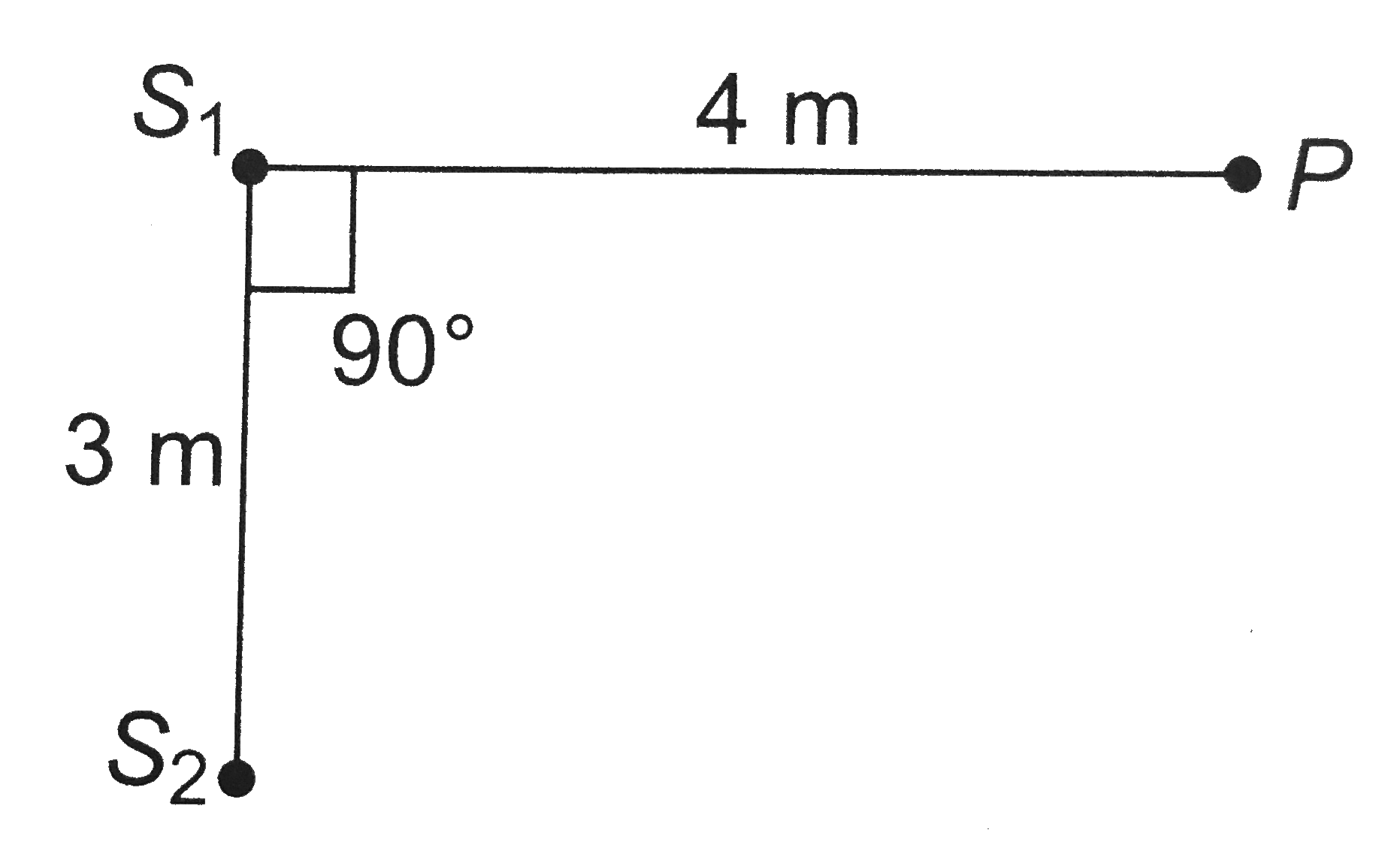
`S_(1)` and `S_(2)` are two coherent sources of sound of frequency `110Hz` each they have no initial phase difference. The intensity at a point P due to `S_(1)` is `I_0` and due to `S_2` is `4I_0`. If the velocity of sound is `330m//s` then the resultant intensity at P is

A

`I_0`

B

`9I_0`

C

`3I_0`

D

`8I_0`

Text Solution

Verified by Experts

The correct Answer is:

C

The wavelength of sound source`=(330)/(110)=3` metre.
The phase difference between interfering waves at P is
`=Delta phi=(2pi)/(lamda)(S_2P-S_1P)=(2pi)/(3)(5-4)=(2pi)/(3)`
`:.` Resultant intensity at
`P=I_0+4I_0+2sqrt(I_0)sqrt(4I_0)cos(2pi)/(3)=3I_0`
Promotional Banner

Topper's Solved these Questions

  • WAVES AND ACOUSTICS

    A2Z|Exercise Beats|20 Videos
  • WAVES AND ACOUSTICS

    A2Z|Exercise Stationary Waves|20 Videos
  • WAVES AND ACOUSTICS

    A2Z|Exercise Equation And Energy Of Progressive Wave|16 Videos
  • VECTORS

    A2Z|Exercise Chapter Test|29 Videos
  • WORK, ENERGY, POWER AND COLLISION

    A2Z|Exercise Chapter Test|29 Videos

Similar Questions

Explore conceptually related problems

Light waves from two coherent sources having intensities I and 2I cross each other at a point with a phase difference of 60^(@) . The intensity at the point will be

If the lengths of a closed rogan pipe is 1.5m and velocity of sound is 330m/s, then the frequency for the second note is

S_1 and S_2 are two coherent sources of sound having no initial phase difference. The velocity of sound is 330m//s . No minimal will be formed on the line passing through S_2 and perpendicular to the line jouning S_1 and S_2 . If the frequency of both the sources is:

S_(1) and S_(2) are two coherent sources of sound having no intial phase difference. The velocity of sound is 330 m//s . No maximum will be formed on the line passing through S_(2) and prependicular to the line joining S_(1) and S_(2) . If the frequency of both the sources is

S_(1) and S_(2) are two coherent sources. The intensity of both sources are same. If the intensity at the point of maxima is 4Wm^(-2) , the intensity of each source is

In the figure the intensity of waves arriving at D from two coherent sources S_1 and S_2 is I_0 The wavelength of the wave is lamda=4m . Resultant intensity at D will be:

Consider an interference arrangement similar to YDSE. Slits S_(1) and S_(2) are illuminated with coherent microwave sources each of frequency 2 MHz. The sources are synchronised to have zero phase difference. The slits are separated by distance d= 75m. The intensity I_((theta)) is measured as a function of theta where theta is defined as shown in figure. if I_(0) is maximum intensity then calculated I_((theta)) for (i) theta= 0^(@), (ii) theta=pi//6 and (iii) theta = pi//2

In the figure , the intensity of waves arriving at D from two coherent soucrces s_(1) and s_(2) is I_(0) . The wavelength of the wave is lambda = 4 m . Resultant intensity at D will be

In an interference arrangement similar to young's double slit experiment the slits S_(1) and S_(2) are illuminated with coherent microwave sources each of frequency 10^(6)Hz the sources are synchronized to have zero phase difference. the slits are separated by a distance d=150.0m. The intensity I(theta) is measured as a funtion of theta , where theta is defined as shown. if I_(0) is the maximum intensity then I(theta) for 0lethetale90^(@) is given by:

In an interference arrangement similar to double-slit experiment, S_(1) and S_(2) are illuminated with coherent source microwave source each of frequency 1 MHz. the sources are synchronized to have zero phase difference . This slits are separated by distance d = 150.0m The intensity I (theta) is measured as a funciton of theta , where theta is defined as shown in figure. If I_(0) is maximum intensity, calculate I (theta) For : a. theta = 0 b. theta = 30^(@) c. theta = 90^(@)

A2Z-WAVES AND ACOUSTICS-Superposition And Interference
  1. Out of given four waves (1),(2),(3) and (4) y=asin(kx+omegat) ..(1)...

    Text Solution

    |

  2. Equation of motion in the same direction is given by y1=Asin(omegat-kx...

    Text Solution

    |

  3. The amplitude of a wave represented by displacement equation y=(1)/(sq...

    Text Solution

    |

  4. Two waves having equations x1=asin(omegat+phi1), x2=asin(omegat+phi...

    Text Solution

    |

  5. A wave travels on a light string. The equation of the wave is Y = A si...

    Text Solution

    |

  6. In a large room, a person receives direct sound waves from a source 12...

    Text Solution

    |

  7. Two speakers connected to the same source of fixed frequency are place...

    Text Solution

    |

  8. Two loudspeakers L1 and L2 driven by a common oscillator and amplifier...

    Text Solution

    |

  9. Two pulses travel in mutually opposite directions in a string with a s...

    Text Solution

    |

  10. Two pulses are travelling along a string in opposite directions toward...

    Text Solution

    |

  11. There are 10 sound sources each producing intensity I at a point indep...

    Text Solution

    |

  12. Two coherent sources of different intensities send waves which interf...

    Text Solution

    |

  13. A string fixed at both ends has consecutive standing wave modes for wh...

    Text Solution

    |

  14. When a wave pulse travelling in a string is reflected from rigid wall ...

    Text Solution

    |

  15. S(1) and S(2) are two coherent sources of sound of frequency 110Hz eac...

    Text Solution

    |

  16. In the figure the intensity of waves arriving at D from two coherent s...

    Text Solution

    |

  17. Two interfering waves have intensities in the ratio 9:1. Then the rati...

    Text Solution

    |

  18. The difference of loudness in decibels (dB) between maximum and minimu...

    Text Solution

    |

  19. The wavelength of the waves arriving at P from two coherent sources S1...

    Text Solution

    |

  20. S1 and S2 are two coherent sources of sound having no initial phase di...

    Text Solution

    |
