Home
Class 11
PHYSICS
An object has a uniformly acclerated mot...

An object has a uniformly acclerated motion. The object always slows down before the time, when its velcity becomes zero. Establish this statement graphiclly when (i) both initial veocity (u) and acceleration (a) are positive(iii) 9u) is positive and (a) is begative and (iv) both (u) and (a) are negativ e.

Text Solution

Verified by Experts
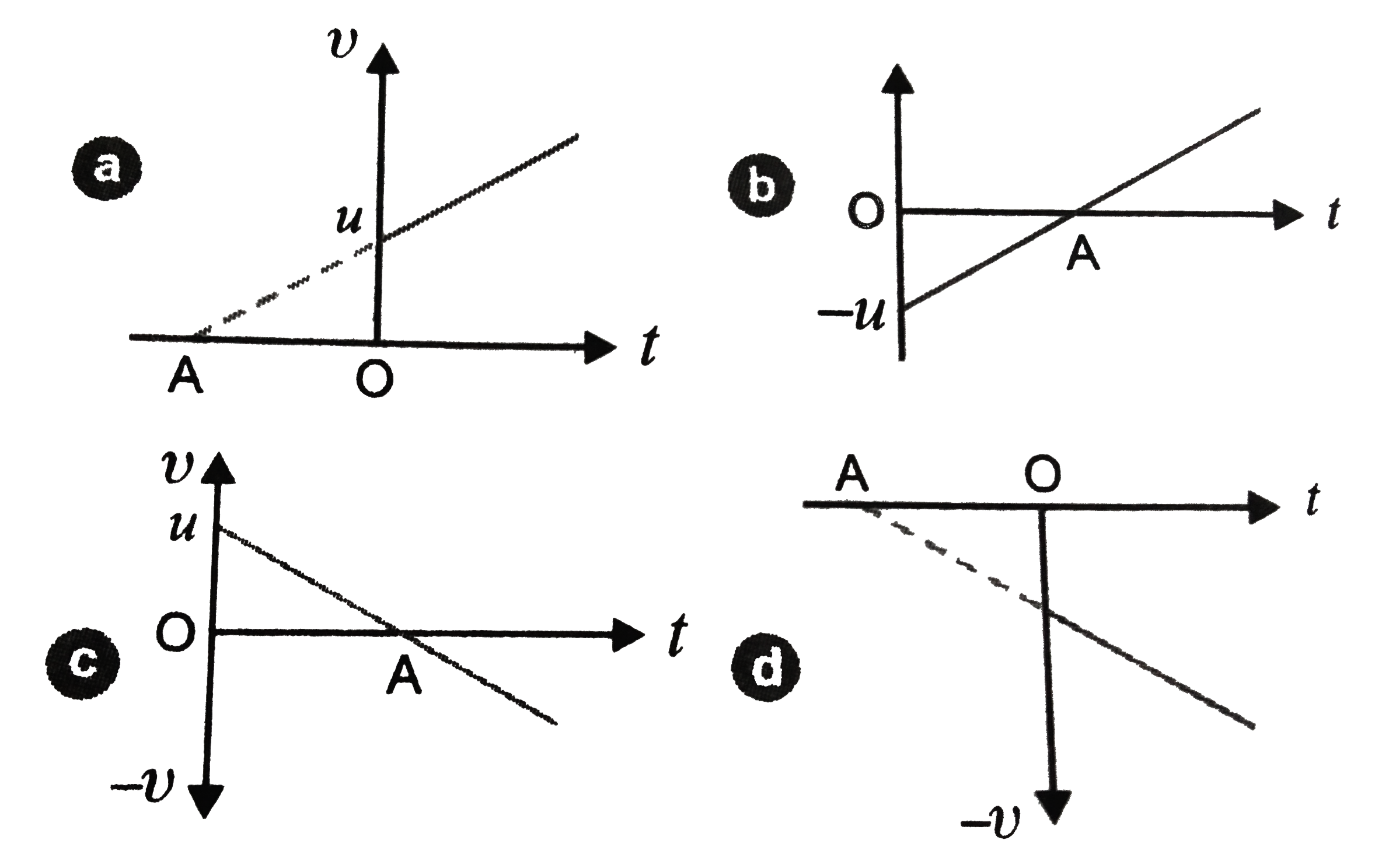
(i) When both (u) and (a) are positive. In this case, the ` v-t` graph is a straight line as shoen in Fig. 2 (b). 22 (a). In this graph at the time corresponding to point (A), velocity of object becomes zero, From the graph it si clear that before the time corrsponing to point (A), the velcity is negative but its begative magnitude decrease with time till it becomes zero at point (A).
.
(ii) When (u) is negative and (a) is positive, In this case, the `v-t` graph is a straight line as shown in Fig. 2 (b) 22 (b). At the time, corresponding to point (A). the velocity becomes zero. From the graph it is clear that before this time, the velocity is negative but irs begative magnitude decreases with time till it becomes zero at point (A).
(iii) When (u) is potive and (a) is negative. Inthis case, the ``v-t` graph is a straight line shown in Fig. 2 (b) .22 (c ).` At the time corresponding to point (A) velocity is zero. From graph it is clear that before this time, corresponding to point (A) the velocity dereases.
(iv) When both (u) and (a) are negative. In this case the ` v-t` graph is a straight line shown in Fig. 2 (b).22 (d) . If we produce his straight line graph backwards, it meets the time axis at point (A) for which velcity is zero. Before this time velocity is positive and dereases till it becomes zero at point (A).
Promotional Banner

Topper's Solved these Questions

  • KINEMATICS

    PRADEEP|Exercise 3 Con ceptual Problems|27 Videos
  • KINEMATICS

    PRADEEP|Exercise 4 Conceptual Problems|1 Videos
  • KINEMATICS

    PRADEEP|Exercise 1 Con ceptual Problems|14 Videos
  • GRAVIATION

    PRADEEP|Exercise Assertion-Reason Type Questions|19 Videos
  • LAWS OF MOTION

    PRADEEP|Exercise Assertion- Reason Type Questions|17 Videos

Similar Questions

Explore conceptually related problems

Statement 1 : An object thrown vertically up with a velocity u reaches the maximum height h after T seconds. At a time 2T seconds its velocity becomes zero. Statement 2: An object thrown vertically up with a velocity comes back to its initial position with same magnitude of velocity but in opposite direction.

A player throwsa a ball upwards with an initial speed of 29.4 ms^(-1) . (i) What is the direction of acceleration during the upwared motion of the ball? (ii) What are the velocity and acceleration of the ball at the highest point of its motion? (iii) Choose the x=0 and t=0 to be the location and time of the ball at its highest point, vertically downward direction to be the positive direction of X-axis, and give the signs of positive, velocity and acceleration of the ball during its upward, and downward motion. (iv) To what height does the ball rise and after how long does the ball return to the player's hand?( Take g =9.8 ms^(-2) , and neglect air resistance).

A physics teacher explains to his students in class, the subject of motion under gravity. When a body is project upwards from the ground with a certain velicity u, the velocity goes on decreasing at a constant rate due to gravitational pill of earth. At a certain height, this velocity becomes zero. the body cannot rise futher. from this maximum height, the body begins to fall and its velocity goes on increasing at the same constant rate due to gravitational pull of earth. the body would strike the ground with exactly the same velocity (v=u) , with which it was thrown initially. this is on the assumption that resistance due to air is zero,either way. Read the above passage and answer the following quetion: (i) why is velocity of body on striking the ground the same as intial velocity of projection of the body? (ii) Does the body take same time to fall to ground as the time it takes to reach the maximum height? (iii) What value of life of life do you learn from this breif study ?

The displacement x of a particle varies as sqrt(x)=t-2 (i) What is the velocity and acceleration of the particle at t=0? (ii) When will the velocity of the particle become zero? (iii) What is the displacement of the particle when its velocity is zero? (iv) Is the motion of the particle uniformly accelerated or not?

A situation is shown in which two objects A and B start their motion from same point in same direction. The graph of their velocities against time is drawn. u_A and u_B are the initial velocities of A and B respectively. T is the time at which their velocities become equal after start of motion. You cannot use the data of one question while solving another question of the same set. So all the questions are independent of each other. 7. After 10 s of the start of motion of both objects A and B, find the value of velocity of A if u_A = 6 ms^-1 , u_B = 12 ms^-1 and at T velocity of A is 8 ms^-1 and T = 4s

An object is moving along a straight line path with a uniform accleration of 4 ms^"(-2) . Intitially its lociation is at 5 ms and velcity is 3 ms^(-1) . ltbRgt (i) What will be position and the velocity of object at time t=3 s? (ii) What will be the position of the object when it has attained a velcotiy 8 ms^(-1) ?

