Home
Class 11
PHYSICS
A particle slides down a frictionless pa...

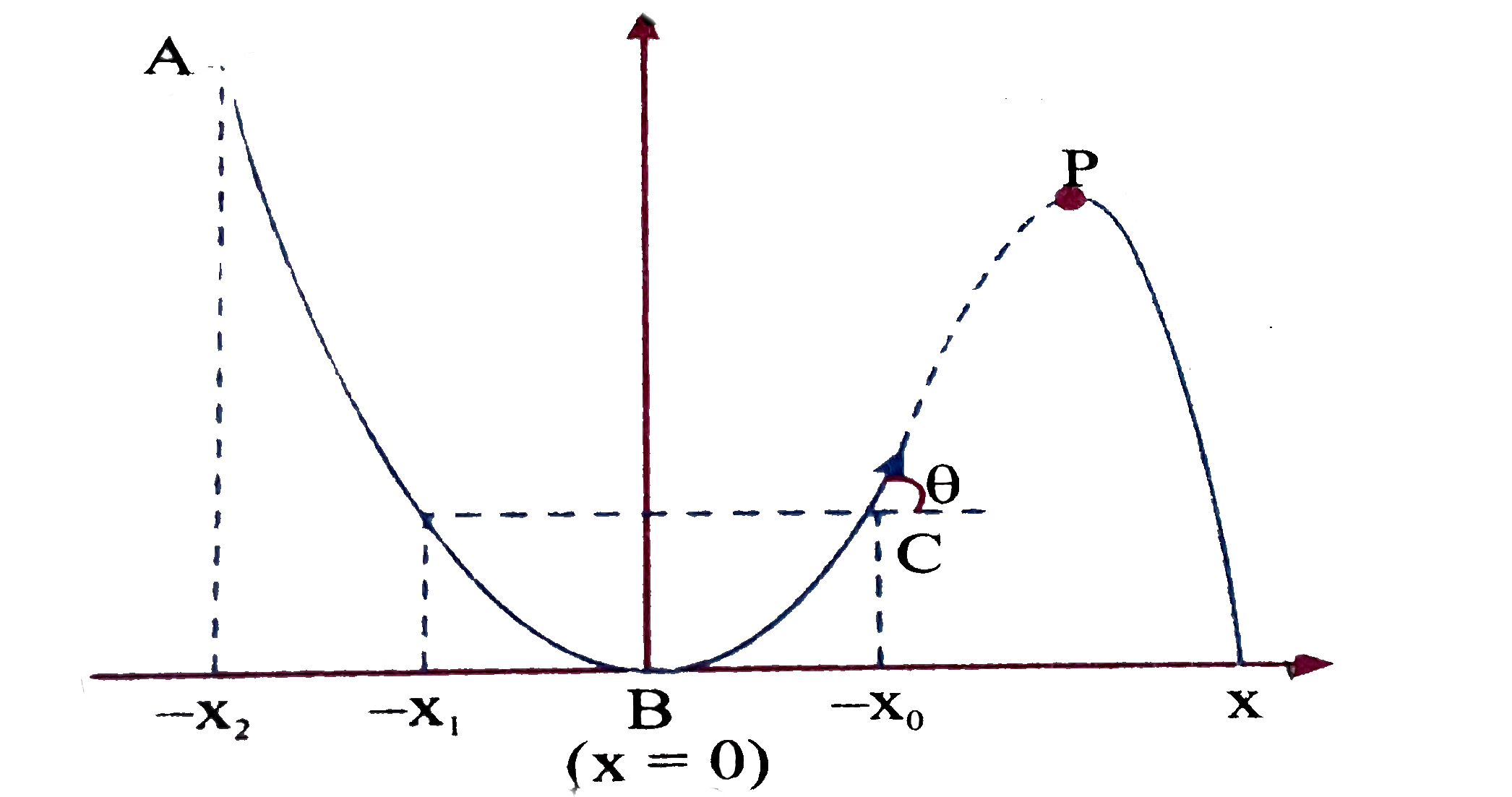
A particle slides down a frictionless paraboli `(y=x^(2))` track `(A-B-C)` starting from rest at point `A`.Point `B` is at the vertex of parabola and point `C` is at a height less than that of point `A`.After `C`,the particle moves freely in air as a projectile. If the particle reaches highest point at `P`,then

A

(a) KE at ` P = KE at B`

B

(b) height at ` P = height at (A)

C

(c ) total eneragy at ` P = total eneragy at (A)`

D

(d) time of travel from ` A` oto ` B = time of travel from (B) tp (P).

Text Solution

Verified by Experts

The correct Answer is:

C

Since ` y= x^2` , the motion is in two dimensions as shown in figure. Velocity at (B) greater than at (P) . In the given motion of a particle, the law of conservation of energy . Therefore, total energy at ` P=` total eneragy at (A). As vertical distance ` ABgt BP`, time of travel from (A) to (B) is greater than that from (B) to (P).
Promotional Banner

Topper's Solved these Questions

  • KINEMATICS

    PRADEEP|Exercise 3 NCERT multiple|161 Videos
  • KINEMATICS

    PRADEEP|Exercise 4 NCERT multiple Choice|10 Videos
  • KINEMATICS

    PRADEEP|Exercise 1 NCERT multiple|11 Videos
  • GRAVIATION

    PRADEEP|Exercise Assertion-Reason Type Questions|19 Videos
  • LAWS OF MOTION

    PRADEEP|Exercise Assertion- Reason Type Questions|17 Videos

Similar Questions

Explore conceptually related problems

A particle (m = 3 kg) slides down a frictionless track (AOC) starting from rest at a point A (height 2m). After reaching C, the particle continues to move freely in air as a projectile. When it reaching its highest point P (height 1.5 m) the kinetic energy of the prarticle (in J) is : Figure drawn is schematic and not to scale , take g = 10 ms^(-2)

A particle of mass m slides on a frictionaless surface ABCD, starting from rest as shown in figure. The part BCD is a circular arc. If it looses contact at point P, the maximum height attained by the particle from point C is

A particle (m = 2 kg) slides down a smooth track AOC starting from rest at point A (height = 5m). After reaching point C (height =1m), the particle continues to move freely in air as a projectile. The particle velocity at point C is at angle 60^(@) with the horizontal. The maximum height attained by particle after leaving point C is _____(in m). [figure drawn is schematic and hot to scale : take =ms^(-2) ]

A particle (m = 1kg) slides down a frictionless track (AOC) starting from rest at a point A (height 2m). After reaching C, the particle continues to move freely in air as a projectile. When it reaches point C (height 1 m), the vertical speed of the particle (in m/s) is (Figure drawn is schematic and not to scale , take g = 9.8 m/ sec^(2) ) [Take ]

Velocity of a particle varies with time as v=athati+2ht^(2)hatj . If the particle starts from point (0,c) , the trajectory of the particle is

In the illustration 1 if the particle shifts from Points P to points C find the displacement of the particle.

A particle is given velocity v_0 at point A as shown in the figure. Find the speed of particle at point B,C and D

Normal to the parabola y^(2)=8x at the point P(2,4) meets the parabola again at the point Q . If C is the centre of the circle described on PQ as diameter then the coordinates of the image of point C in the line y=x are

A particle starts from point A moves along a straight line path with an acceleration given by a = p - qx where p, q are connected and x is distance from point A . The particle stops at point B. The maximum velocity of the particle is

A particle moves on a path as shown. The particle takes 10 seconds in going from starting point to the final point. What is the average velocity vector of the particle ?
