Home
Class 11
PHYSICS
Consider the decay of a free neutron at ...

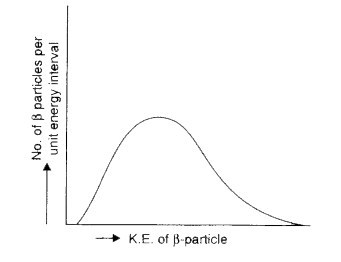
Consider the decay of a free neutron at rest: n`top+e^(-)` Show that the tow-body dacay of this type must necessarily give an electron of fixed energy and, therefore, cannot for the observed continous energy distribution in the `beta`-decay of a neutron or a nucleus.

Text Solution

Verified by Experts

In the decay process, `nrarr p+e`
energy of electron is equal to `(Delta m)c^(2)`
where`Deltam=` mass defect `=` mass of neutron `-` mass of proton and electron ,
which is fixed. Therefore, two body decay of this type cannot explain the observed continuous energy distribution in the `beta-` decay of a neutron in a nucleus.
Promotional Banner

Topper's Solved these Questions

  • WORK, ENERGY AND POWER

    PRADEEP|Exercise Additional Exercises|3 Videos
  • WORK, ENERGY AND POWER

    PRADEEP|Exercise higher order thinking skills|10 Videos
  • WORK, ENERGY AND POWER

    PRADEEP|Exercise Advanced Problems For Competitions|20 Videos
  • THERMODYNAMICS

    PRADEEP|Exercise Assertion- Reason Type Questions|19 Videos

Similar Questions

Explore conceptually related problems

Draw the graph showing distribution of kinetic energy of electrons emitted during beta decay.

STATEMENT-1 : In the decay of a free neutron at rest, into a proton and electron, it has been predicated that a third particle must also be emitted because the emitted electrons do not have a definite kinetic energy. and STATEMENT-2 : For the simple decay of a stationary particle into two moving particles, the kinetic energies of the particle must have a sharply defined value.

Before the neutrino hypothesis the beta decay process was throught to be the transition. n to p+bar(e) If this was true show that if the neutron was at rest the proton and electron would emerge with fixed energies and calculate them. Experimentally the electron energy was found to have a large range.

The beta -decay process, discovered around 1900 , is basically the decay of a neutron (n) , In the laboratory, a proton (p) and an electron (e^(-)) are observed as the decay products of the neutron. Therefore, considering the decay of a neutron as a tro-body dcay process, it was observed that the electron kinetic energy has a continuous spectrum. Considering a three-body decay process i.e., n rarr p + e^(-)+overset(-)v_(e ) , around 1930 , Pauli explained the observed electron energy spectrum. Assuming the anti-neutrino (overset(-)V_(e )) to be massless and possessing negligible energy, and neutron to be at rest, momentum and energy conservation principles are applied. From this calculation, the maximum kinetic energy of the electron is 0.8xx10^(6)eV . The kinetic energy carried by the proton is only the recoil energy. What is the maximum energy of the anti-neutrino?

The beta -decay process, discovered around 1900 , is basically the decay of a neutron (n) , In the laboratory, a proton (p) and an electron (e^(-)) are observed as the decay products of the neutron. Therefore, considering the decay of a neutron as a tro-body dcay process, it was observed that the electron kinetic energy has a continuous spectrum. Considering a three-body decay process i.e., n rarr p + e^(-)+overset(-)v_(e ) , around 1930 , Pauli explained the observed electron energy spectrum. Assuming the anti-neutrino (overset(-)V_(e )) to be massless and possessing negligible energy, and neutron to be at rest, momentum and energy conservation principles are applied. From this calculation, the maximum kinetic energy of the electron is 0.8xx10^(6)eV . The kinetic energy carried by the proton is only the recoil energy. If the anti-neutrino has a mass of 3eV//c^(2) (where c is the speed of light) instead of zero mass, what should be the range of the kinetic energy, K of the electron?

One of the fundamental laws of physics is that matter is most stable with the lowest possible energy. Thus, the electron in a hydrogen atom usually moves in the n=1 orbit, the orbit in which it has the lowest energy. When the electon is in this lowest energy orbit, the atom is said to be in its ground electronic state. If the atom receives energy from an outside source, it is possible for the electron to move ot an orbit with a higher n value, in which case the atoms is in an excited state with a higher energy. The law of conservation of energy says that we cannot create or destroy energy. Thus, if a certain amount of external energy is required to excite an electron from one energy level to another, then that same amount of energy will be liberated when the electron returns to its initial state. Lyman series is observed when the electron returns to the lowest orbit while Balmer series is formed when the electron returns returns to second orbit. Similarly, Paschen, Brackett and Pfund series are formed when electrons returns to the third, fourth and fifth orbits from higher energy orbits respectively. When electrons return form n_(2) " to " n_(1) state, the number of lines in the spectrum will equal to ((n_(2)-n_(1))(n_(2)-n_(1)+1))/(2) If the electon comes back from energy level having energy E_(2) to energy level having energy E_(1) , then the difference may be expressed in terms of energy of photon as : E_(2)-E_(1)=DeltaE, deltaE implies (hc)/(lambda) Since, h and c are constant, deltaE corresponds to definite energy. Thus, each transition from one energy level to another will produce a radiatiob of definite wavelength. This is actually Wave number of a spectral line is given by the formula barv=R((1)/(n_(1)^(2))-(1)/(n_(2)^(2))) . where R is a Rydberg's constant (R=1.1xx10^(7) m^(-1)) An electron in H-atom in M-shell on de-excitation to ground state gives maximum ........... spectrum lines.

PRADEEP-WORK, ENERGY AND POWER-NCERT EXERCISES WITH SOLUTIONS
  1. A body constrained to move along the z-axis of a co-ordinate system, i...

    Text Solution

    |

  2. An electron and a proton are detected in a cosmic ray experiment, the ...

    Text Solution

    |

  3. A rain drop of radius 2mm, falls from a height of 500 m above the grou...

    Text Solution

    |

  4. A molecules in a gas container hits the wall with speed 200m//s at an ...

    Text Solution

    |

  5. A pump on the ground floor of a building can pump of water to fill a ...

    Text Solution

    |

  6. Two identical ball bearings in contact with each other and resting on ...

    Text Solution

    |

  7. The bob A of a simple pendulum released from 30^(@) to the vertical hi...

    Text Solution

    |

  8. The bob A of a simple pendulum is released from a horizontal position ...

    Text Solution

    |

  9. A trolley of mass 300 ks carrying a sand bag of 25 kg is moving unifor...

    Text Solution

    |

  10. A particle of mass 0.5kg travels in a straight line with velocity v=ax...

    Text Solution

    |

  11. The blades of a windmill sweep out a circle of area A. (a) If the wind...

    Text Solution

    |

  12. A person trying to lose weight (dieter ) lifts a 10 kg mass through 0....

    Text Solution

    |

  13. A family uses 8kW of power. (a) Direct solar energy is incident on the...

    Text Solution

    |

  14. A bullet of mass 0.012 kg and horizontal speed 70ms^(-1) strikes a blo...

    Text Solution

    |

  15. Two inclined frictionless tracks, one gradual and the other steep meet...

    Text Solution

    |

  16. A 1kg block situated on a rough incline is connected to a spring of sp...

    Text Solution

    |

  17. A bob of mass 0.3 kg falls from the ceiling of an elevator moving down...

    Text Solution

    |

  18. A trolly of mass 200kg moves with a uniform speed of 36 km//h on a fri...

    Text Solution

    |

  19. Which of the following potential energy curves in figure., cannot poss...

    Text Solution

    |

  20. Consider the decay of a free neutron at rest: ntop+e^(-) Show that the...

    Text Solution

    |
