Home
Class 11
PHYSICS
A ball of mass mm, moving with a speed 2...

A ball of mass m`m`, moving with a speed `2upsilon_(0)`, collides inelasticaly `(egt0)` with an identical ball at rest. Show that `(a)` For head - on collision, both the balls move forward.
(b) For a genergcollision, the angle between the two velocities of scattered balls is less that `90^(@)`.

Text Solution

Verified by Experts
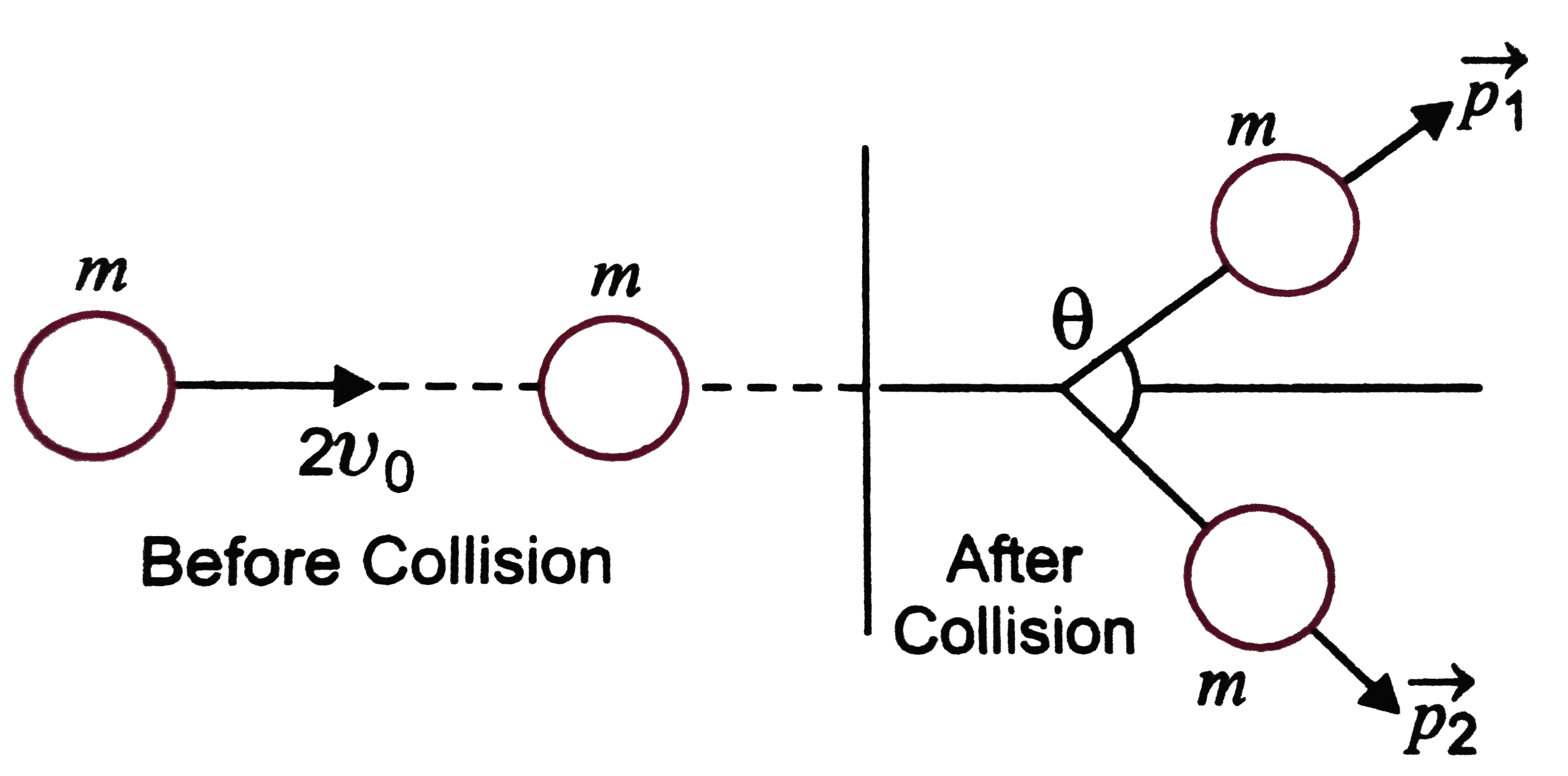
(a) If `upsilon_(1),upsilon_(2)` are velocities of two balls after collision, then according to the principle of conservation of linear momentum.
`m(2upsilon_(0))=m upsilon_(1)+m upsilon_(2)` or `2upsilon_(0)=upsilon_(1)+upsilon_(2)` …(i)
By definition, `e=(upsilon_(2)-upsilon_(1))/(upsilon_(2)+upsilon_(1))=(upsilon_(2)-upsilon_(1))/(2upsilon_(0))` `:. upsilon_(2)=upsilon_(1)+2upsilon_(0)e` ...(ii)
From (i), `2upsilon_(0)=upsilon_(1)+(upsilon_(1)+2upsilon_(0)e)`
or `=2(upsilon_(1)+upsilon_(0)e)` or `upsilon_(1)=upsilon_(0)(1-e)`
As `elt1, upsilon_(1)` has the same sign sign as `upsilon_(0)`. `:.` the ball moves forward after collision.
From (ii), `upsilon_(2)=upsilon_(0)(1-e)+2upsilon_(0)e=upsilon_(0)(1+e)`
Again, as `e lt 1, upsilon_(2)` has the same sign as `upsilon_(0)`. Hence the other ball also moves forward after collision.
(b) Accordin to principle of conservation of linear momentum,
`vec(p)=vec(p)_(1)+vec(p)_(2)`
For a general collision, some KE is lost
`:. ((p^(2))/(2m))gt ((p_(1)^(2))/(2m))+((p_(2)^(2))/(2m))`
or `p^(2)gt(p_(1)^(2)+p_(2)^(2)). `
which is possible onely when `thetalt 90^(@).` figure , which was to be proved.
Promotional Banner

Topper's Solved these Questions

  • WORK, ENERGY AND POWER

    PRADEEP|Exercise Long Answer Question|24 Videos
  • WORK, ENERGY AND POWER

    PRADEEP|Exercise Advanced Problems For Competitions|20 Videos
  • WORK, ENERGY AND POWER

    PRADEEP|Exercise Very Short Anwer Question.|54 Videos
  • THERMODYNAMICS

    PRADEEP|Exercise Assertion- Reason Type Questions|19 Videos

Similar Questions

Explore conceptually related problems

A billiard ball moving with a speed of 5 m//s collides with an identical ball, originally at rest. If the first ball stop dead after collision, then the second ball will move forward with a speed of:

A ball of mass m moving with velocity v collides head on elastically with another identical ball moving with velocity - V. After collision

A ball of mass m moving with a speed 2v_0 collides head-on with an identical ball at rest. If e is the coefficient of restitution, then what will be the ratio of velocity of two balls after collision?

A ball of mass M moving with speed v collides perfectly inelastically with another ball of mass m at rest. The magnitude of impulse imparted to the first ball is

A ball of mass m is moving with velocity u and collides head on with another identical body at rest . What is the maximum possible loss of kinetic energy due to collision ?

A ball of mass m moving at a speed v makes a head on inelastic collision with an identical ball at rest. The kinetic energy of the balls after the collision is 3/4th of the original. Find the coefficient of restitution.

A ball of mass m moving with a velocity v undergoes an oblique elastic collision with another ball of the same mass m but at rest. After the collision if the two balls move with the same speeds , the angle between their directions of motion will be:

PRADEEP-WORK, ENERGY AND POWER-Short Answer Question
  1. A bullet of mass 0.01J kg and travelling at a speed of 500m//s strikes...

    Text Solution

    |

  2. In any perfectly inelastic collision, is whole of KE lost ?

    Text Solution

    |

  3. Throwinig mud on a wall is an example of perfectly inelastic collisio...

    Text Solution

    |

  4. What is meant by zero work ? State the conditions under which a force ...

    Text Solution

    |

  5. Two bodies of unequal masses have same linear momentum. Which one has ...

    Text Solution

    |

  6. Tow bodies of unequal masses have same K.E. Which one has greater line...

    Text Solution

    |

  7. How do potential energy and K.E. of a spring vary with displacement ?...

    Text Solution

    |

  8. What is meant by mass energy equivalence ? Discuss its significance in...

    Text Solution

    |

  9. Hydrogenic materials are used as moderators in nuclear reactors to slo...

    Text Solution

    |

  10. How do you justify energy conservation from the vibrations of a simple...

    Text Solution

    |

  11. A graph of potential energy V(x) verses x is shown in figure. A partic...

    Text Solution

    |

  12. A ball of mass mm, moving with a speed 2upsilon(0), collides inelastic...

    Text Solution

    |

  13. Consider a one-dimensional motion of a particle with total energy E. T...

    Text Solution

    |

  14. The bob A of a pendulum released from horizontal to the vertical hits ...

    Text Solution

    |

  15. A raindrop of mass 1g falling from a height of 1km hits is the ground ...

    Text Solution

    |

  16. Two pendulums with identical bobs and lengths are suspended from a com...

    Text Solution

    |

  17. Suppose the average mass of raindrops is 3.0xx10^(-5)kg and their aver...

    Text Solution

    |

  18. An engine is attahed to a wagon through a shock absorber of length 1.5...

    Text Solution

    |

  19. An adult weighing 600N raises the centre of gravity of his body by 0.2...

    Text Solution

    |

  20. On complete combustion , a litre of petrol gives off heat equivalent t...

    Text Solution

    |

