
Home
Class 12
CHEMISTRY
(A)(C(8)H(14))underset(Acidic KMnO(4))ov...

(A)`(C_(8)H_(14))underset(Acidic KMnO_(4))overset([O])(rarr)(B)+(C )+(D)`
(A) requires `2 mol` of `H_(2)` for its saturation.
(B) reduces ammoniacal `AgNO_(3)` and gives yellow colour with `NaOH+I_(2)`.
(C ) does not reduce Tollens reagent but gives iodoform test.
(D) on dehydration with conc. `H_(2)SO_(4)` gives a mixture of colourless gases.
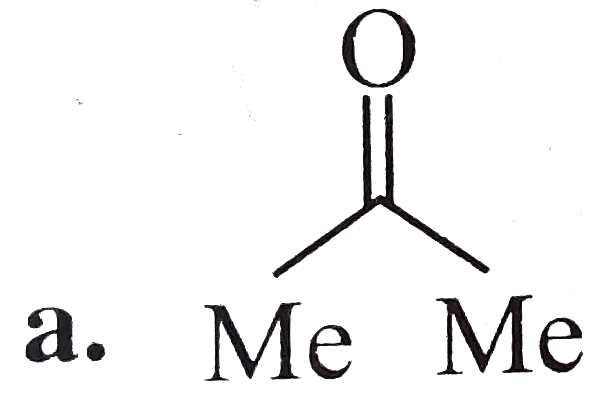
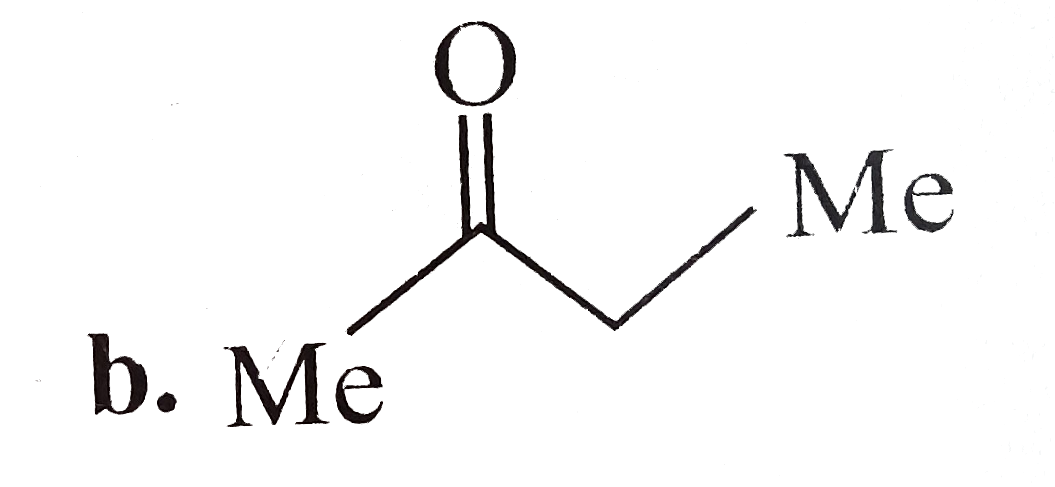
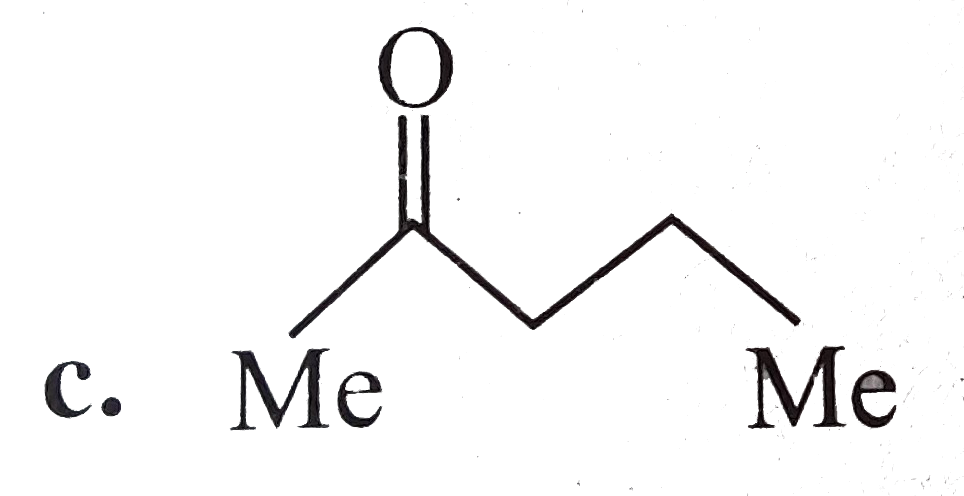
The compound (C ) is:

A

a.

B

b.

C

c.

D

d.

Text Solution

Verified by Experts

The correct Answer is:
B

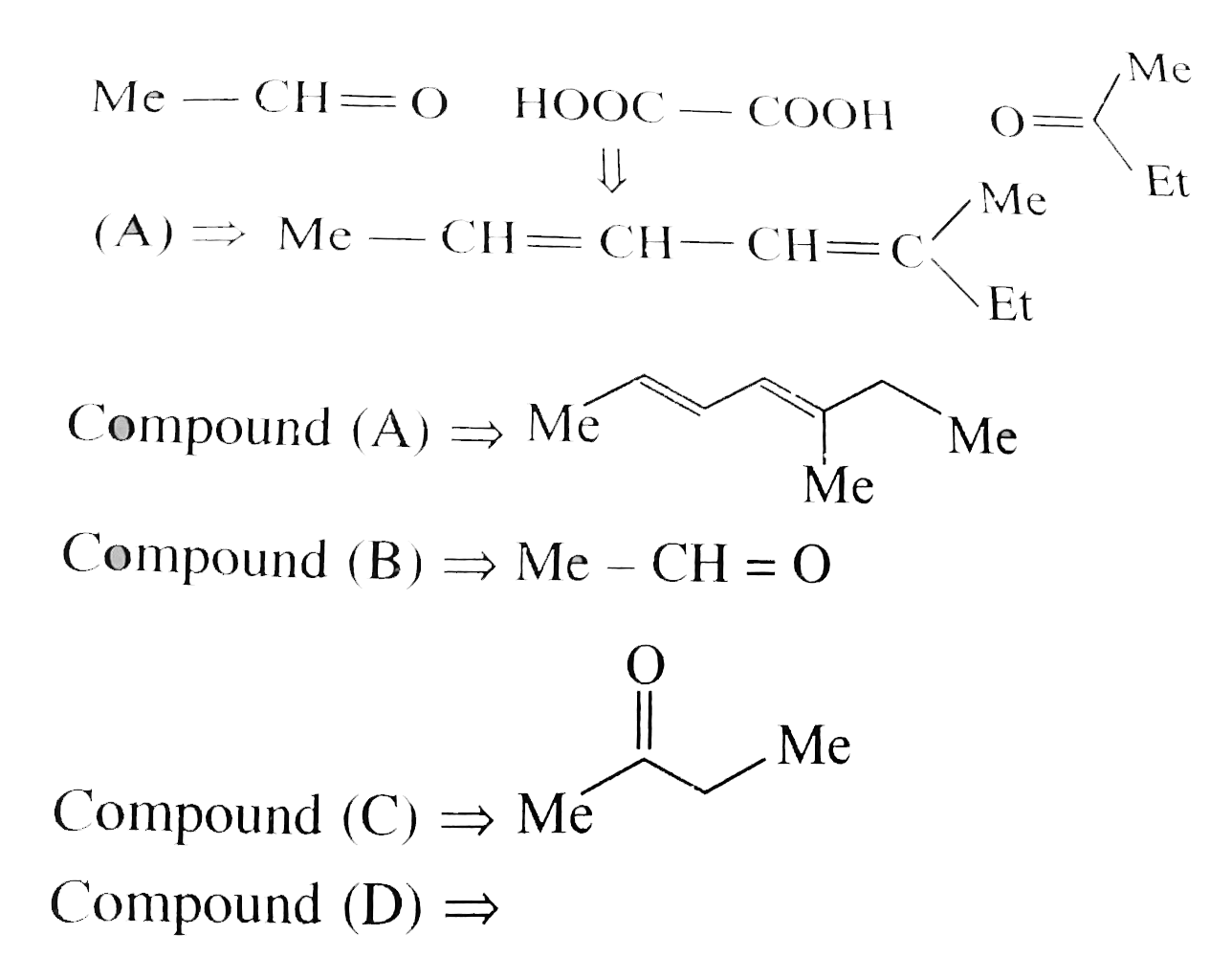
`(2Du "in" A)`. It may have either two `(C=C)` or one `(C-=C)` bond. Formation of three compounds on oxidation of (A) shows that it contains two `(C=C)` bonds. (B) reduces ammoniacal `AgNO_(3)` solution and gives iodoform test.
Therefore, (B) is an aldehyde and it is `(CH_(3)-CHO)`(two-C-atom aldehyde).
(C ) is a ketone containing `(CH_(3)-overset(O)overset(||)(C)-)` group (since it gives iodoform test).
(D) is two-C dibasic acid since it gives `CO_(2), CO`, and `H_(2)O` with conc. `H_(2)SO_(4)`. So, (D) may be oxalic acid `(HOOC-COOH)`(two C atoms). Total C atoms in (C ) must be four.
`(A) (C_(8)H_(14))impliesunderset((B))CH_(3)CHO ("two C atoms")+underset(("four C atoms"))((CH_(3)COCH_(2)CH_(3)))+(HOOC-COOH)underset((D))overset((C ))(("two C atoms"))`
Structure of `(A) implies`
Structure of (A) `implies`

Compound (D) `implies`
`HOOC-COOH overset("Conc". H_(2)SO_(4))(rarr) CO_(2)+CO+H_(2)O`
Promotional Banner

Topper's Solved these Questions

  • REDUCTION AND OXIDATION REACTION OF ORGANIC COMPOUNDS

    CENGAGE CHEMISTRY|Exercise Exercise (Multiple Correct)|35 Videos
  • REDUCTION AND OXIDATION REACTION OF ORGANIC COMPOUNDS

    CENGAGE CHEMISTRY|Exercise Exercise (Single Correct)|90 Videos
  • REDUCTION AND OXIDATION REACTION OF ORGANIC COMPOUNDS

    CENGAGE CHEMISTRY|Exercise Exercise|11 Videos
  • QUALITATIVE INORGANIC SALT ANALYSIS

    CENGAGE CHEMISTRY|Exercise Viva Voce Questions And Part-C (Analysis Of Cations)|42 Videos
  • SOLID STATE

    CENGAGE CHEMISTRY|Exercise Ex 1.2 (Objective)|9 Videos

Similar Questions

Explore conceptually related problems

(A) (C_(8)H_(14))underset(Acidic KMnO_(4))overset([O])(rarr)(B)+(C )+(D) (A) requires 2 mol of H_(2) for its saturation. (B) reduces ammoniacal AgNO_(3) and gives yellow colour with NaOH+I_(2) . (C ) does not reduce Tollens reagent but gives iodoform test. (D) on dehydration with conc. H_(2)SO_(4) gives a mixture of colourless gases. The mixture of colourless gases is:

(A) (C_(9)H_(12)O)underset(Hot KMnO_(4))overset([O])(rarr) PhCOOH i. (A) does not decolourise Br_(2) in C Cl_(4) , reacts with Na to give a colourless and odourless gas (B). ii. (A) does not give iodoform test. iii. (A) is a chiral compound and oxidation of (A) with CrO_(3)//Py gives a chiral compound (C ). iv. The colour of Cr_(2)O_(7)^(2-) change to blue-green when added to compound (A). The colourless and odourless gas (B) is:

(A) (C_(9)H_(12)O)underset(Hot KMnO_(4))overset([O])(rarr) PhCOOH i. (A) does not decolourise Br_(2) in C Cl_(4) , reacts with Na to give a colourless and odourless gas (B). ii. (A) does not give iodoform test. iii. (A) is a chiral compound and oxidation of (A) with CrO_(3)//Py gives a chiral compound (C ). iv. The colour of Cr_(2)O_(7)^(2-) change to blue-green when added to compound (A). The compound (C ) is:

(A) (C_(9)H_(12)O)underset(Hot KMnO_(4))overset([O])(rarr) PhCOOH i. (A) does not decolourise Br_(2) in C Cl_(4) , reacts with Na to give a colourless and odourless gas (B). ii. (A) does not give iodoform test. iii. (A) is a chiral compound and oxidation of (A) with CrO_(3)//Py gives a chiral compound (C ). iv. The colour of Cr_(2)O_(7)^(2-) change to blue-green when added to compound (A). The structure of compound (A) is:

(A) (C_(9)H_(12)O)underset(Hot KMnO_(4))overset([O])(rarr) PhCOOH i. (A) does not decolourise Br_(2) in C Cl_(4) , reacts with Na to give a colourless and odourless gas (B). ii. (A) does not give iodoform test. iii. (A) is a chiral compound and oxidation of (A) with CrO_(3)//Py gives a chiral compound (C ). iv. The colour of Cr_(2)O_(7)^(2-) change to blue-green when added to compound (A). The colour of Cr_(2)O_(7)^(2-) changes from orange to blue-green when added to compound (A). The blue-green colour is due to the formation of:

(A) A(C_(7)H_(14)) overset(O_(3)//Red)(rarr)B(C_(3)H_(6)O)+C (B) Gives positive Tollens test but negative iodform test. (C ) Give negative Tollens test but positive iodoform test. The compound (C ) is:

A substance C_(4)H_(10)O yields on oxidation a compound C_(4)H_(8)O which gives an oxime and a positive iodoform test. The original substance on treatment with conc. H_(2)SO_(4) gives C_(4)H_(8) , The structure of the compound is

(A) A(C_(7)H_(14)) overset(O_(3)//Red)(rarr)B(C_(3)H_(6)O)+C (B) Gives positive Tollens test but negative iodform test. (C ) Give negative Tollens test but positive iodoform test. The compound (B) is:

