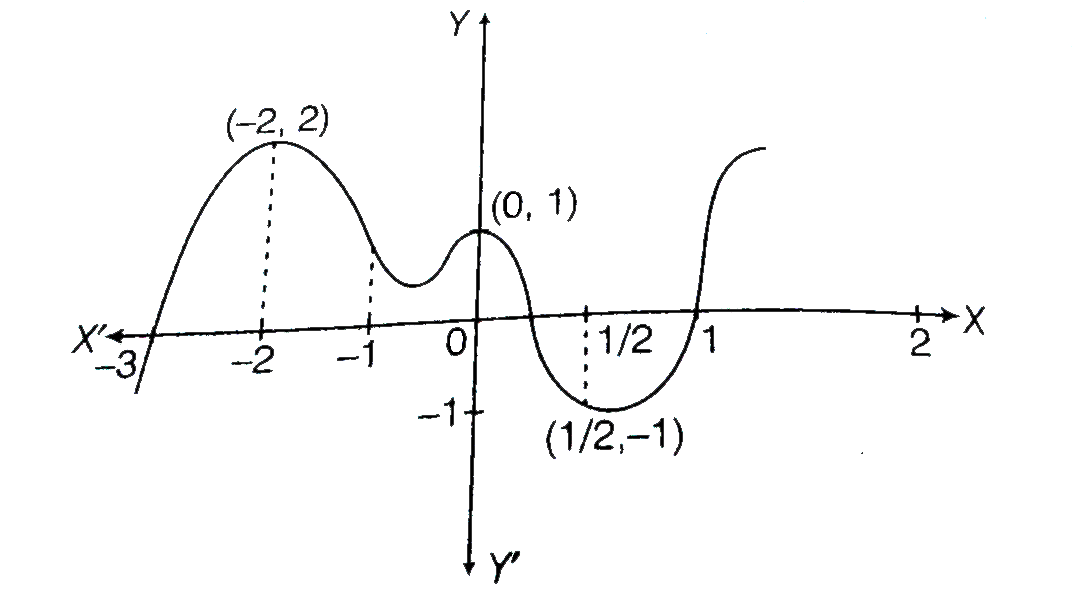
A
B
C
D
Text Solution
Verified by Experts
The correct Answer is:



Topper's Solved these Questions
DIFFERENTIATION
ARIHANT MATHS|Exercise Exercise (More Than One Correct Option Type Questions)|64 VideosDIFFERENTIATION
ARIHANT MATHS|Exercise Exercise (Statement I And Ii Type Questions)|10 VideosDIFFERENTIAL EQUATION
ARIHANT MATHS|Exercise Exercise (Questions Asked In Previous 13 Years Exam)|26 VideosDY / DX AS A RATE MEASURER AND TANGENTS, NORMALS
ARIHANT MATHS|Exercise Exercise (Questions Asked In Previous 13 Years Exam)|7 Videos
Similar Questions
Explore conceptually related problems
ARIHANT MATHS-DIFFERENTIATION -Exercise For Session 10
- If p''(x) has real roots alpha,beta,gamma. Then , [alpha]+[beta]+[gamm...
Text Solution
|
- The function f(x)=e^x+x , being differentiable and one-to-one, has a d...
Text Solution
|
- Let g(x) be the inverse of an invertible function f(x), which is diffe...
Text Solution
|
- Let g(x) be the inverse of an invertible function f(x) which is differ...
Text Solution
|
- If f(x)=x+tanx and g(x) is inverse of f(x) then g^(')(x) is equal to
Text Solution
|