Text Solution
Verified by Experts



Topper's Solved these Questions
REFRANCTION OF LIGHT
NAVNEET PUBLICATION - MAHARASHTRA BOARD|Exercise Text|29 VideosREFRANCTION OF LIGHT
NAVNEET PUBLICATION - MAHARASHTRA BOARD|Exercise WRITE SHORT NOTES|2 VideosREFRANCTION OF LIGHT
NAVNEET PUBLICATION - MAHARASHTRA BOARD|Exercise TEXTBOOK 73|11 VideosQUESTIONS BASED ON THE TABLE AND FLOW CHART
NAVNEET PUBLICATION - MAHARASHTRA BOARD|Exercise Space Missions|1 VideosREMEDIES/MEASURES ON PROBLEMS
NAVNEET PUBLICATION - MAHARASHTRA BOARD|Exercise CHAPTER 10 : DISASTER MANAGEMENT|1 Videos
Similar Questions
Explore conceptually related problems
NAVNEET PUBLICATION - MAHARASHTRA BOARD-REFRANCTION OF LIGHT -TEXTBOOK 75
- If the refractive index of the second medium with respect to the first...
Text Solution
|
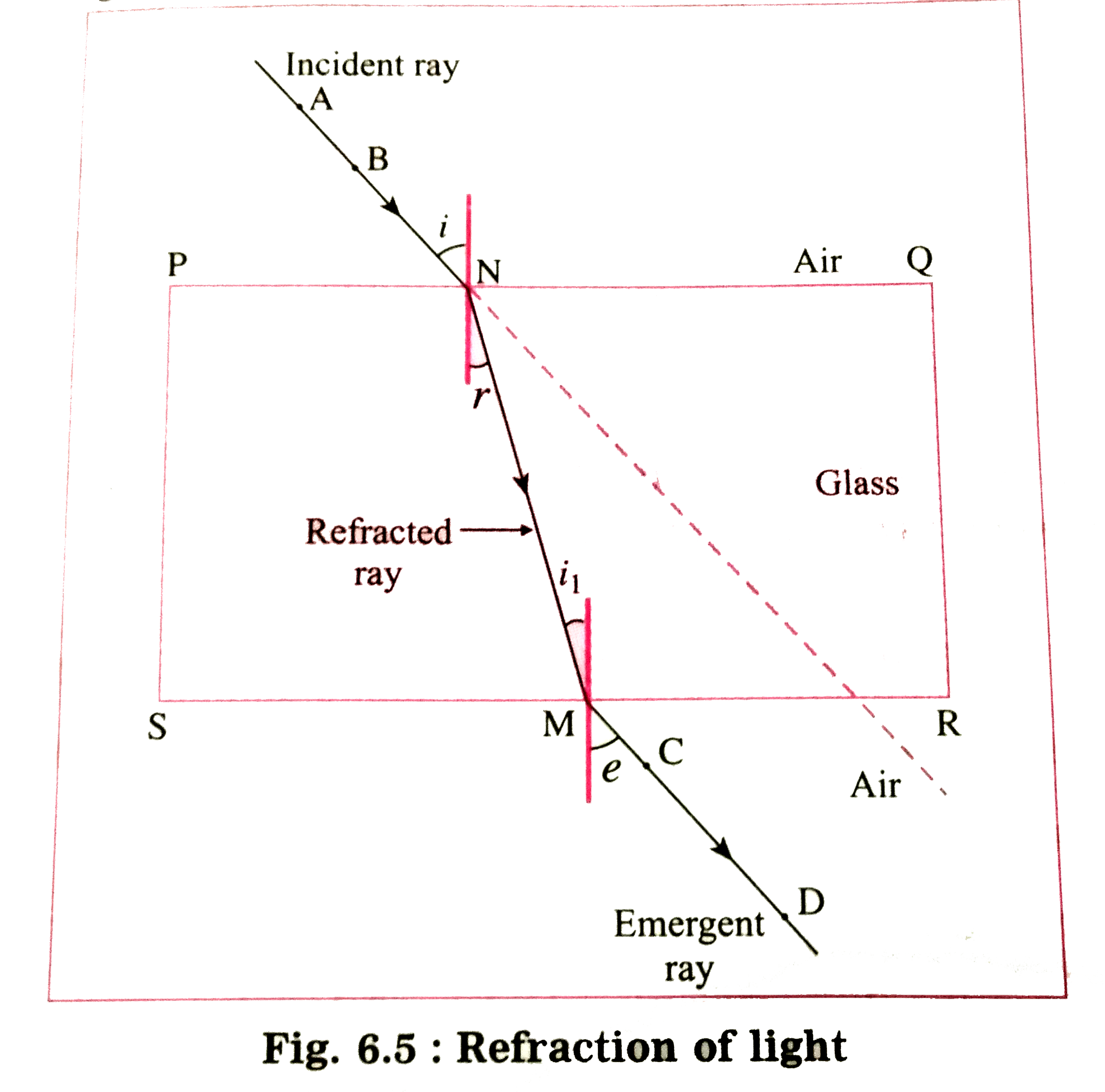
- Prove that i = e, If the angle of incidence and angle of emergence sub...
Text Solution
|
- Explain the terms optically rarer medium and optically denser medium w...
Text Solution
|
- A ray of light is incident obliquely at a boundary separating two medi...
Text Solution
|
- Observer the following figure and write accurate conclusion regarding ...
Text Solution
|
- What happens when a ray of light is incident normal to the interface b...
Text Solution
|
- Draw a neat and labelled diagram to show the path of a ray of light in...
Text Solution
|
- Observe the given figure and name the following rays : (i) ray AB...
Text Solution
|
- A plane mirror is kept at the bottome of a trough with water in it . ...
Text Solution
|