Home
Class 12
PHYSICS
A positively charge particle moving alon...

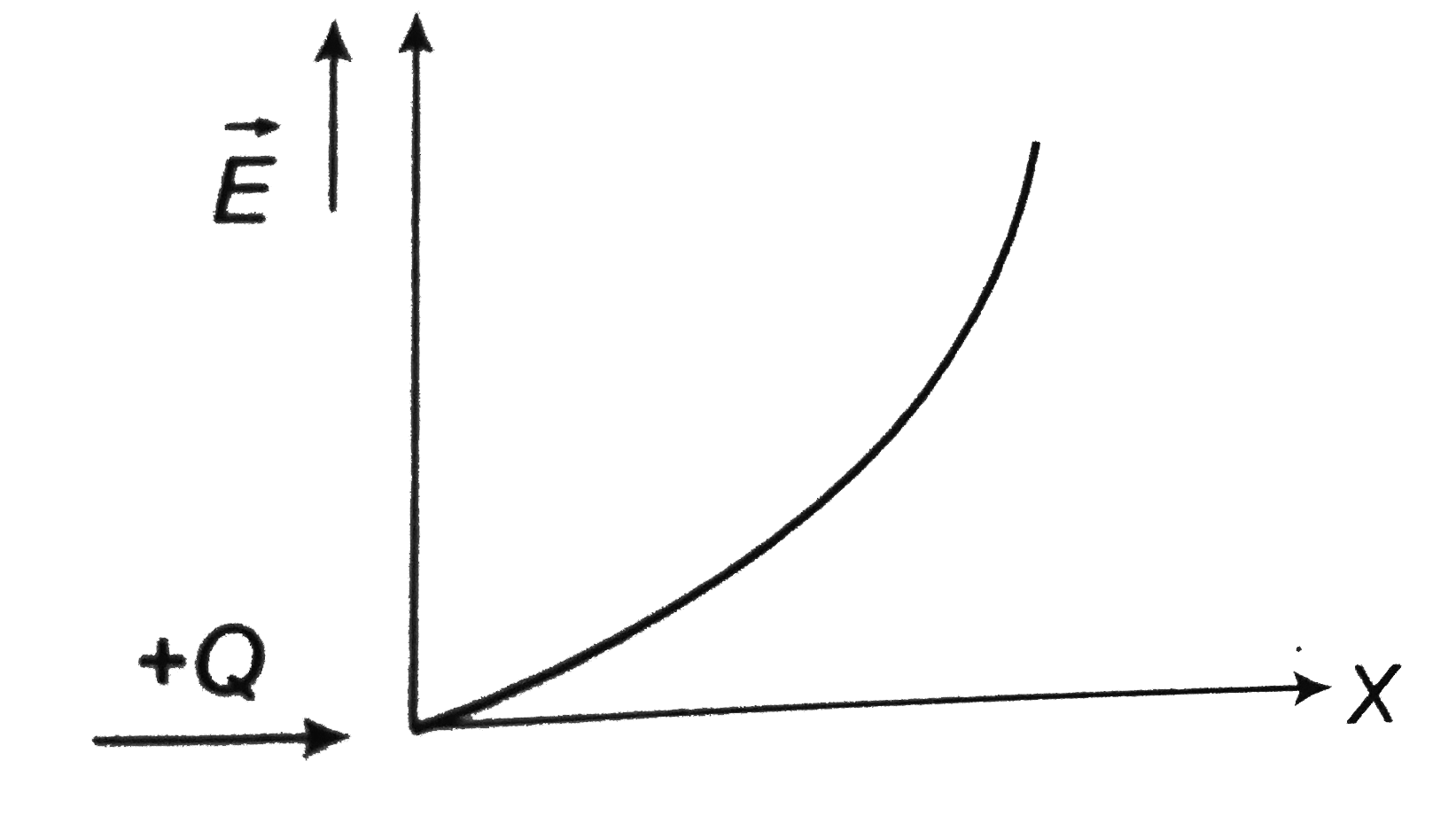
A positively charge particle moving along `x`-axis with a certain velocity enters a uniform electric field directed along positively y-axis. Its

A

vertical velocity changes but horozontal velocity remains constant

B

horizontal velocity changes but vertical velocity remains constant

C

both vertical and horizontal velocities change

D

neither verticle nor horizontal velocity changes

Text Solution

Verified by Experts

The correct Answer is:
a

Vertical velocity changes due to electric field, but no change in horizontal velocity .
Promotional Banner

Topper's Solved these Questions

  • ELECTRIC CHARGE, FIELD & FLUX

    A2Z|Exercise Assertion Reason|7 Videos
  • ELECTRIC CHARGE, FIELD & FLUX

    A2Z|Exercise Section D - Chapter End Test|29 Videos
  • ELECTRIC CHARGE, FIELD & FLUX

    A2Z|Exercise AIPMTNEET Questions|24 Videos
  • DUAL NATURE OF RADIATION AND MATTER

    A2Z|Exercise Section D - Chapter End Test|30 Videos
  • ELECTRIC POTENTIAL & CAPACITANCE

    A2Z|Exercise Section D - Chapter End Test|29 Videos

Similar Questions

Explore conceptually related problems

A particle of mass m carrying a positive charge q moves simple harmonically along the x-axis under the action of a varying electric field E directed along the x-axis. The motion of the particle is confined between x=0 and x=2l. The angular frequency of the motion is omega . Then which of the following is correct ?

A positively charged particle moving due east enters a region of uniform magnetic field directed vertically upwards. The partical will be

A charged particle moves along positive y-axis with constant velocity in uniform electric and magnetic fields. Ilf magnetic fiedl is actig along positive x-axis, then, electric field should act along positive z-axis. Reason: To keep the charged particle undeviated the relation E=Bxxv must hold good.

A positively charged particle, having charge q, is accelerated by a potential difference V. This particle moving along the x-axis enters a region where an electric field E exists. The direction of the electric field is along positive y-axis. The electric field exists in the region bounded by the lines x=0 and x=a. Beyond the line x=a (i.e., in the region xgta ), there exists a magnetic field of strength B, directed along the positive y-axis. Find a. at which point does the particle meet the line x=a . b. the pitch of the helix formed after the particle enters the region xgea. (Mass of the particle is m.)

A charge q moving along the X-axis with a velocity vecv is subjected to a uniform magnetic field B acting along the Z-axis as it crosses the origin O. Figure. (i) Trace its trajectory . (ii) Does the charge gain kinetic energy as it enters the magnetic field? Justify yous answer.

Equipotential surfaces associated with a uniform electric field along positive x-axis are planes parallel to

A positively charged particle with specific charge sigma leaves the origin with a velocity u directed along positive x direction. The entire space has a uniform electric field (E) and magnetic field (B) directed along the positive y direction. Find the angle that the velocity of the particle makes with y direction at the instant it crosses the y axis for n^(th) time.

A positively charged ion is released at the origin of a co-ordinate system. The entire space is filled with a uniform electric field directed along positive x axis and a uniform magnetic field directed along positive z direction. (i) Which (x, y or z) co-ordinate of the particle will always remain zero during its course of motion? (ii) Which (x, y or z) co-ordinate of the particle will always be negative? (iii) It is true to say that radius of curvature of the path of the particle is decreasing while its x co-ordinate decreases? (iv) If the ion is negatively charged will its y co-ordinate ever become negative?

A2Z-ELECTRIC CHARGE, FIELD & FLUX-AIIMS Questions
  1. Shown below is a distribution of charges. The flux of electric field d...

    Text Solution

    |

  2. The electric field due to uniformly charged sphere of radius R as a fu...

    Text Solution

    |

  3. Four point +ve charges of same magnitude(Q) are placed at four corners...

    Text Solution

    |

  4. Two infinitely long parallel conducting plates having surface charge d...

    Text Solution

    |

  5. Two concentric coducting thin spherical shells A and B having radii rA...

    Text Solution

    |

  6. The spatial distribution of the electric field due to charges (A,B) is...

    Text Solution

    |

  7. The point charges + q, -2q and + q are placed at point (x = 0, y = a, ...

    Text Solution

    |

  8. A hollow cylinder has a charge qC within it. If phi is the electric fl...

    Text Solution

    |

  9. Two point charges +8q and -2q are located at x=0 and x=L respectively....

    Text Solution

    |

  10. A sphere of radius R has a uniform distribution of electric charge in ...

    Text Solution

    |

  11. A positively charge particle moving along x-axis with a certain veloci...

    Text Solution

    |

  12. An electron falls through a small distance in a uniform electric field...

    Text Solution

    |

  13. Two point charge -q and +q//2 are situated at the origin and the point...

    Text Solution

    |

  14. Two charges each equal to eta q(eta^(-1) lt sqrt(3)) are placed at the...

    Text Solution

    |

  15. Four charges are arranged at the corners of a square ABCD, as shown in...

    Text Solution

    |

  16. In a certain region of space, electric field is along the z-direction ...

    Text Solution

    |

  17. According to early model of an atom, the atom is considered it to have...

    Text Solution

    |

  18. A large solid sphere with uniformly distributed positive charge has a ...

    Text Solution

    |

  19. A uniformly charged non conducting disc with surface charge density 10...

    Text Solution

    |

  20. Two small balls, each having equal positive charge Q are suspended by ...

    Text Solution

    |

