Home
Class 12
PHYSICS
Four charges are rigidly fixed along the...

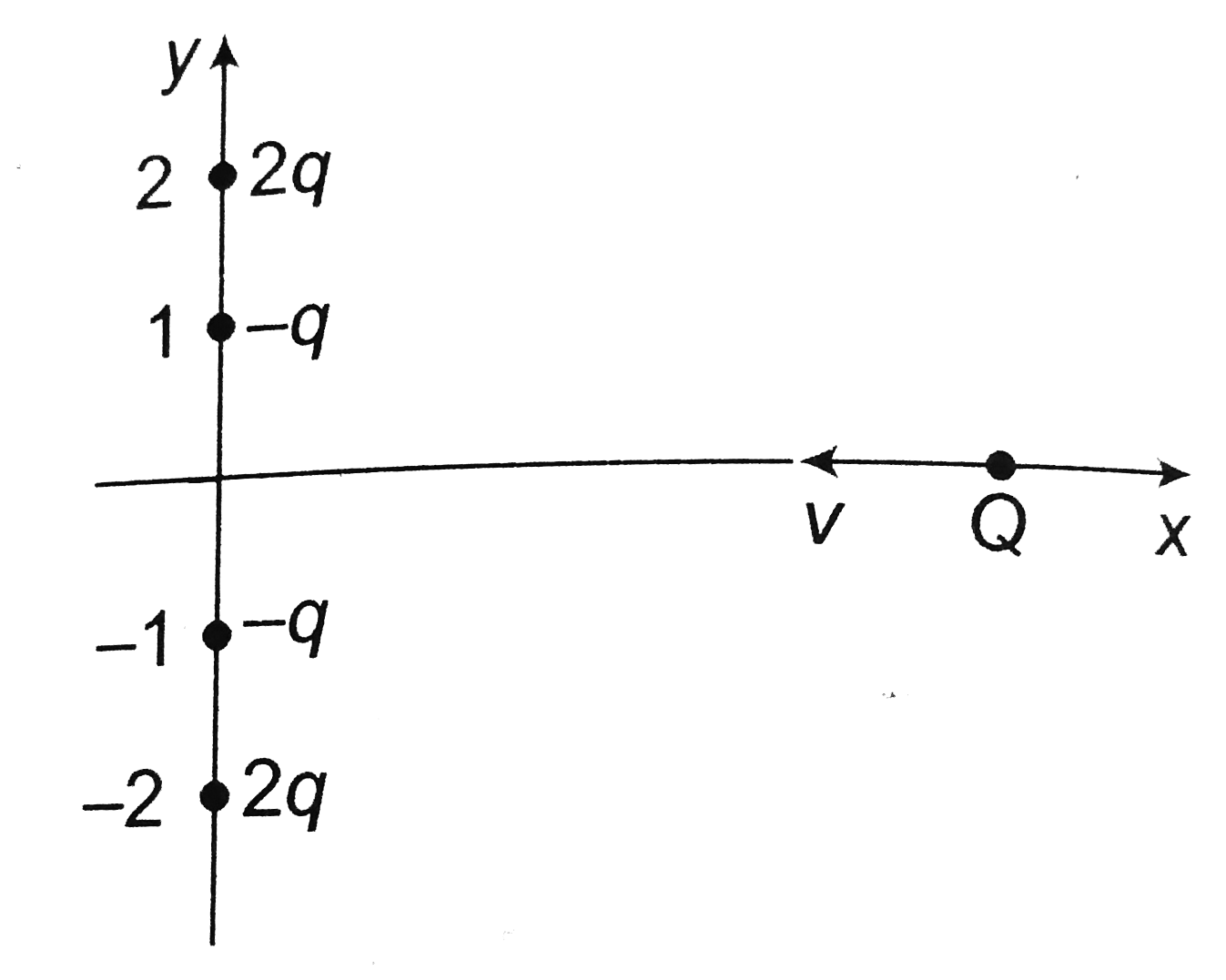
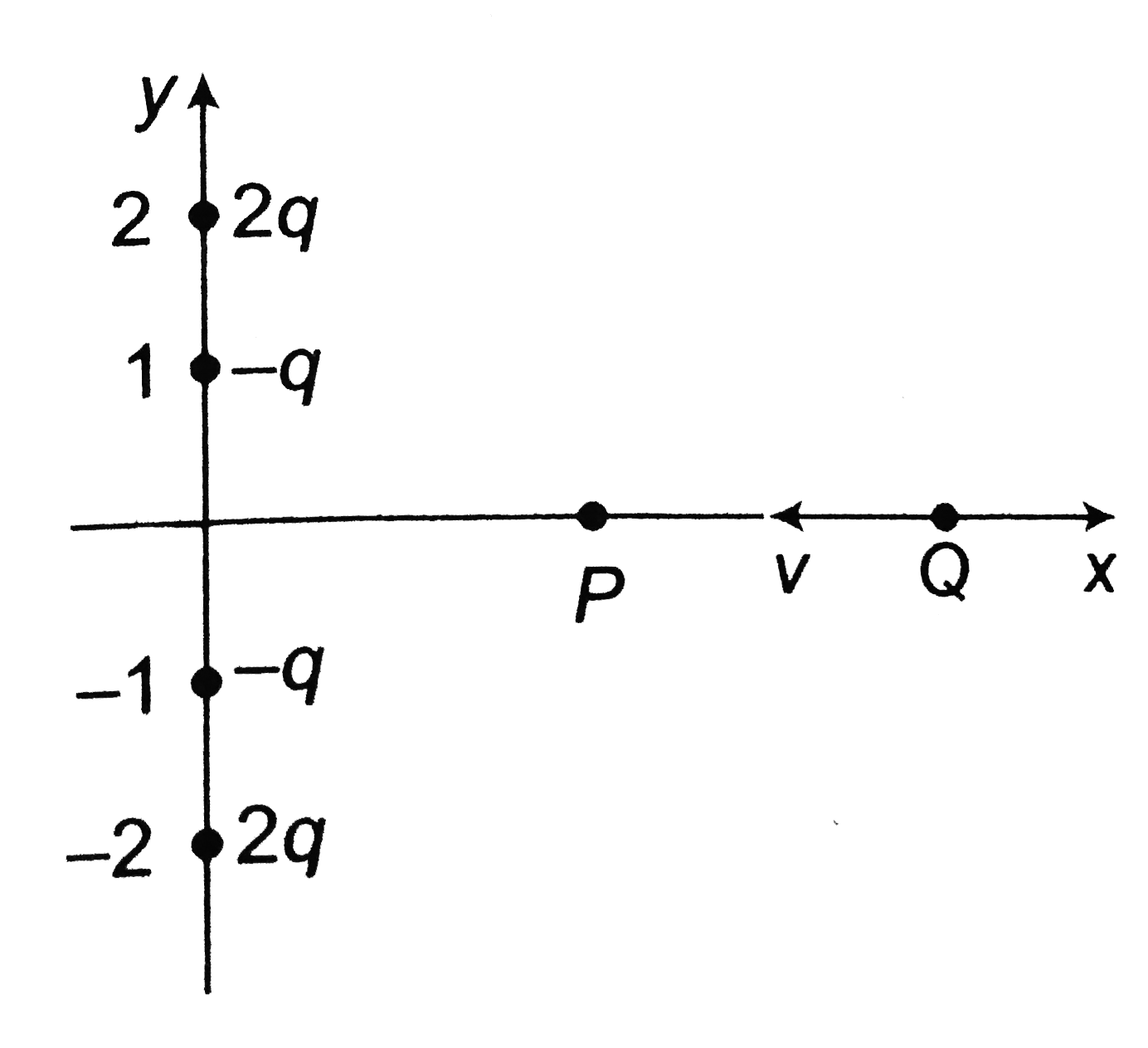
Four charges are rigidly fixed along the Y-axis as shown. A positive charge approches the system along the `X`axis with initial speed just enough to cross the origin. Then its total energy at the origin is

A

zero

B

positive

C

negative

D

data insufficient

Text Solution

Verified by Experts

The correct Answer is:
B


There exists a point `P` on the x-axis (other than the origin), where not electric field is zero. Once the charge `Q` reaches point `P`, attractive forces of the two `-ve` charge will dominate and automatically cause the charge `Q` to cross the origin.
Now if `Q` is projected with just enough velocity to reach `P`, its `K.E.` at `P` is zero,
But while being attracted towards origin it acquires `K.E.` and hance its net energy at the origin is positive.
(`P.E.` at origin = zero).
Promotional Banner

Topper's Solved these Questions

  • ELECTRIC POTENTIAL & CAPACITANCE

    A2Z|Exercise Section B - Assertion Reasoning|17 Videos
  • ELECTRIC POTENTIAL & CAPACITANCE

    A2Z|Exercise AIPMTNEET Questions|38 Videos
  • ELECTRIC POTENTIAL & CAPACITANCE

    A2Z|Exercise Capacitor Circuits|52 Videos
  • ELECTRIC CHARGE, FIELD & FLUX

    A2Z|Exercise Section D - Chapter End Test|29 Videos
  • ELECTROMAGNETIC INDUCTION

    A2Z|Exercise Section D - Chapter End Test|30 Videos

Similar Questions

Explore conceptually related problems

Consider two positive point charges, each of magnitude q, placed on the y-axis at the points (0, a) and (0, -a). A positively charged particle of charge q' and mass m is displaced slightly from the origin in the direction of the positive x-axis. At the origin, charge q' will be in

Consider two positive point charges, each of magnitude q, placed on the y-axis at the points (0, a) and (0, -a). A positively charged particle of charge q' and mass m is displaced slightly from the origin in the direction of the positive x-axis. Speed of charge q' at infinity is

Two identical negative charges are fixed on X axis at equal distances from the origin (O). A particle having positive charge starts at a large distance from O, moves along the Y axis, passes through the origin and moves far away from O in the positive Y direction. Describe qualitatively how its acceleration charges as it moves. Draw a rough graph showing the variation of acceleration (a) vs position of the particle (y). Take the acceleration of the particle to be positive in + Y direction.

Two equal negative charges are fixed at points and on y-axis. A positive charge Q is released from rest at the point on the x-axis. The charge Q will:

A charge +q is located at the origin, while an identical charge is located on the x axis at x = +0.50 m. A third charge of +2 q is located on the x axis at such a place that the net electrostatic force on the charge at the origin doubles, its direction remaining unchanged. Where should the third charge be located ?

A charge q moving along the X-axis with a velocity vecv is subjected to a uniform magnetic field B acting along the Z-axis as it crosses the origin O. Figure. (i) Trace its trajectory . (ii) Does the charge gain kinetic energy as it enters the magnetic field? Justify yous answer.

Two identical positive charges are fixed on the y-axis, at equal distances from the origin O. A particle with a negative charges starts on the x-axis at a large distance from O. moves along the x-axis passes through O, and moves far away from O on the other side. Its acceleration a is taken as positive along its direction of motion. Plot acceleration a of the particle against its x-coordinate.

A2Z-ELECTRIC POTENTIAL & CAPACITANCE-Problems Based On Mixed Concepts
  1. In the figure shown the electric potential energy of the system is : (...

    Text Solution

    |

  2. A point charge 'Q' is placed at the centre of a spherical cavity of ra...

    Text Solution

    |

  3. Four charges are rigidly fixed along the Y-axis as shown. A positive c...

    Text Solution

    |

  4. Three charge +q, -q, and +2q are placed at the vertices of a right ang...

    Text Solution

    |

  5. Three equal charges Q are placed at the three vertices of an equilater...

    Text Solution

    |

  6. You are moving a negative charge q lt 0 at a small constant speed away...

    Text Solution

    |

  7. Charge on the outer sphere is q, and the inner sphere is grounded. The...

    Text Solution

    |

  8. A ring of radius 0.5 m carries a total charge of 1.0xx 10^(-10)C distr...

    Text Solution

    |

  9. Two connectric spheres of radii R and r have similar charges with equa...

    Text Solution

    |

  10. A 5C charge experience a force of 2000 N when moved between two points...

    Text Solution

    |

  11. Two points are at distance a and b (a lt b) from a long string of char...

    Text Solution

    |

  12. Four chrages 2C, -3C, -4C and 5C respectively are placed at all the co...

    Text Solution

    |

  13. The electric potetnial in a region along x-axis varies with x accordin...

    Text Solution

    |

  14. Two charges, each equal to 1muC, are placed at the vertices A and B of...

    Text Solution

    |

  15. Eight charged water drops, each with a radius of 1 mm and a charge of ...

    Text Solution

    |

  16. Consider a unifrom electric field in a region as shown below. Then, po...

    Text Solution

    |

  17. The elctric potential in a region is given by, v = 3x^(2) + 4x. An ele...

    Text Solution

    |

  18. Two particles of charge q(1) and q(2) are separated by distance d as s...

    Text Solution

    |

  19. An infinite number of concentric rings carry a charge Q each alternate...

    Text Solution

    |

  20. In the region where electric field E = 0, the relation between electir...

    Text Solution

    |

