Home
Class 12
PHYSICS
The image of point P when viewed from to...

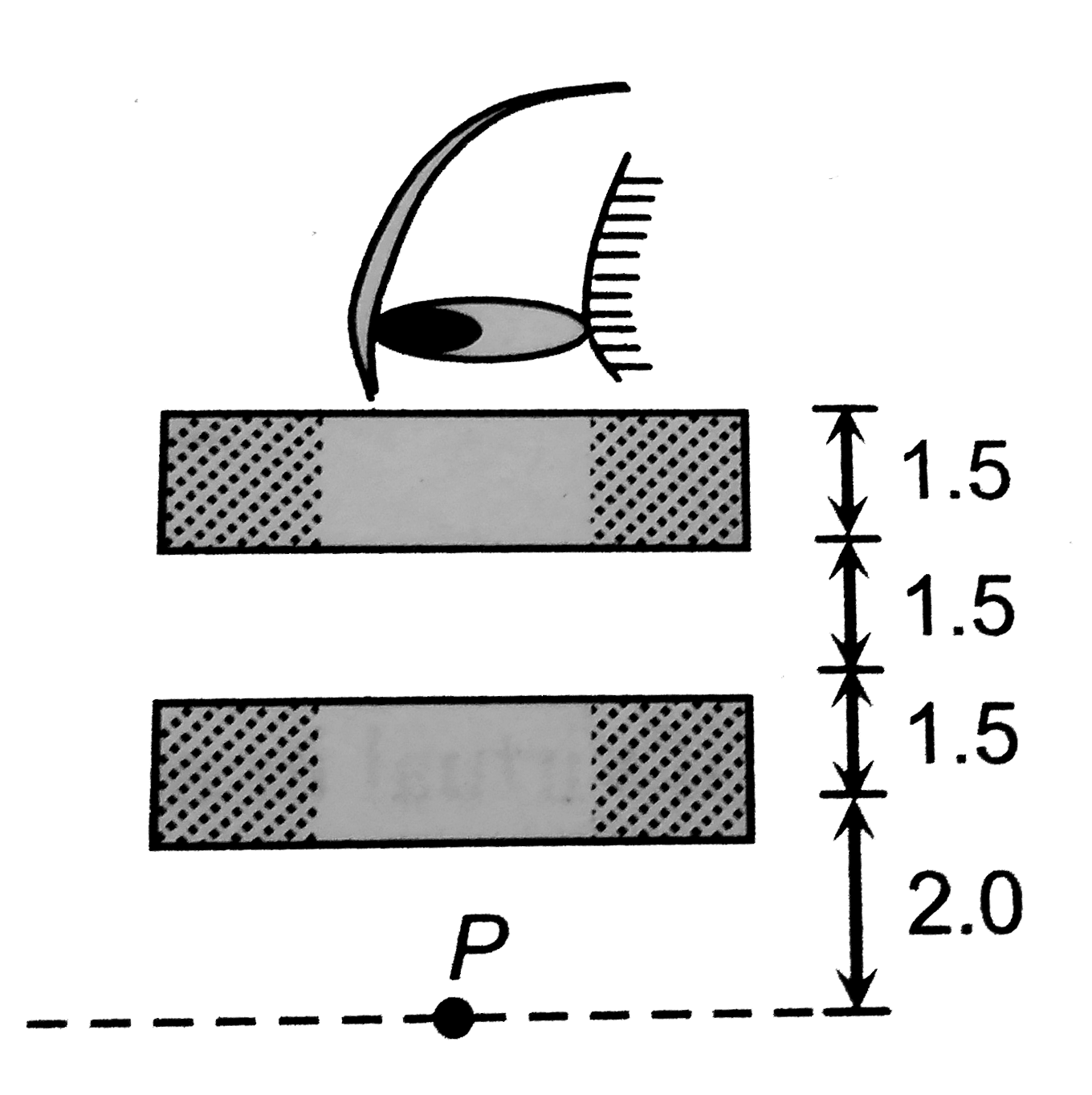
The image of point `P` when viewed from top of the slabs will be

A

`2.0cm` above `P`

B

`1.5cm` above `P`

C

`2.0 cm` below `P`

D

`1 cm` above `P`

Text Solution

Verified by Experts

The correct Answer is:

D

The two slabs will shift the image a distance
`d=2(1+(1)/(mu))t=2(1-(1)/(1.5))(1.5)=1.0 cm`
Therefore, final image will be `1 cm` above point `P`.
Promotional Banner

Topper's Solved these Questions

  • GEOMETRICAL OPTICS

    A2Z|Exercise Refraction At Curved Surface|64 Videos
  • GEOMETRICAL OPTICS

    A2Z|Exercise Prism Theory And Dispersion Of Light|45 Videos
  • ELECTROMAGNETIC WAVES AND COMMUNICATION SYSTEM

    A2Z|Exercise Section D - Chapter End Test|30 Videos
  • MAGNETISM AND MATTER

    A2Z|Exercise Section D - Chapter End Test|30 Videos

Similar Questions

Explore conceptually related problems

The image of point P when viewd from top of the slabs will be

A point object is placed at a distance of 20 cm from a glass slab, half immersed in water as shown in figure. The distance between two images when seen from the other side of the slab is (mu_(g) = (3)/(2) and mu_(w) = (4)/(3))

An air bubble inside a glass slab (µ=1.5) appears 6 cm when viewed from one side and 4 cm when viewed from the opposite side. The thickness of the slab is

An air bubble in a glass slab with refrctive index 1.5 (near normal incidence ) is 5 cm deep when viewed from one surface and 3 cm deep when viewed from the opposite face, the thickness (in cm) of the slab is

If the angular velocity vector of a spinning body points out of the page then, when viewed from above the page, the body is spinning,

Image formation by slab

An air bubble in a glass slab with refractive index 1.5 (near normal incidence) is 5 cm deep when viewed from one surface and 3cm deep when viewed from the opposite face. The thickness (in cm) of the slab is

The word ‘’KVPY’’ is written on a board and viewed through different lense such that board is at a distance beyond the focal length of the lens. lgnorging magnification effects, consider the following statements (I) Image (i) has been viewed from the planar side of a plano-convex lens and image (ii) from the convex side of a plano-convex lens. (II) Image (i) has been viewed from the concave side of a plano-concave lens and image (ii) from the planar side of a plano-convex lens. (iii) Image (i) has been viewed from the cocave side of a plano-concave lens and image (ii) from the planar side of a plano-convex lens. (iv) Image (i) has been viewed from the planar side of a plano-concave lens and image (ii) from the convex side of a plano-convex lens. Which of the above statements are correct ?

The word ‘’KVPY’’ is written on a board and viewed through different lense such that board is at a distance beyond the focal length of the lens. lgnorging magnification effects, consider the following statements (I) Image (i) has been viewed from the planar side of a plano-convex lens and image (ii) from the planar side of a plano-convex lens. (II) Image (i) has been viewed from the concave side of a plano-concave lens and image (ii) from the convex side of a plano-convex lens. (iii) Image (i) has been viewed from the cocave side of a plano-concave lens and image (ii) from the planar side of a plano-convex lens. (iv) Image (i) has been viewed from the planar side of a plano-concave lens and image (ii) from the convex side of a plano-convex lens. Which of the above statements are correct ?

A2Z-GEOMETRICAL OPTICS-Section D - Chapter End Test
  1. The image of point P when viewed from top of the slabs will be

    Text Solution

    |

  2. Wavelength of light used in an optical instrument are lambda(1)=400 Å ...

    Text Solution

    |

  3. A plano convex lens of refractive index 1.5 and radius of curvature 30...

    Text Solution

    |

  4. A light ray is incident perpendicularly to one face of a 90^circ prism...

    Text Solution

    |

  5. A thin glass (refractive index 1.5) lens has optical power of -5D in a...

    Text Solution

    |

  6. Which of the following graphs is the magnification of a real image aga...

    Text Solution

    |

  7. A thin prism P(1) with angle 4degree and made from glass of refractive...

    Text Solution

    |

  8. A converging lens is used to form an image on a screen. When the upper...

    Text Solution

    |

  9. A diminished image of an object is to be obtained on a screen 1.0 m fr...

    Text Solution

    |

  10. An object 15cm high is placed 10cm from the optical center of a thin l...

    Text Solution

    |

  11. A lens forms a virtual, diminished image of an object placed at 2 m fr...

    Text Solution

    |

  12. When the distance between the object and the screen is more than 4 f....

    Text Solution

    |

  13. a convex lens of power +6 diopter is placed in contact with a concave ...

    Text Solution

    |

  14. A concave lens of focal length 20 cm product an image half in size of ...

    Text Solution

    |

  15. A convex lens of focal length 1.0m and a concave lens of focal length ...

    Text Solution

    |

  16. If in a planoconvex lens, the radius of curvature of the convex surfac...

    Text Solution

    |

  17. A convex lens A of focal length 20cm and a concave lens G of focal le...

    Text Solution

    |

  18. The radii of curvature of the two surfaces of a lens are 20cm and 30 c...

    Text Solution

    |

  19. A lens forms a virtual image 4 cm away from it when an object is place...

    Text Solution

    |

  20. A concave lens of focal length (1)/(3)m forms a real, inverted image t...

    Text Solution

    |

  21. An object is placed at a distance of f//2 from a convex lens. The imag...

    Text Solution

    |
