Home
Class 12
PHYSICS
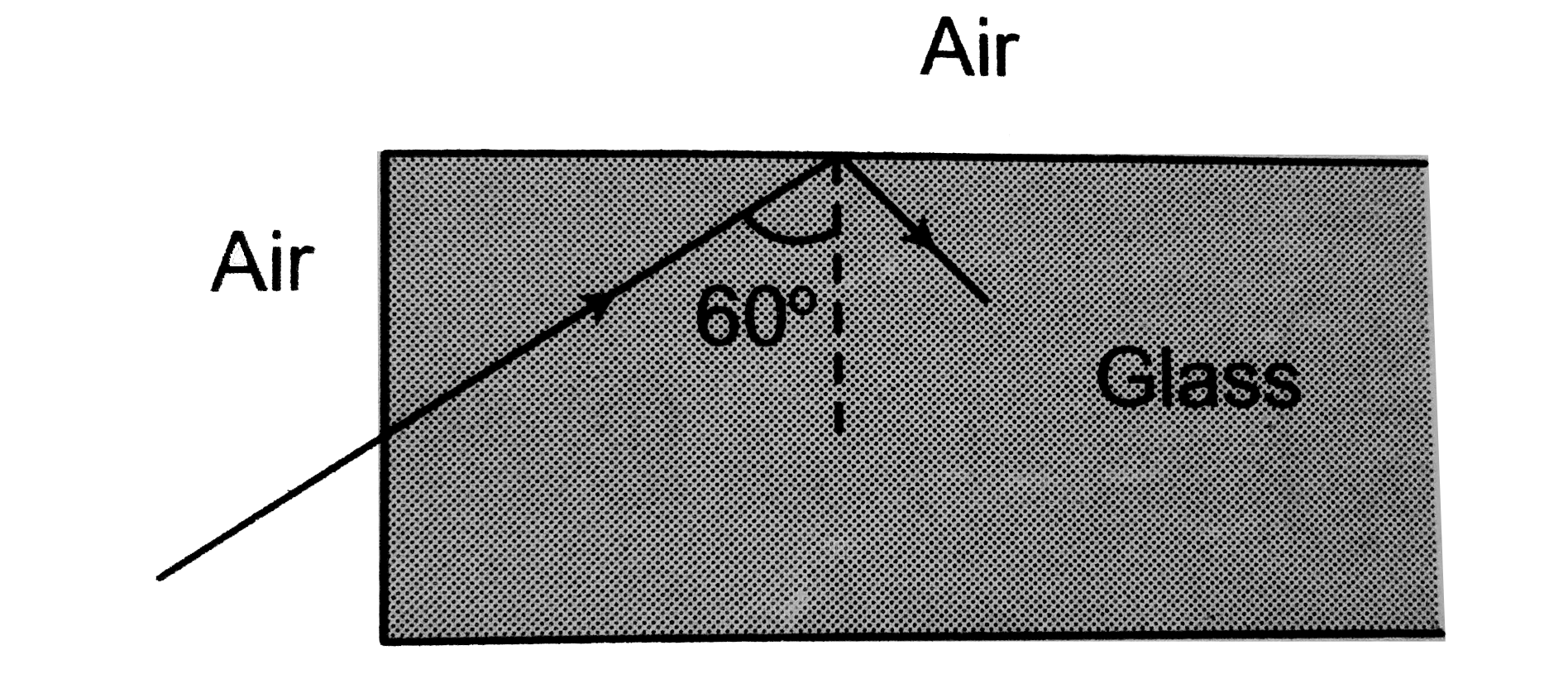
A light ray from air is incident (as sho...

A light ray from air is incident (as shown in figure ) at one end of a glass fiber ( refractive index `mu=1.5)` making an incidence angle of `60^(@)` on the lateral surface, so that it undergoes a total internal reflection. How much time would it take to traverse the straight fiber of length `1 km `?

A

`3.33 m sec`

B

`6.67 m sec`

C

`5.77 m sec`

D

`3.85 mu sec`

Text Solution

Verified by Experts

The correct Answer is:

D

When total internal reflection just take place from lateral surface `i=C` i.e., `60^(@)=C`
`implies sin 60^(@)=sin C=(1)/(mu)impliesmu=(2)/(sqrt(3))`
Time taken by light to traverse some distance in a medium `t=(mu x)/(c)=((2)/(sqrt(3))xx10^(3))/(3xx10^(8))=3.85mu sec.`
Promotional Banner

Topper's Solved these Questions

  • GEOMETRICAL OPTICS

    A2Z|Exercise Refraction At Curved Surface|64 Videos
  • GEOMETRICAL OPTICS

    A2Z|Exercise Prism Theory And Dispersion Of Light|45 Videos
  • ELECTROMAGNETIC WAVES AND COMMUNICATION SYSTEM

    A2Z|Exercise Section D - Chapter End Test|30 Videos
  • MAGNETISM AND MATTER

    A2Z|Exercise Section D - Chapter End Test|30 Videos

Similar Questions

Explore conceptually related problems

A light ray going from air is incident (as shown in figure) at one end of a optical fibre used for communication purpose (refractive index of core mu=1.5 ) making an incidence angle of 60^(@) on the lateral surface. so that it undergoes a total internal reflection. how much time would it take to traverse the straight fibre of length 1 km?

A ray of light is incident on a glass slab of refractive index 1.5, making an angle of 40^(@) with the surface. The angle of refraction in glass is

A ray of light is incident on the surface of plate of glass of refractive index 1.5 at the polarising angle. The angle of refraction of the ray will be

A ray of light is incident on the surface of a glass plate of refractive index 1.6 at polarzing angle. Calculate the angles of reflection and refraction.

A light ray from air is incident on a glass plate of thickness t and refractive index mu at an angle of incidence equal to the angle of total internal reflection of glass. Compute the displacement of the ray due to this plate in terms of thickness and refractive index of glass mu .

A ray of light is incident on the surface of a glass plate of index of refraction 1.55 at the polarizing angle. Calculate the angle of refraction.

The refractive index of the core of an optical fibre is mu_(2) and that of the cladding is mu_(1) .The angle of incidence on the face of the core so that the light ray just under goes total internal reflection at the cladding is

A ray of light is incident at an angle of 60^(@) on one face of a rectangular glass slab of thickness 0.1 m , and refractive index 1.5 .Calculate the lateral shift produced.

A ray of light is travelling from glass to air. ("Refractive index of glass =1.5") . The angle of incidence is 50^(@) . The deviation of the ray is

A2Z-GEOMETRICAL OPTICS-Section D - Chapter End Test
  1. A light ray from air is incident (as shown in figure ) at one end of a...

    Text Solution

    |

  2. Wavelength of light used in an optical instrument are lambda(1)=400 Å ...

    Text Solution

    |

  3. A plano convex lens of refractive index 1.5 and radius of curvature 30...

    Text Solution

    |

  4. A light ray is incident perpendicularly to one face of a 90^circ prism...

    Text Solution

    |

  5. A thin glass (refractive index 1.5) lens has optical power of -5D in a...

    Text Solution

    |

  6. Which of the following graphs is the magnification of a real image aga...

    Text Solution

    |

  7. A thin prism P(1) with angle 4degree and made from glass of refractive...

    Text Solution

    |

  8. A converging lens is used to form an image on a screen. When the upper...

    Text Solution

    |

  9. A diminished image of an object is to be obtained on a screen 1.0 m fr...

    Text Solution

    |

  10. An object 15cm high is placed 10cm from the optical center of a thin l...

    Text Solution

    |

  11. A lens forms a virtual, diminished image of an object placed at 2 m fr...

    Text Solution

    |

  12. When the distance between the object and the screen is more than 4 f....

    Text Solution

    |

  13. a convex lens of power +6 diopter is placed in contact with a concave ...

    Text Solution

    |

  14. A concave lens of focal length 20 cm product an image half in size of ...

    Text Solution

    |

  15. A convex lens of focal length 1.0m and a concave lens of focal length ...

    Text Solution

    |

  16. If in a planoconvex lens, the radius of curvature of the convex surfac...

    Text Solution

    |

  17. A convex lens A of focal length 20cm and a concave lens G of focal le...

    Text Solution

    |

  18. The radii of curvature of the two surfaces of a lens are 20cm and 30 c...

    Text Solution

    |

  19. A lens forms a virtual image 4 cm away from it when an object is place...

    Text Solution

    |

  20. A concave lens of focal length (1)/(3)m forms a real, inverted image t...

    Text Solution

    |

  21. An object is placed at a distance of f//2 from a convex lens. The imag...

    Text Solution

    |
