Home
Class 12
PHYSICS
A fish is vertically below a flying bird...

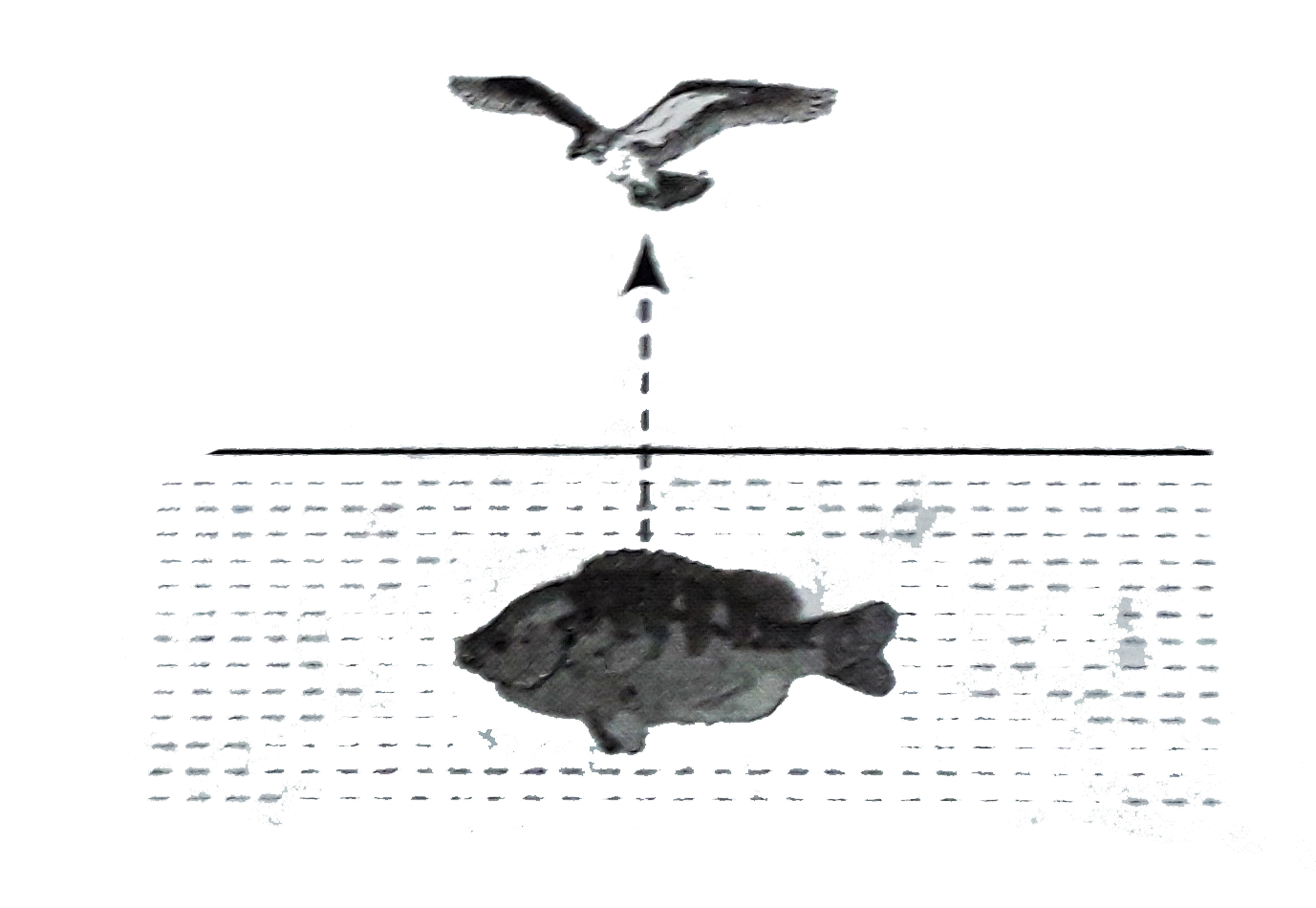
A fish is vertically below a flying bird moving vertically down toward water surface. The bird will appear to the fish to be

A

moving faster than its speed and also away from the real distance

B

moving faster than its real speed and never than its real distance.

C

moving slower than its real speed and also nearer than its real distance

D

moving slower than its real speed and away from the real distance

Text Solution

Verified by Experts

The correct Answer is:

A

`(mu_(1))/(-u)+(mu_(2))/(v)=(mu_(1)-mu_(2))/(R)`
For a polane surface, `R=oo`
`:. (mu_(1))/(-u)+(mu_(2))/(v)=0`
or `(mu_(2))/(v)=(mu_(1))/(u)` or `(mu)/(v)=(1)/(u)`
`v=muu`
Clearly, to the fish , the bird appears farther than its actual distance.
Again, `(dv)/(dt)=mu(du)/(dt)`
or Apparent speed of bird
`=` refractive index `xx` Actual speed of bird.
Promotional Banner

Topper's Solved these Questions

  • GEOMETRICAL OPTICS

    A2Z|Exercise Section B - Assertion Reasoning|19 Videos
  • GEOMETRICAL OPTICS

    A2Z|Exercise AIPMT/NEET Questions|95 Videos
  • GEOMETRICAL OPTICS

    A2Z|Exercise Optical Instruments|55 Videos
  • ELECTROMAGNETIC WAVES AND COMMUNICATION SYSTEM

    A2Z|Exercise Section D - Chapter End Test|30 Videos
  • MAGNETISM AND MATTER

    A2Z|Exercise Section D - Chapter End Test|30 Videos

Similar Questions

Explore conceptually related problems

The fish that swims vertically :-

A fish is moving up vertically with speed 4 cm/s inside a pond. A bird is moving vertically downward (see figure). Velocity of the bird w.r.t. fish is 16 cm/s downward. Find out the actual velocity of the bird (in cm/s). Given refractive index of water is (4)/(3) .

A brid flies down vertically towards a water surface. To a fish inside the water, vertically below the bird, the bird will appear to

A bird is flying up at angle sin^(-1)(3//5) with the horizontal. A fish in a pond looks at that bird. When it is vertically above the fish. The angle at which the bird appears to fly (to the fish) is [n_(water)=4//3]

A bird is flying up at an angle sin^(-1)(3//5) with the horizontal. A fish in a pond looks at that bird when it is vertically above the fish. The angle at which the bird appears to fly (to the fish) is [mu_(w) = 4//3]

A bird flies down vertically towards a water surface. To a fish inside the water, vertically below the bird, the bird will appear to (i) be farther away than its actual distance (ii) be closer than its actual distance (iii) move faster than its actual speed (iv) move slower than its actual speed

In a lake, a fish rising vertically to the surface of water uniformly at the rate of 3 m/s, observes a bird diving vertically towards the water at the rate of 9 m/s. The actual velocity of the dive of the bird is (given, refractive index of water = 4/3)

A diver under water sees a bird in air, vertically above him. If the actual, height of the bird above the water surface is 'h' , then does it appear at the same height 'h' to the diver ? Explain giving reasons. If mu_(w) is the refractive index of water, find the shift in the bird's position as observed by the diver.

A fish is rising up vertically inside a pond with velocity 4 cm/s and notices a bird, which is diving vertically downward and its velocity apperars to be 16 cm//s (to the fish) . What is the real velocity of the diving bird, If refractive index of water is 4/3

A fish is rising up vertically inside a pond with velocity of 4cm//s , and notices a bird , which is diving vertically downward and its velocity appears to be 16cm//s (to th fish). What is the real velocity of the diving bird, if refractive index of water is 4//3 ?

A2Z-GEOMETRICAL OPTICS-Problems Based On Mixed Concepts
  1. A fish is vertically below a flying bird moving vertically down toward...

    Text Solution

    |

  2. A fish rising up vertically toward the surface of water with speed 3m...

    Text Solution

    |

  3. What is the angle of incidence for an equilateral prism of refractive ...

    Text Solution

    |

  4. A plano-convex lens when silvered on the plane side behaves like a con...

    Text Solution

    |

  5. A ray of light passes from vacuum into a medium of refractive index mu...

    Text Solution

    |

  6. A combination of two thin lenses with focal lengths f(1) and f(2) resp...

    Text Solution

    |

  7. A point source S is placed at the bottom of different layers as shown ...

    Text Solution

    |

  8. A plane mirrorr is placed at origin parallel of y-axis, facing the po...

    Text Solution

    |

  9. Light is incident normally on face AB of a prism as shown in Figure. A...

    Text Solution

    |

  10. A point source of light B is placed at a distance L in front of the ce...

    Text Solution

    |

  11. Two plane mirrors A and B are aligned parallel to each other, as shown...

    Text Solution

    |

  12. A rectangular slab ABCD, of refractive index n1 , is immersed in water...

    Text Solution

    |

  13. A diverging beam of light from a point source S having divergence angl...

    Text Solution

    |

  14. An observer can see through a pin-hole the top end of a thin rod of he...

    Text Solution

    |

  15. A ray of light is incident at the glass-water interface at an angle I,...

    Text Solution

    |

  16. A glass prism of refractive index 1.5 is immersed in water (refractive...

    Text Solution

    |

  17. A convex lens A of focal length 20cm and a concave lens G of focal le...

    Text Solution

    |

  18. A hollow double concave lens is made of very thin transparent materia...

    Text Solution

    |

  19. The size of the image of an object, which is at infinity, as formed by...

    Text Solution

    |

  20. An isosceles prism of angle 120degree has a refractive index 1.44. Two...

    Text Solution

    |
