Home
Class 12
PHYSICS
The graph shows how the magnification m ...

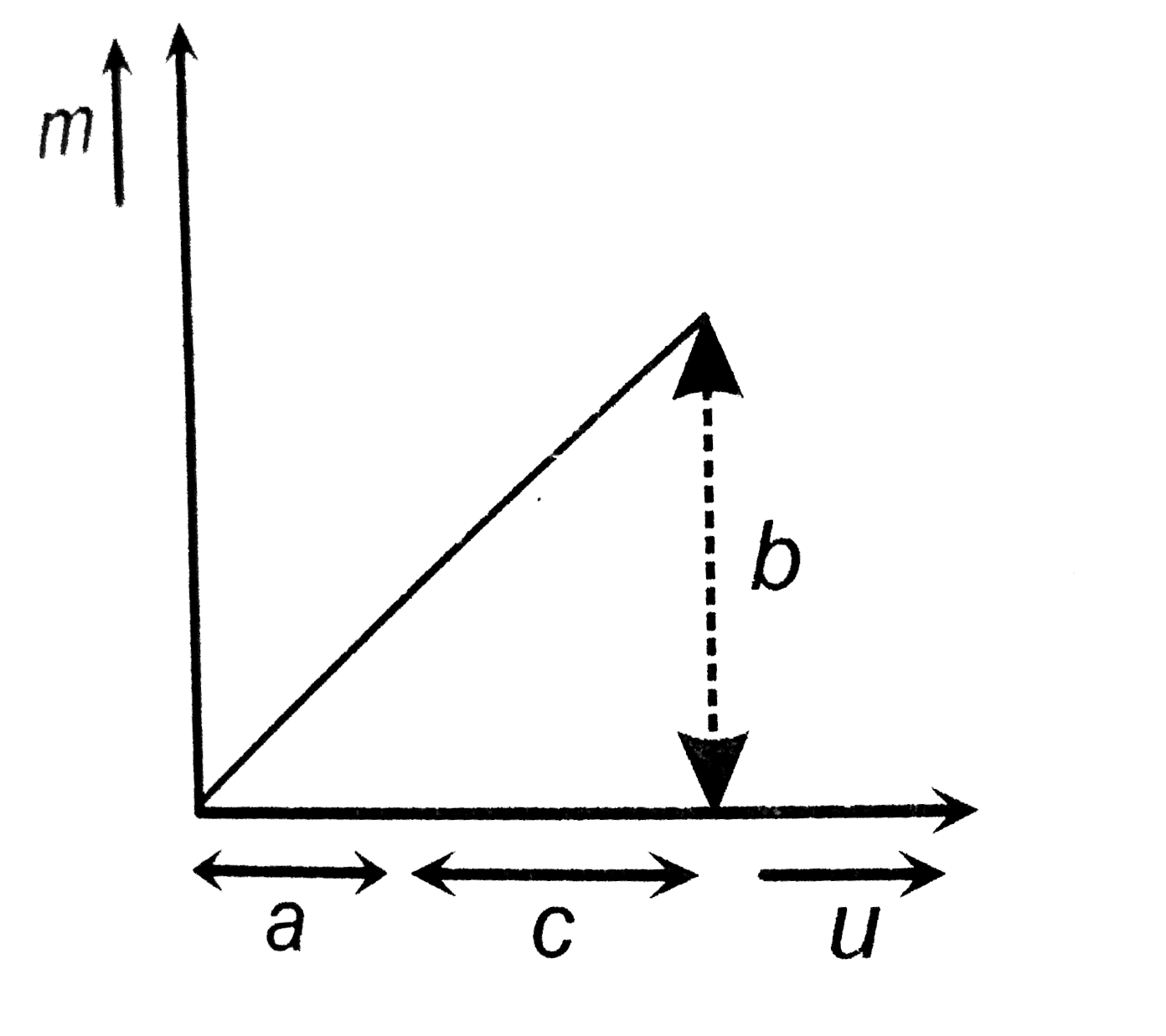
The graph shows how the magnification `m` produced by a convex thin lens varies with image distance `v`. What was the focal length of the used ?

A

`(b)/(c)`

B

`(b)/(ca)`

C

`(bc)/(a)`

D

`(c)/(b)`

Text Solution

Verified by Experts

The correct Answer is:

D

For a lens `m=(f-v)/(f)=-(1)/(f)v+1`
Comparing it with `y=mx+c`
Slope `=m=-(1)/(f)`
From graph, slpe of the line `=(b)/(c)`
Hence `-(1)/(f)=(b)/(c)implies|f|=(c)/(b)`
Promotional Banner

Topper's Solved these Questions

  • GEOMETRICAL OPTICS

    A2Z|Exercise Assertion Reason|15 Videos
  • ELECTROMAGNETIC WAVES AND COMMUNICATION SYSTEM

    A2Z|Exercise Section D - Chapter End Test|30 Videos
  • MAGNETISM AND MATTER

    A2Z|Exercise Section D - Chapter End Test|30 Videos

Similar Questions

Explore conceptually related problems

The graph shows how the magnification m produced by a thin lens varies with image distance v. What is the focal length of the lens used?

The graph in Fig. shows how the inverse of magnification 1//m produced by a convex thin lens varies with object distance u . What was the focal length of the lens used ? .

The graps shows the variation of magnification m produced by as convex lens with the image distance v . The focal length of the lens is

The graph between the lateral magnification (m) produced by a lens and the distance of the image (v) is given by

Figure, shows variation of magnification m (produced by a thin convex lens) and distance v of image from pole of the lens. When of the following statements are correct?

The magnification of the real images produced by a convex lens varies from one to infinity. What are the values of the distances of the object from the lens for these magnifications ?

The graph in shows the variation of image distance (v) with object distance (u) in case of a lens. Find focal length of the lens. What is the nature of the lens, if image formed is real ? .

If the image formed by a thin convex lens of power P has magnification m then image distance v is

How does the magnification (m) of the real image formed by a lens vary with the distance (x) of the object from the focus of a concave mirror ?

The magnification power of a convex lens of focal length 10cm, when the image is formed at the near point is

A2Z-GEOMETRICAL OPTICS-Section D - Chapter End Test
  1. When the distance between the object and the screen is more than 4 f....

    Text Solution

    |

  2. a convex lens of power +6 diopter is placed in contact with a concave ...

    Text Solution

    |

  3. A concave lens of focal length 20 cm product an image half in size of ...

    Text Solution

    |

  4. A convex lens of focal length 1.0m and a concave lens of focal length ...

    Text Solution

    |

  5. If in a planoconvex lens, the radius of curvature of the convex surfac...

    Text Solution

    |

  6. A convex lens A of focal length 20cm and a concave lens G of focal le...

    Text Solution

    |

  7. The radii of curvature of the two surfaces of a lens are 20cm and 30 c...

    Text Solution

    |

  8. A lens forms a virtual image 4 cm away from it when an object is place...

    Text Solution

    |

  9. A concave lens of focal length (1)/(3)m forms a real, inverted image t...

    Text Solution

    |

  10. An object is placed at a distance of f//2 from a convex lens. The imag...

    Text Solution

    |

  11. The graph shows how the magnification m produced by a convex thin len...

    Text Solution

    |

  12. A convex lens forms an image of an object placed 20cm away from it at ...

    Text Solution

    |

  13. A converging lens is to projected image of a lamp 4 times the size of ...

    Text Solution

    |

  14. A thin lens produces an upright image of the same size as the object. ...

    Text Solution

    |

  15. A convex lens of focal length 10cm and concave lens of focal length 20...

    Text Solution

    |

  16. The focal lengths of the objective and eye- lens of a microscope are 1...

    Text Solution

    |

  17. A microscope has an objective of focal length 1.5 cm and eye piece of ...

    Text Solution

    |

  18. An equiconvex lens is cut into two halves along (i) XOX^(') and (ii) Y...

    Text Solution

    |

  19. Assertion : For the sensitivity of a camera, its aperture should be re...

    Text Solution

    |

  20. Assertion : The mirrors used in search lights are parabolic and not co...

    Text Solution

    |
