Home
Class 12
CHEMISTRY
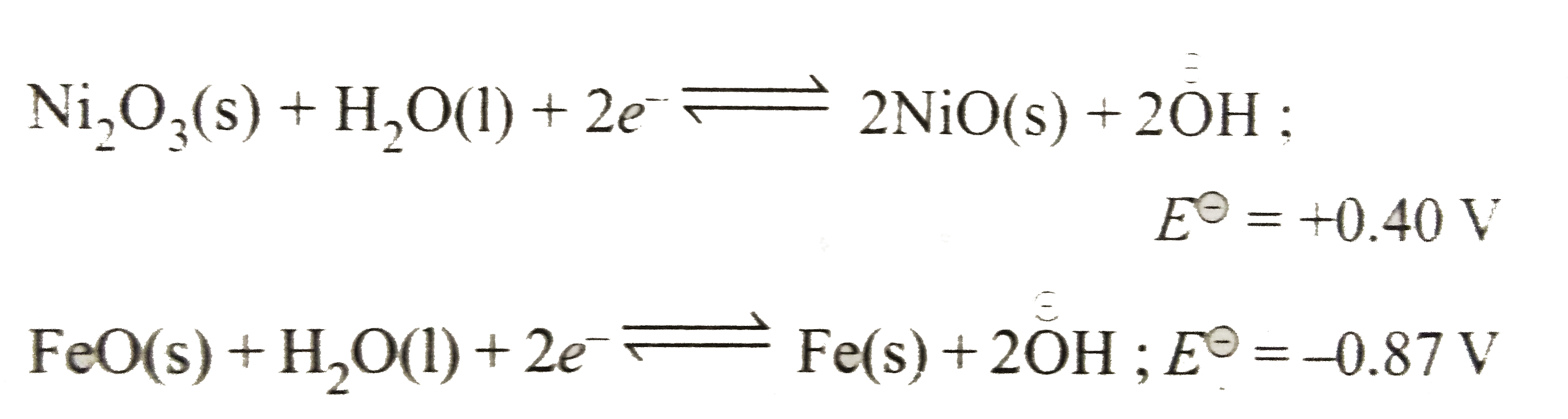
The Edison storage cell is represented a...

The Edison storage cell is represented as `:`
`Fe(s)|FeO(s)|KOH(aq)|Ni_(2)O_(3)(s)|Ni(s)`
The half`-` cell reactions are `:`

`a.` What is the cell reaction ?
`b.` What is the cell `EMF` ? How does it depend on the concentration of `KOH` ?
`c.` What is maximum amount of electrical energy that can be obtained from `1 mol ` of `Ni_(2)O_(3)` ?

Text Solution

Verified by Experts

Given, `E_("FeO"//Fe)^(@) = -0.87, E_(Ni_(2)O_(3)//NiO) = +0.40 V`
`:. E_("Fe"//FeO)^(@) = +0.87 V, E_(NiO_(3)//Ni_(2)O_(3)) = -0.40 V`
Since , `E_(OP)^(@)` for `Fe//FeOgtE_(OP)^(@)` for `NiO // Ni_(2)O_(3)`, and thus, redox changes are,
At anode: `Fe_((s)) + 2OH^(-) rarr FeO_((s)) + underset(("oxidation"))(H_(2)O_((l)) + 2e)`
At cathode: `Ni_(2)O_(3_((s))) + H_(2)O_((l)) + 2e rarr 2NiO_((s)) + underset(("reducation"))(2OH^(-))`
Redox reaction:
`Fe_((s)) + Ni_(2)O_(3(s)) rarr FeO_((s)) + 2NiO_((s))`
(i) `E_(cell) = E_(OP_(Fe//FeO))^(@) - (0.059)/(2)log_(10).([H_(2)O])/([OH^(-)]^(2)) + E_(RP_(Ni_(2)O_(3)//NiO))^(@) + (0.059)/(2)log_(10).([H_(2)O])/([OH^(-)]^(2))`
`= E_(OP_(Fe//FeO))^(@) + E_(RP_(Ni_(2)O_(3)//NiO))^(@) = 0.87 + 0.40 = 1.27 V`
(ii) The `E_(cell)` is indepdent of `OH^(-)` ion concentration.
(iii) `-DeltaG^(@) = nE^(@)F = 2 xx 1.27 xx 96500 = 245110J`
`= 245.11 kJ`
Promotional Banner

Topper's Solved these Questions

  • ELECTROCHEMISTRY

    P BAHADUR|Exercise (A) ELECTROLYSIS|2 Videos
  • ELECTROCHEMISTRY

    P BAHADUR|Exercise (B) ELECTRODE POTENTIAL AND EMF|1 Videos
  • DILUTE SOLUTION AND COLLIGATIVE PROPERTIES

    P BAHADUR|Exercise Exercise 9 Advanced Numerical|12 Videos
  • MOCK TEST PAPER

    P BAHADUR|Exercise Exercise|92 Videos

Similar Questions

Explore conceptually related problems

The Edison storage cell is represented as Fe(s)|FeO(s)|KOH (aq)|Ni_(2)O_(3)(s)|Ni(s) the half-cell reactions are Ni_(2)O_(3)(s)+H_(2)O(l)+2e^(-) hArr 2NiO(s)+ 2OH^(-), E^(@)= + 0.40 V FeO(s)+H_(2)O(l) +2e^(-) hArr Fe(s)+2OH^(-), E^(@)=- 0.87 V What is the maximum amount of electrical energy that can be obtained from one mole of Ni_(2)O_(3) ?

The Edison storage cell is represented as, Fe_((s))|FeO_(S)||KOH_((aq.))||Ni_(2)O_(3(S))|No_((S)) the half-cell reactions are : Ni_(2)O_(3(S))+H_(2)O_((l))+2e^(-)rarr 2NiO_((S))+2OH^(-) , E^(@)=+0.40V FeO_((S))+H_(2)O_((I))+2e^(-)rarr Fe_((S))+2OH^(-) , E^(@)=-0.87V (i) What is the cell reaction ? (ii) What is the cell e.m.f. ? How does ir depend on the concentration of KOH ? (iii) What is the maximum amount of electrical energy that can be obtained from one mole of Ni_(2)O_(3) ?

A voltaic cell whose cell reaction is 2Fe^(3+)(aq) + Zn(s) = 2Fe^(2+)(aq) + Zn^(2+) (aq) has an e.m.f. of 0.72 V. What is the maximum electrical work that can be obtained from the cell per mole of Fe (II) ion?

For the voltaic cell respresents below Ni(s) | Ni^(2+)(aq) || Ag^(+)(aq) | Ag(s) Which change will increase the cell potential?

In the cell reaction Ag_((s))+Cu(aq))^(2+)+Br_((aq))^(-) to AgBr_((s))+Cu_((s)) the reduction half reaction is

P BAHADUR-ELECTROCHEMISTRY-Exercise (9) ADVANCED NUMERICAL PROBLEMS
  1. The Edison storage cell is represented as : Fe(s)|FeO(s)|KOH(aq)|Ni(...

    Text Solution

    |

  2. A current of 0.5 A is passed through acidulated water for 30 minute. C...

    Text Solution

    |

  3. A copper cell containing 5% solution of CuSO(4).5H(2)O and a silver ce...

    Text Solution

    |

  4. Some quantity of electricity being used to liberate iodine (at anode) ...

    Text Solution

    |

  5. A test for complete romovel of Cu^(2+) ions form a solution of Cu((aq....

    Text Solution

    |

  6. A Zn rod weighing 25g was kept in 100 mL of 1M CuSO(4) solution. After...

    Text Solution

    |

  7. Assume that impure copper contains only Fe, Au and Ag as impurities. A...

    Text Solution

    |

  8. 50 mL of 0.1 M CuSO(4) solution is electrolysed using Pt electrodes wi...

    Text Solution

    |

  9. An oxide of metal ("at. wt. "= 112) contain 12.5% O(2) by weight. The ...

    Text Solution

    |

  10. 19g fused SnCl(2) was electrolysed using inert electrodes. 0.119g Sn w...

    Text Solution

    |

  11. A lead storage cell is discharged which causes the H(2)SO(4) electroly...

    Text Solution

    |

  12. Two litre solution of a buffer mixture containing 1.0 M NaH(2)PO(4) an...

    Text Solution

    |

  13. A current of 40 microampere is passed through a solution of AgNO(3) fo...

    Text Solution

    |

  14. Suppose a fully charged battery containes 1.50 litre of 5.0 M H(2)SO(4...

    Text Solution

    |

  15. In an analytical determination of aresenic , a solution containing are...

    Text Solution

    |

  16. Assuming that a constant current is delivered, how many kW-h of electr...

    Text Solution

    |

  17. Find the e.m.f. of the following cell at 18^(@)C taking the degree of ...

    Text Solution

    |

  18. If it is disreed to construct the following voltaic cell to have E(cel...

    Text Solution

    |

  19. The e.m.f. of the obtained by combining Zn and Cu electrodes of Danie...

    Text Solution

    |

  20. Calcualte the potential of an indicator electrode versus the standard ...

    Text Solution

    |

  21. An electrode is prepared by dipping a silver strip into a solution sat...

    Text Solution

    |
