Home
Class 11
PHYSICS
Two masses of 500 kg each are placed at ...

Two masses of `500 kg` each are placed at two points `A` and `B`, distance `5 m` apart. There is a point `P` such that `AP = 3 m` and `BP = 4 m`. Find (i) the magnitude of gravitational intensity at `P` and
(ii) gravitational potential at `P`.
Given `G = 6.67 xx 10^(-11) Nm^(2) kg^(-2)`.

Text Solution

Verified by Experts
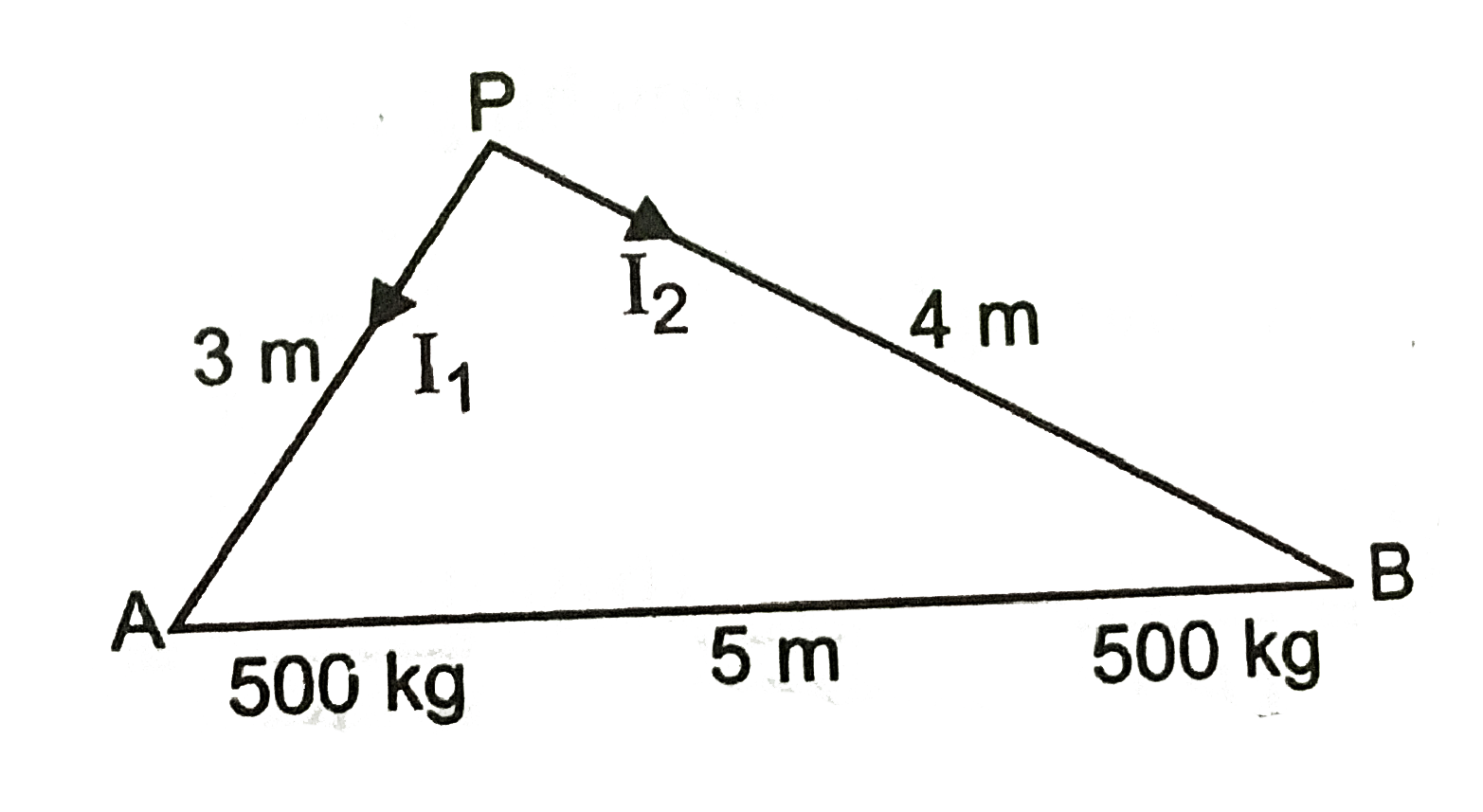
Refer to Fig.
`5^(2) = 3^(2) + 4^(2)` or `AB^(2) = (AP)^(2) + (BP)^(2)`
So `/_APB = 90^(@)`

(i) Gravitational intensity at `P` due to mass at `A` is
`I_(1) = (G xx 500)/((3)^(2)) = (500)/(9) G along PA`
Gravitational intensity at `P` due to mass at `B` is
`I_(2) = (G xx 500)/((4)^(2)) = (500)/(16) G along PB`
As `/_APB = 90^(@)`, so the resultant gravitational intensity (in magnitude) at `P` is
`I = sqrt(I_(1)^(2) + I_(2)^(2)) = sqrt(((500)/(9)G)^(2) + ((500G)/(16))^(2))`
`=- (6.67 xx 10^(-11) xx 500 xx 7)/(12)`
`= - 1.945 xx 10^(-8) J kg^(-1)`
Promotional Banner

Topper's Solved these Questions

  • GRAVIATION

    PRADEEP|Exercise PROBLEMS FOR PRACTIVE B|1 Videos
  • GRAVIATION

    PRADEEP|Exercise PROBLEMS FOR PRACTIVE C|1 Videos
  • GRAVIATION

    PRADEEP|Exercise PROBLEMS FOR PRACTIVE A|1 Videos
  • BEHAVIOUR OF PERFECT GAS & KINETIC THEORY

    PRADEEP|Exercise Assertion - Reason Type questions|14 Videos
  • KINEMATICS

    PRADEEP|Exercise 1 NCERT Comprehension|4 Videos

Similar Questions

Explore conceptually related problems

Two bodies of masses 100 kg and 10,000 kg are at a distance 1 m apart. At which point on the line joining them will the resultant gravitational field intensity is zero? What is the gravitational potential at that point ? G = 6.67 xx 10^(-11) Nm^(2) kg^(-2) .

Give the order of the following : Gravitational constant ( 6.67xx10^(-11)N-m^(2)//kg^(2) )

A point mass body of mass 2 kg is placed at a distance 20 cm from one end of a uniform rod of length 2 m and mass 10 kg . Calculate (i) gravitational intensity at the location of point mass body due to the rod. (ii) gravitational force on the body due to the rod. Use G = 6.67 xx 10^(-11) Nm^(2) kg^(-2) .

Two point masses m and 2m are kept at points A and B as shown. E represents magnitude of gravitational field strength and V the gravitational potential. As we move from A to B

Three masses of 1 kg, 2kg, and 3 kg are placed at the vertices of an equilateral triangle of side 1m. Find the gravitational potential energy of this system (Take, G = 6.67 xx 10^(-11) "N-m"^(-2)kg^(-2) )

Three masses of 1kg , 2kg , and 3kg , are placed at the vertices of an equilateral traingle of side 1m . Find the gravitational potential energy of this system. Take G= 6.67xx10^(-11) N-m^(2)//kg^(2) .

Four point mass bodies of masses as shown in Fig. are placed at the vertices of a square ABCD , gravitational force on the body at A . Given, G = 6.6 xx 10^(-11) Nm^(2) kg^(-2)

The bodies of mass m and 4m are placed at a distance of 6m apart. P is the point on the line joining two bodies where gravitational field is zero. The gravitational potential at this point is

The bodies of mass 100 kg and 8100 kg are held at a distance of 1 m. The gravitational field at a point on the line joining them is zero. The gravitational potential at that point in J/kg is (G= 6.67xx10^(-11)Nm^2//kg^2 )

PRADEEP-GRAVIATION-PROBLEMS FOR PRACTIVE
  1. How far from Earth must a body be along a line joining the sun to the ...

    Text Solution

    |

  2. calculate the gravitaional intensity and graviational potential at a l...

    Text Solution

    |

  3. Two masses of 500 kg each are placed at two points A and B, distance 5...

    Text Solution

    |

  4. What is the minimum energy required to launch a satellite of mass m fr...

    Text Solution

    |

  5. A satellite of a mass m orbits the earth at a hight h above the surfac...

    Text Solution

    |

  6. Calculate the gravitational potential energy of a body of mass 30 kg,...

    Text Solution

    |

  7. In the solar system, the Sun is in the focus of the system for Sun-ear...

    Text Solution

    |

  8. An artifical satellitee of mass 100 kg is in a circular orbit at 500 k...

    Text Solution

    |

  9. The orbit of a geostationary satellite is concentric and coplanar with...

    Text Solution

    |

  10. An Earth's satellite makes a circule around the Earth in 100 minutes. ...

    Text Solution

    |

  11. The radius of a planet is R. A satellite revolves around it in a circl...

    Text Solution

    |

  12. The escape speed of a body on the earth's surface is 11.2kms^(-1). A b...

    Text Solution

    |

  13. A body is projected vertically upwards from the surface of the Earth s...

    Text Solution

    |

  14. A spaceship is launched into a circular orbit close to the earth's sur...

    Text Solution

    |

  15. The mass of the earth is 6.0 xx 10^(24) kg and its radius is 6.4 xx 10...

    Text Solution

    |

  16. A body of mass 50 kg falls on the earth from infinity. What will be it...

    Text Solution

    |

  17. Find the work done to bring 4 particle each of mass 100 gram from dist...

    Text Solution

    |

  18. Two masses, 800 kg and 600 kg are at a distance 0.25 m apart. The magn...

    Text Solution

    |

  19. Infinite number of masses, each of mass m, are placed along a straight...

    Text Solution

    |

  20. In an imaginary planetary systam, the centrel star has the same mass a...

    Text Solution

    |

