Home
Class 11
PHYSICS
particles of masses 2M m and M are resec...

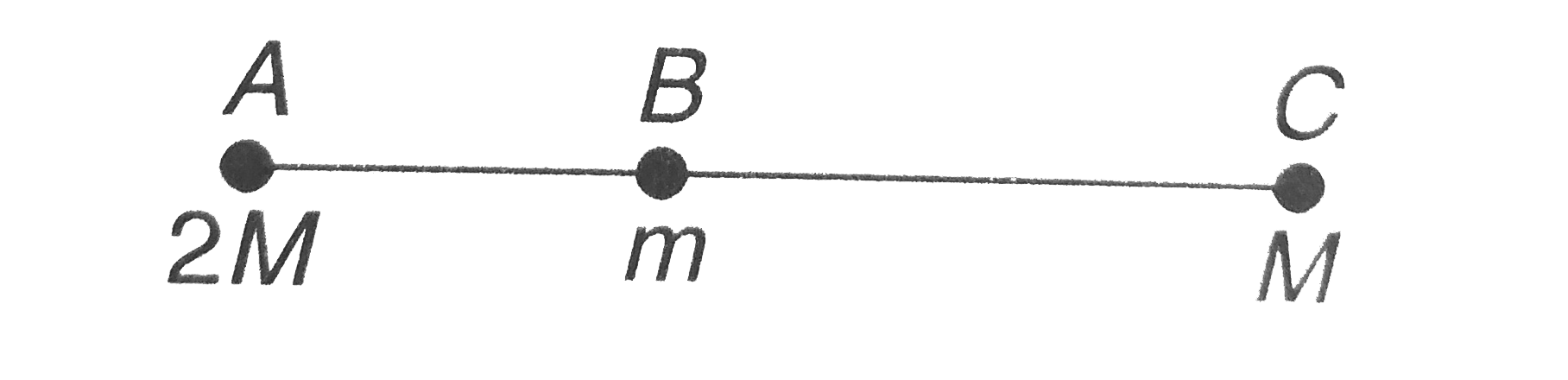
particles of masses 2M m and M are resectively at points A , B and C with ` AB = (1)/(2) (BC)` m is much - much smaller than M and at time ` t=0` they are all at rest as given in figure . As subsequent times before any collision takes palce .

A

`m` will remains at rest.

B

`m` will move towards `M`

C

`m` will move towards `2 M`.

D

`m` will have oscillatory motion.

Text Solution

Verified by Experts

The correct Answer is:

C

Resultant force on mass `m` due to masses at `A` and `B` is `F = (G2M xx m)/((AB)^(2)) - (GMm)/((BC)^(2))` towards `BA`.
Therefore, `m` will move towards `2M`.
Promotional Banner

Topper's Solved these Questions

  • GRAVIATION

    PRADEEP|Exercise FILL IN THE BLANKS|11 Videos
  • GRAVIATION

    PRADEEP|Exercise PROBLEMS FOR PRACTIVE A|1 Videos
  • GRAVIATION

    PRADEEP|Exercise CURIOSITY QUESTION|1 Videos
  • BEHAVIOUR OF PERFECT GAS & KINETIC THEORY

    PRADEEP|Exercise Assertion - Reason Type questions|14 Videos
  • KINEMATICS

    PRADEEP|Exercise 1 NCERT Comprehension|4 Videos

Similar Questions

Explore conceptually related problems

Two particle of masses m and 2m are coliding elastically as given in figure. If V_(1) and V_(2) speed of particle just after collision then

A particle A of mass m initially at rest slides down a height of 1.25 m on a frictionless ramp, collides with and sticks to an identical particles B of mass m at rest as shown in the figure. Then, particles A and B together collide elastically with particle G of mass 2m at rest. The speed of particle G after the collision with combined body (A+B) would be (Take, g =10 ms^(-2))

consider a head on collision between two particles of masses m_1 and m_2 . The initial speeds of the particles are u_1 and u_2 in the same directioin. The collision starts at t=0 and the particles interact for a time inteval /_\t. Lduring the collision the speed o the first particle varies as v(t)=u_1+t//_\(v_1-u_1) Find the speed of the second particle as as function of time during the collision.

Blocks of masses m , 2m , 4m and 8m are arranged in a line on a frictionless floor . Another block of mass m , moving with speed v along the same line (see figure ) collides with mass m in perfectly inelastic manner. All the subsequent collisions are also perfectly inelastic. By the time the last block of mass 8 m starts moving the total energy loss is p% of the original energy . Value of 'p' is close to :

Two particles of masses m_1 and m_2 in projectile motion have velocities vecv_1 and vecv_2 respectively at time t=0. They collide at time t_0. Their velocities become vecv_1' and vecv_2' at time 2t_0 while still moving in air. The value of |(m_1vecv_1' + m_2vecv_2') - (m_1vecv_1 + m_2vecv_2)| is

A particle of mass m collides elastically with the pan of mass (M = 2m) of a spring balance, as shown in figure. Pan is in equillibrium before collision. Spring constant is k and speed of the particle before collision is v_(0) . Answer the following three questions regarding this collision. Minimum kinetic energy of the particle after collision is

A particle of mass m collides elastically with the pan of mass (M = 2m) of a spring balance, as shown in figure. Pan is in equillibrium before collision. Spring constant is k and speed of the particle before collision is v_(0) . Answer the following three questions regarding this collision. Maximum compression in the spring after the collision the

At time t=0 , a particle is at (-1m, 2m) and at t=2s it is at (-4m,6m) . From this we can conclude that in the given time interval.

PRADEEP-GRAVIATION-MULTIPLE CHOICE QUESTIONS
  1. In our solar system, the inter-planetery region has chunks of matter (...

    Text Solution

    |

  2. Choose the wrong option.

    Text Solution

    |

  3. particles of masses 2M m and M are resectively at points A , B and C w...

    Text Solution

    |

  4. If the law of gravitational, instead of being inverse-square law, beco...

    Text Solution

    |

  5. If the mass of the sun were ten times smaller and the universal gravit...

    Text Solution

    |

  6. If the sun and the planets carried huge amounts of opposite charges

    Text Solution

    |

  7. There have been suggestions that the value of the gravitational consta...

    Text Solution

    |

  8. Supposing Newton's law of gravitation for gravitation force F(1) and F...

    Text Solution

    |

  9. Which of the following are true?

    Text Solution

    |

  10. The centre of mass of a body

    Text Solution

    |

  11. The largest and the shortest distance of the earth from the sun are r(...

    Text Solution

    |

  12. A satellite is launched into a circular orbit of radius R around the e...

    Text Solution

    |

  13. A geo-stationary stellite orbits around the earth in a circular orbit ...

    Text Solution

    |

  14. Two small satellies move in a circular orbits around the earth, at dis...

    Text Solution

    |

  15. A system of binary stars of mass m(A) and m(B) are moving in circular ...

    Text Solution

    |

  16. A geostationary satellite is orbiting the earth at a height of 5R abov...

    Text Solution

    |

  17. A satellite moves in a circle around the earth. The radius of this cir...

    Text Solution

    |

  18. A geostationary satellite orbits around the earth in a circular orbit ...

    Text Solution

    |

  19. If the distance between the earth and the sun were half its present va...

    Text Solution

    |

  20. A U-tube with both ends open to the atmosphere is partially filled wit...

    Text Solution

    |
