Home
Class 11
PHYSICS
A particle is placed at the origin and a...

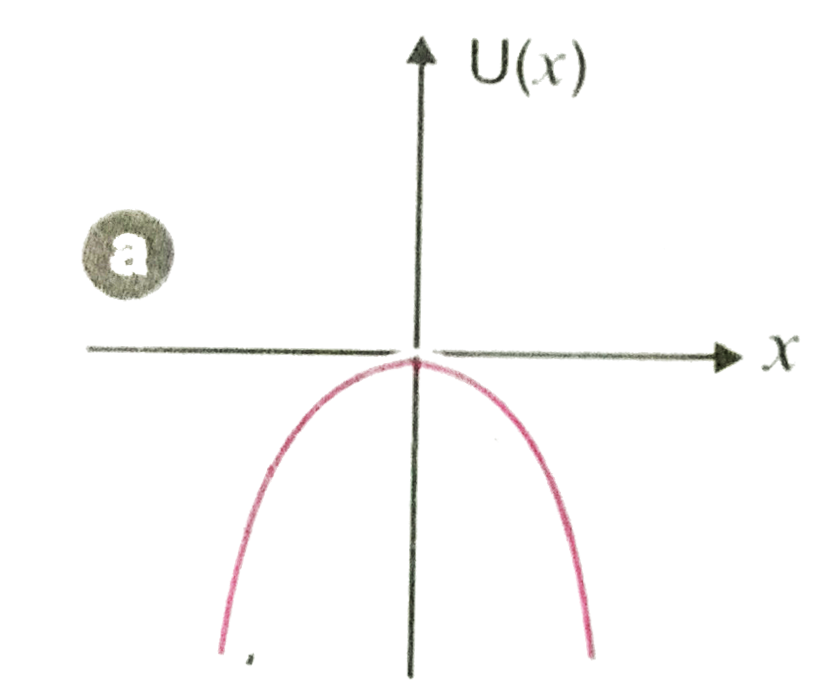
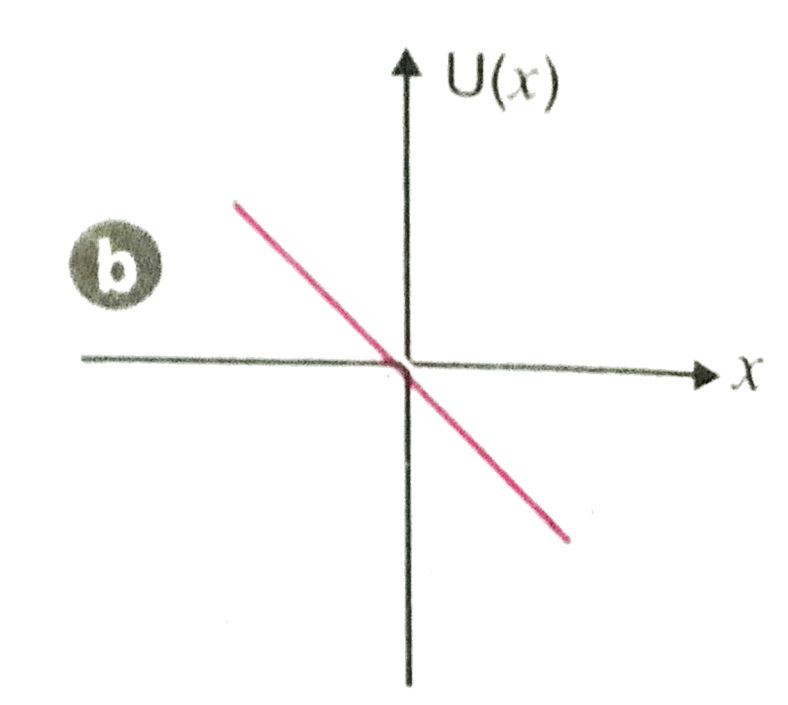
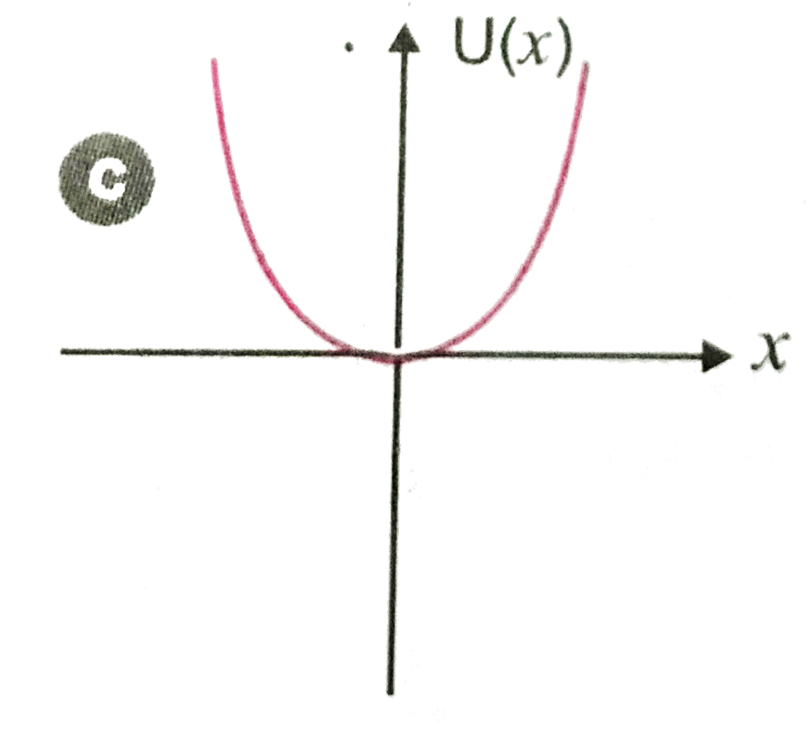
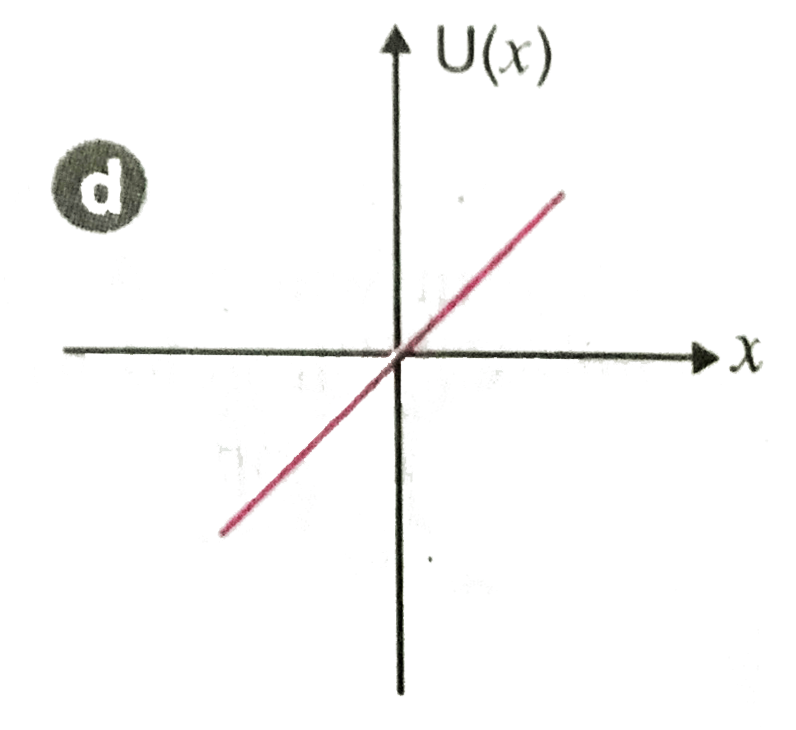
A particle is placed at the origin and a force F=Kx is acting on it (where k is a positive constant). If `U_((0))=0`, the graph of `U (x)` verses x will be (where U is the potential energy function.)

A

B

C

D

Text Solution

AI Generated Solution

The correct Answer is:

To solve the problem of finding the potential energy function \( U(x) \) given the force \( F = kx \), we can follow these steps: ### Step 1: Understand the relationship between force and potential energy The force acting on a particle is related to the potential energy by the equation: \[ F = -\frac{dU}{dx} \] This means that the force is equal to the negative gradient (or derivative) of the potential energy function. ### Step 2: Substitute the given force into the equation We are given that: \[ F = kx \] Substituting this into the relationship gives: \[ kx = -\frac{dU}{dx} \] ### Step 3: Rearrange the equation Rearranging the equation to isolate \( dU \): \[ dU = -kx \, dx \] ### Step 4: Integrate both sides To find \( U(x) \), we need to integrate: \[ U(x) = -\int kx \, dx \] Calculating the integral: \[ U(x) = -\left(\frac{k}{2} x^2\right) + C \] where \( C \) is the constant of integration. ### Step 5: Determine the constant of integration We are given that the potential energy at \( x = 0 \) is \( U(0) = 0 \). Substituting \( x = 0 \) into the equation: \[ U(0) = -\frac{k}{2}(0)^2 + C = 0 \] This implies that \( C = 0 \). ### Step 6: Write the final expression for potential energy Thus, the potential energy function is: \[ U(x) = -\frac{k}{2} x^2 \] ### Step 7: Analyze the graph of \( U(x) \) The function \( U(x) = -\frac{k}{2} x^2 \) represents a downward-opening parabola. The vertex of this parabola is at the origin (0,0), and it decreases as \( |x| \) increases. ### Conclusion The graph of \( U(x) \) versus \( x \) will be a downward-opening parabola. ---

To solve the problem of finding the potential energy function \( U(x) \) given the force \( F = kx \), we can follow these steps: ### Step 1: Understand the relationship between force and potential energy The force acting on a particle is related to the potential energy by the equation: \[ F = -\frac{dU}{dx} \] This means that the force is equal to the negative gradient (or derivative) of the potential energy function. ...
Promotional Banner

Topper's Solved these Questions

  • PROPERTIES OF BULK MATTER

    PRADEEP|Exercise Integer Type Questions|12 Videos
  • PROPERTIES OF BULK MATTER

    PRADEEP|Exercise Asseration - Reason Type Question|18 Videos
  • PROPERTIES OF BULK MATTER

    PRADEEP|Exercise Multiple choice questions-II|14 Videos
  • PHYSICAL WORLD AND MEASUREMENT

    PRADEEP|Exercise Competiton Focus Jee Medical Entrance|18 Videos
  • RAY OPTICS

    PRADEEP|Exercise Problem For Practice(a)|25 Videos

Similar Questions

Explore conceptually related problems

On a particle placed at origin a variable force F=-ax (where a is a positive constant) is applied. If U(0)=0, the graph between potential energy of particle U(x) and x is best represented by:-

A particle of mass m is executing osciallations about the origin on the x-axis with amplitude A. its potential energy is given as U(x)=alphax^(4) , where alpha is a positive constant. The x-coordinate of mass where potential energy is one-third the kinetic energy of particle is

A particle free to move along x-axis is acted upon by a force F=-ax+bx^(2) whrte a and b are positive constants. For ximplies0 , the correct variation of potential energy function U(x) is best represented by.

A particle, which is constrained to move along x-axis, is subjected to a force in the some direction which varies with thedistance x of the particle from the origin an F (x) =-kx + ax^(3) . Here, k and a are positive constants. For x(ge0, the functional form of the potential energy (u) U of the U (x) the porticle is. (a) , (b) , (c) , (d) .

The potential energy U for a force field vec (F) is such that U=- kxy where K is a constant . Then

The potential energy of configuration changes in x and y directions as U=kxy , where k is a positive constant. Find the force acting on the particle of the system as the function of x and y.

PRADEEP-PROPERTIES OF BULK MATTER-Multiple choice questions-I
  1. Two small drop of mercury, each of radius R coalesce in from a simple ...

    Text Solution

    |

  2. Work W is required to form a bubble of volume V from a given solution....

    Text Solution

    |

  3. A particle is placed at the origin and a force F=Kx is acting on it (w...

    Text Solution

    |

  4. The potential energy function for the force between two atoms in a dia...

    Text Solution

    |

  5. A certain number of spherical drops of a liquid of radius r coalesce t...

    Text Solution

    |

  6. Assume that a drop of liquid evaporates by decreases in its surface en...

    Text Solution

    |

  7. On heating water, bubbles being formed at the bottom of the vessel det...

    Text Solution

    |

  8. Under isothermal condition two soap bubbles of radii r(1) and r(2) coa...

    Text Solution

    |

  9. The lower end of a capillary tube is dipped in water. Water rises to a...

    Text Solution

    |

  10. The lower end of a capillary tube of radius r is placed vertically in ...

    Text Solution

    |

  11. A capillary tube of radius r is immersed in water and water rises in t...

    Text Solution

    |

  12. A glass capillary tube is of the shape of a truncated cone with an ape...

    Text Solution

    |

  13. Water rises to height h in capillary tube. If the length of capillary ...

    Text Solution

    |

  14. if a ball of steel (density rho=7.8 g//cm^(3)) attains a terminal velo...

    Text Solution

    |

  15. The velocity of small ball of mass M and density d(1) when dropped a c...

    Text Solution

    |

  16. A small sphere of mass m is dropped from a great height. After it has ...

    Text Solution

    |

  17. The rate of steady volume flow of water through a capillary tube of le...

    Text Solution

    |

  18. A lead shot of 1 mm diameter falls through a long colummn of glycerine...

    Text Solution

    |

  19. Two solild spheres manufactured of the same material freely fall down ...

    Text Solution

    |

  20. A spherical solild of volume V is made of a material of density rho(1)...

    Text Solution

    |
