Home
Class 11
PHYSICS
An ideal monoatomic gas is confined in a...

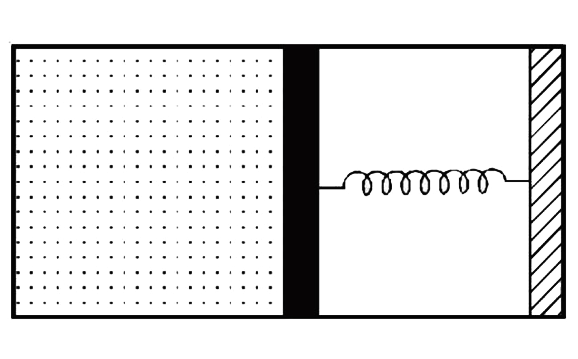
An ideal monoatomic gas is confined in a horizontal cylinder by a spring loaded piston (as shown in the figure). Initially the gas is at temperature `T_1`, pressure `P_1` and volume `V_1`and the spring is in its relaxed state. The gas is then heated very slowly to temperature `T_2`,pressure `P_2`and volume `V_2`. During this process the piston moves out by a distance x. Ignoring the friction between the piston and the cylinder, the correct statement (s) is (are)

A

If `V_(2) = 2V_(1) and T_(2)=3T_(1)`, then the energy stored in the string is `1/4 P_(1)V_(1)`

B

If `V_(2) and 2V_(1)` and `T_(2) = 3T_(1)`, then the charge in iternal energy is `3P_(1)V_(1)`.

C

If `V_(2)=3V_(1)` and `T_(2) = 4T_(1)`, then the work done by the gas is `7/3 P_(1)V_(1)`

D

If `V_(2) = 3V_(1)` and `T_(2) = 4T_(1)`, then the heat supplied to the gas is `17/6 P_(1)V_(1)`.

Text Solution

Verified by Experts

The correct Answer is:

B

From gas equation , `(P_(1)V_(1))/(T_1) = (P_(2)V_(2))/(T_2) = nR or P_(2) = (P_(1)V_(1)T_(2))/(V_(2)T_(1)) ` ...(i)
(a) when `V_(2) = 2 V_(1), T_(2) = 3T_(1)`, then
`P_(2) = (P_(1)V_(1) xx 3T_(1))/(2 V_(1) xx T_(1)) = 3/2 P_(1)`
If A is the area of cross- section of the piston, then
`P_(2)A = kx or P_(2)Ax = kx^(2)`
Energy in spring , `U = 1/2 kx^(2) = 1/2 P_(2) Ax`
`=1/2 P_(2)(V_(2)-V_(1))`
`=1/2 xx (3P_1)/(2) (2V_(1)-V_(1)) = 3/4 P_(1)V_(1)`
Thus, option (a) is wrong.
(b) When `V_(2) = 2V_(1) and T_(2) = 3T_(1) , P_(2) = 3/2P_(1)` [from (i) ]
Change in internal energy ,
`dU = nC_(v) dT = m((3R)/(2)) (T_(2)-T_(1))`
`= n xx (3R)/(2) [3T_(1)-T_(1)] = 3nRT_(1) = 3P_(1)V_(1)`
Thus option (b) is true.
(c) when `V_(2) = 3V_(1) and T_(2) = 4T_(1)`
`P_(2) = (P_(1)V_(1)xx4T_(1))/(3V_(1)xxT_(1)) = 4/2 P_(1)`
Workdone , dW = energy in spring
`1/2kx^(2) = 1/2 P_(2)(V_(2)-V_(1))`
`1/2 xx 4/3 P_(1)[3V_(1)-C_(1)] = 4/3 P_(1)V_(1)`
Thus option (c) is wrong.
(d) when `V_(2) = 3V_(1) and T_(2) = 4T_(1), P_(2) = 4/3 P_(1)`
Heat supplied to the gas, `dQ = dU + dW`
`dQ = n xx (3R)/(2)[T_(2)-T_(1)]+1/2 P_(2)(V_(2)-V_(1))`
`=3/2 nR [4T_(1)-T_(1)] + 1/2 4/3 P_(1)[3V_(1)-V_(1)]`
`= 9/2 nRT_(1)+4/2 P_(1)V_(1) = 9/2 P_(1)V_(1)+ 4/2 P_(1)V_(1) = 35/6 P_(1)V_(1)`.
Thus, option (d) is wrong.
Promotional Banner

Topper's Solved these Questions

  • BEHAVIOUR OF PERFECT GAS & KINETIC THEORY

    PRADEEP|Exercise Multiple choice questions-II|8 Videos
  • BEHAVIOUR OF PERFECT GAS & KINETIC THEORY

    PRADEEP|Exercise Multiple choice questions-III|12 Videos
  • BEHAVIOUR OF PERFECT GAS & KINETIC THEORY

    PRADEEP|Exercise Problems for practice|47 Videos
  • GRAVIATION

    PRADEEP|Exercise Assertion-Reason Type Questions|19 Videos

Similar Questions

Explore conceptually related problems

An ideal monatomic gas is confined in a cylinder by a spring-loaded piston of cross-section 8.0xx10^-3m^2 . Initially the gas is at 300K and occupies a volume of 2.4xx10^-3m^3 and the spring is in its relaxed (unstretched, unompressed) state, fig. The gas is heated by a small electric heater until the piston moves out slowly by 0.1m. Calculate the final temperature of the gas and the heat supplied (in joules) by the heater. The force constant of the spring is 8000 N//m , atmospheric pressure is 1.0xx10^5 Nm^-2 . The cylinder and the piston are thermally insulated. The piston is massless and there is no friction between the piston and the cylinder. Neglect heat loss through lead wires of the heater. The heat capacity of the heater coil is negligible. Assume the spring to be massless.

An ideal monatonic gas is confined in a cylinder by a spring-loaded piston of cross section 8.0xx10^(-3) m^(2). initially the gas is at 300K and occupies a volume of 2.4xx10^(-3)m^(-3) and the sprinng is in its relaxed state. The gas is heated by a small heater until the piston moves out slowly by 0.1m. Calculate the final tenoerature of the gas. The force constant if the spring is 8000Nm^(-1) ,and the atmospheric pressure is 1.0xx10^(5)Nm^(-2).Hte cylinder and the piston are thermally insylated. The piston and the spring are massless and there is no friction between the piston and the cylinder. Neglect any heat-loss through the lead wires of the heater. The heat capacity of the heater coil is negligible.

During an experiment, an ideal gas is found to obey a condition Vp^2 = constant. The gas is initially at a temperature (T), pressure (p) and volume (V). The gas expands to volume (4V).

One mole of an ideal gas is contained with in a cylinder by a frictionless piston and is initially at temperature T. The pressure of the gas is kept constant while it is heated and its volume doubles. If R is molar gas constant, the work done by the gas in increasing its volume is

One mole of an ideal monatomic gas undergoes a linear process from A to B , in which is pressure P and its volume V change as shown in figure . The absolute temperature T versus volume V for the given process is

A monoatomic gas is enclosed in a nonconducting cylinder having a piston which can move freely. Suddenly gas is compressed to 1//8 of its initial volume. Find the final pressure and temperature if initial pressure and temperature are P_(0) and T_(0) respectively.

Two moles of an ideal monoatomic gas are confined within a cylinder by a massless and frictionless spring loaded piston of cross-sectional area 4 xx 10^(-3)m^(2) . The spring is, initially in its relaxed state. Now the gas is heated by an electric heater, placed inside the cylinder, for some time. During this time, the gas expands and does 50J of work in moving the piston through a distance 0.10m . The temperature of the gas increases by 50K . Calculate the spring constant and the heat supplied by the heater. P_(atm) = 1 xx 10^(5)N//m^(2)R = 8.314 J//mol-K

PRADEEP-BEHAVIOUR OF PERFECT GAS & KINETIC THEORY-Multiple choice questions-I
  1. In the given (V-T) diagram, what is the relation between pressure P(1)...

    Text Solution

    |

  2. An open glass tube is immersed in mercury in such a way that a lenth o...

    Text Solution

    |

  3. An ideal monoatomic gas is confined in a horizontal cylinder by a spri...

    Text Solution

    |

  4. The rms speed of oxygen molecules at a certain temperature is upsilon....

    Text Solution

    |

  5. Consider an ideal gas confined in an isolated closed chamber. As the g...

    Text Solution

    |

  6. A gas mixture consists of 2 moles of oxygen and 4 moles of argon at te...

    Text Solution

    |

  7. The ratio of the specific heats (C(P))/(C(upsilon)) = gamma in terms o...

    Text Solution

    |

  8. The molar specific heat of a gas as given from the kinetic theory is (...

    Text Solution

    |

  9. Two vessel separately contains two ideal gases A and B at the same tem...

    Text Solution

    |

  10. A gas is filled in a container at pressure P(0). If the mass of molecu...

    Text Solution

    |

  11. In a mixture of gases, the average number of degrees of freedom per mo...

    Text Solution

    |

  12. Three moles of oxygen ar mixed with two moles of helium. What will be ...

    Text Solution

    |

  13. Four cylinders contain equal number of moles of argon, hydrogen, nitro...

    Text Solution

    |

  14. Oxygen and hydrogen gas are at same temperature and pressure. And the ...

    Text Solution

    |

  15. The average translational energy and the rms speed of molecules in a s...

    Text Solution

    |

  16. The K.E. of one mole of an ideal gas is

    Text Solution

    |

  17. At what temperature is the rms velocity of a hydrogen molecule equal t...

    Text Solution

    |

  18. The molar specific heat at constant pressure of an ideal gas is (7//2 ...

    Text Solution

    |

  19. Two rigid boxes containing different ideal gases are placed on a table...

    Text Solution

    |

  20. Given is the graph between (PV)/T and P for 1 gm of oxygen gas at two ...

    Text Solution

    |
