Home
Class 11
PHYSICS
An empty spherical flask of diameter 15 ...

An empty spherical flask of diameter `15 cm` is placed in water of `mu = 4//3`. A parallel beam of light strikes the flask. Where does it get focussed, when observed from within the flask ?

Text Solution

Verified by Experts
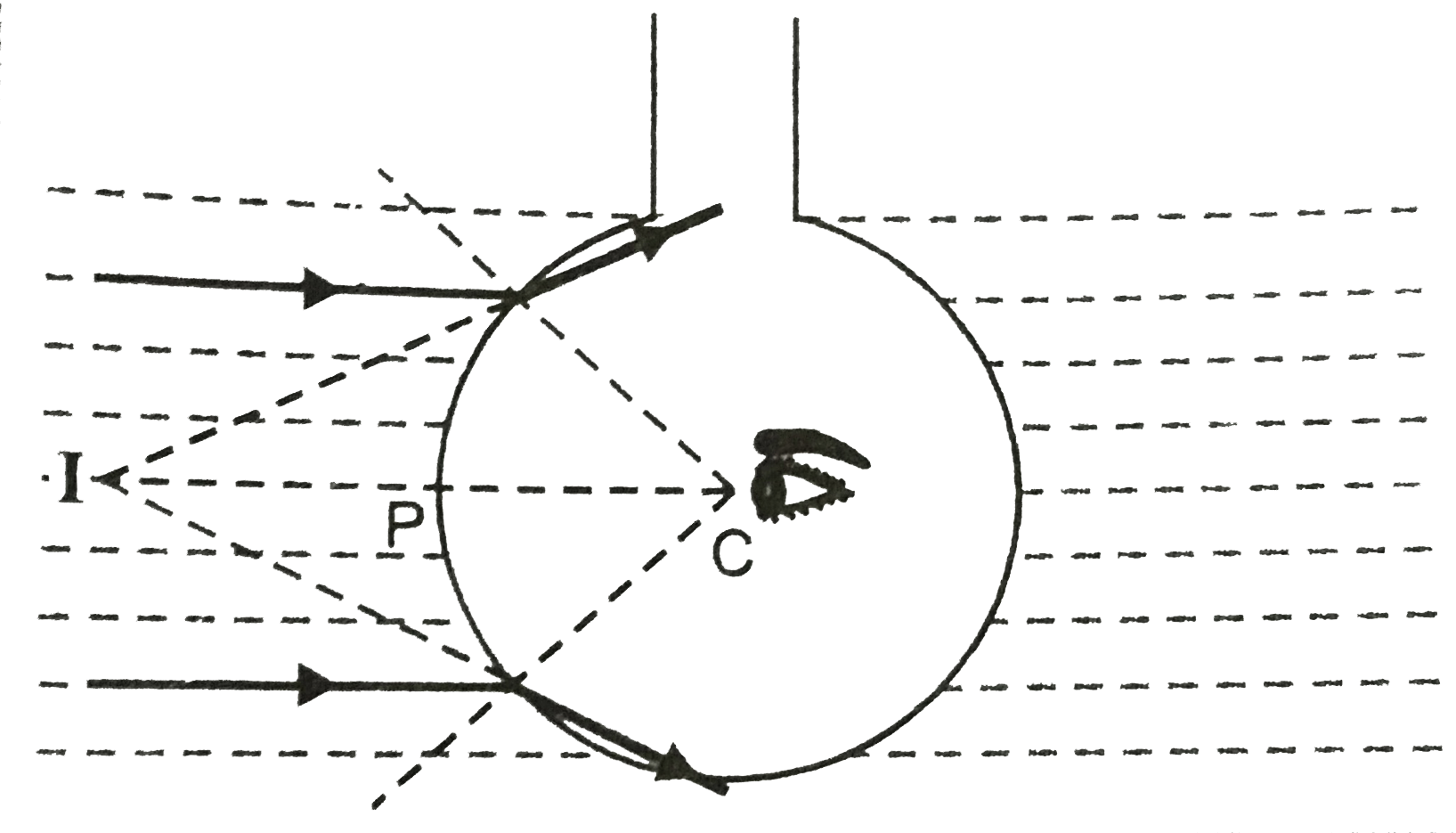
Here, `R = PC = + 15//2 cm`
`mu_2 = 4//3, mu_1 = 1`
For a prallel beam of light, `u = oo`, Fig.
The beam diverges on refraction and appears to come from `I`.
`PI = v = ?`
As refraction ocurs from denser to rarer medium, therefore,
`-(mu_2)/(u)+(mu_1)/(v)=(mu_1 - mu_2)/( R)`
`-(4)/(3 xx oo)+(1)/(v)=(1 - 4//3)/(15//2) = -(2)/(45)`
`v = -(45)/(2) = -22.5 cm`.
.
Promotional Banner

Topper's Solved these Questions

  • RAY OPTICS

    PRADEEP|Exercise Solved Example(c )|21 Videos
  • RAY OPTICS

    PRADEEP|Exercise Solved Example(d)|32 Videos
  • RAY OPTICS

    PRADEEP|Exercise Sample problem(d)|5 Videos
  • PROPERTIES OF BULK MATTER

    PRADEEP|Exercise Multiple choice questions|7 Videos
  • SYSTEMS OF PARTICLES AND ROTATIONAL MOTION

    PRADEEP|Exercise Assertion- Reason Type questions|20 Videos

Similar Questions

Explore conceptually related problems

A sphere of glass (mu = 1.5) is of 20 cm diameter. A parallel beam enters it from one side. Where will it get focussed on the other side ?

A glass sphere of diameter 20 cm is constructed with a material of refractive index 1.5. A beam of light strikes the sphere and converges at a point 40 cm behind the pole of a spherical surface. Find the position of the image.

A sunshine recorder globe is a device that provides the information about climate and weather by recording the amount of sunshine for a given location. One such globe of diameter 20 cm and refractive index 1.5 is used for the purpose. A parallel beam of light enters the globe and is refracted by the spherical surface of the globe. Determine the position of the image of the rays formed.

A spherical surface of radius R separates air from a medium of refractive index mu . Parallel beam of light is incident, from medium side, making a small angle theta with the principal axis of the spherical surface. Find the co-ordinates of the point where the rays will focus in air.

A converging lens of focal length 20cm is separated 8 cm from a diverging lens of focal length 30 cm. A parallel beam of light falls on converging lens and after passing through diverging lens focussed at point P. Find the location of point P. Repeat the calculation for the case when the parallel beam first falls on diverging lens. [4.2 cm from convex lens]

A convex lens of power 3 D is held in contact with a concave lens of power -1D.A parallel beam of light is made to fall on the combination. At what distance from the combination will the beam get focussed?

A spherical ball of transparent material has index of refraction mu. A narrow beam of light AB is aimed as shown. What must the index of refraction be in order that the light is focused at the point C on the opposite end of the diameter from where the light entered? Given that xgt gtR.

A beam of light rays converges to a point O on x-axis as shown. The angle of convergence is small. A cube of glass of refractive index mu = 1.5 and side length 40 cm containing a concentric spherical air cavity of radius 10 cm is to be placed in the path of the converging beam so that the beam emerging from the cube is parallel to x-axis. At what point C on x-axis should the centre of the cube be placed to achieve this? Give the x coordinate of C taking O as origin.

A sunshine recorder globe of 30 cm diameter is made of glass of mu = 1.5 . A ray enters the globe parallel to its axis. Find the position from the centre of the sphere, where the ray crosses the axis.

A parallel beam of light travelling in water (refractive index =4//3) is refracted by a spherical air bublle of radius 2mm situated in water. Assuming the light rays to be paraxial, a. Find the position of image due to refraction at first surface and position of the final image. b. Draw a ray diagram showing the position of both images.

PRADEEP-RAY OPTICS-Solved Example(b)
  1. A mark placed on the surface of a sphere is viewed through glass from ...

    Text Solution

    |

  2. Light from a point source in air falls on a convex spherical glass sur...

    Text Solution

    |

  3. An empty spherical flask of diameter 15 cm is placed in water of mu = ...

    Text Solution

    |

  4. Light from a point source in air falls on a convex spherical glass sur...

    Text Solution

    |

  5. What curvature must be given to the bounding surface of mu = 1.5 for ...

    Text Solution

    |

  6. A sunshine recorder globe of 30 cm diameter is made of glass of mu = 1...

    Text Solution

    |

  7. A biconvex lens has focal length (2)/(3) times the radius of curvature...

    Text Solution

    |

  8. Shows a thin lens with centres of curvature C1 and C2. If mu = 1.5, wh...

    Text Solution

    |

  9. A diverging lens of refractive index 1.5 and focal length 15 cm in air...

    Text Solution

    |

  10. A double convex lens made of glass of refractive index 1.56 has both r...

    Text Solution

    |

  11. Find the radius of curvature of convex surface of a plano convex lens,...

    Text Solution

    |

  12. A magician during a show makes a glass lens mu = 1.5 disappear in a th...

    Text Solution

    |

  13. The focal length of an equiconvex lens is equal to radius of curvature...

    Text Solution

    |

  14. Explain what happens when a convex lens of refractive index 1.2 is imm...

    Text Solution

    |

  15. The graph in shows the variation of image distance (v) with object dis...

    Text Solution

    |

  16. At what distance should an object be placed from a convex lens of foca...

    Text Solution

    |

  17. The image obtained with a convex lens is erect and its length is 4 tim...

    Text Solution

    |

  18. An illuminated object and a screen are placed 90 cm apart. What is the...

    Text Solution

    |

  19. A convergent beam of light passes through a diverging lens of focal le...

    Text Solution

    |

  20. The image obtained with a convex lens is erect and its length is 4 tim...

    Text Solution

    |

