Home
Class 11
PHYSICS
Assuming human pupil to have a radius of...

Assuming human pupil to have a radius of 0.25 cm and a comfortable viewing distance of 25 cm, the minimum separation between two objects than human eye can resolve at 500nm wavelength is :

A

`1 mu m`

B

`30 mu m`

C

`100 mu m`

D

`300 mu m`

Text Solution

Verified by Experts

The correct Answer is:
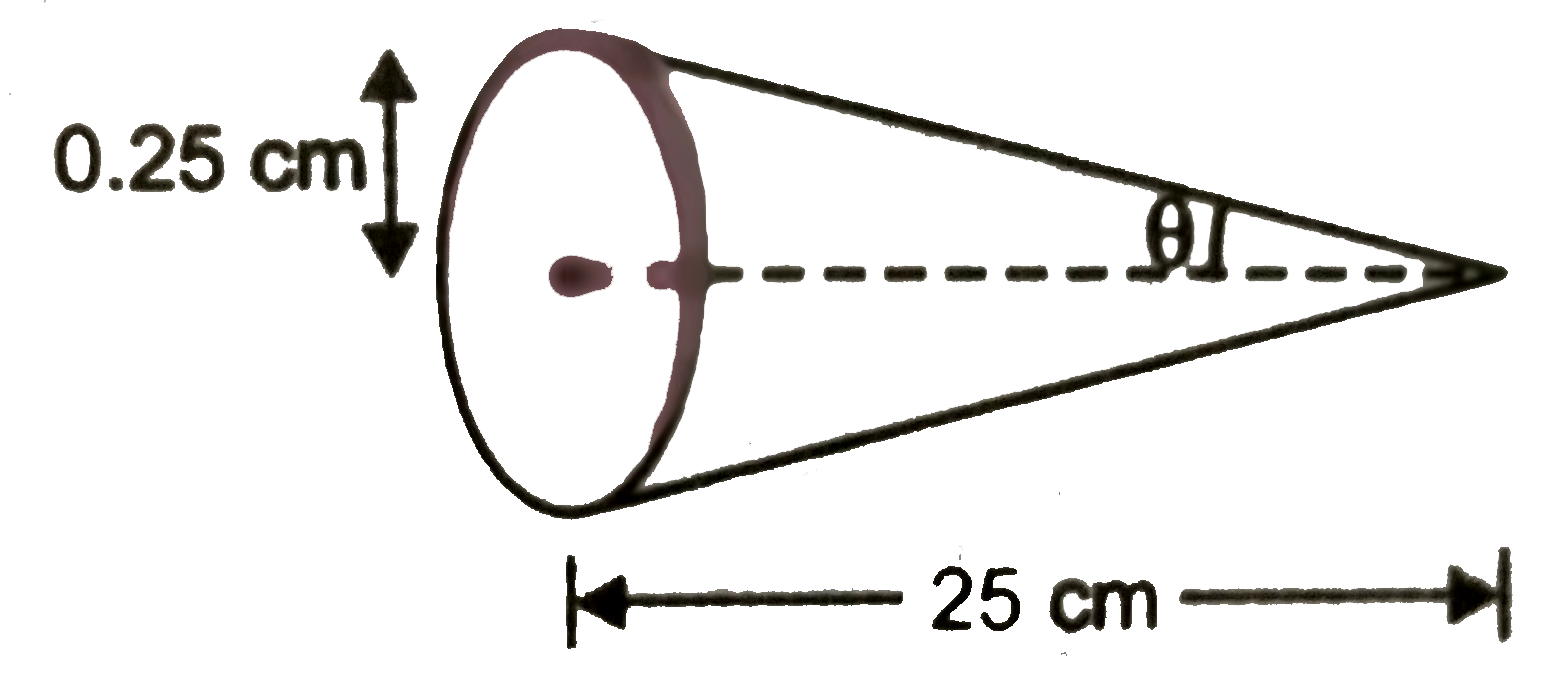
B

`sin theta = (0.25)/(25) = (1)/(100)`
Resolving power of eye is
`RP = (1.22 lamda)/(2 mu sin theta) = (1.22 xx(500 xx 10^-9))/(2 xx 1 xx(1//100))`
=`3.05 xx 10^-5 m`
`~~ 30 mu m`.
.
Promotional Banner

Topper's Solved these Questions

  • RAY OPTICS

    PRADEEP|Exercise (Competition)Comprehension|7 Videos
  • RAY OPTICS

    PRADEEP|Exercise Integer Question|4 Videos
  • RAY OPTICS

    PRADEEP|Exercise (Exemplar) Multiple choice|16 Videos
  • PROPERTIES OF BULK MATTER

    PRADEEP|Exercise Multiple choice questions|7 Videos
  • SYSTEMS OF PARTICLES AND ROTATIONAL MOTION

    PRADEEP|Exercise Assertion- Reason Type questions|20 Videos

Similar Questions

Explore conceptually related problems

Assuming that the human pupil has a radius of 0.25 cm and a comfortable viewing distance of 25 cm. The minimum separation between two point object that the human eye can resolve for the light of wavelength 500 nm is

The diameter of human eye lens is 2 mm . What should be the minimum separation between two points situated at 50 m from eye, to resolve tham. Take wavelength of light = 5000 Å .

A telescope has an objective lens of 10 cm, diameter and is situated at a distance of one kilometer from two objects. The minimum distance between these two objects, which can be resolved by the telescope, when the mean wavelength of light is 5000 A, is of the order of (in mm):

A telescope has an objective lens of 10cm diameter and is situated at a distance of one kilometre from two objects. The minimum distance between these two objects, which can be resolved by the telescope, when the mean wavelength of light is 5000 Å , of the order of

An eye can distinguish between two points of an object if they are separated by more than 0.22 mm when the object is placed at 25 cm from the eye. The object is now seen by a compound microscope having a 20 D objective and 10 D eyepiece separated by a distance of 20 cm. The final image is formed at 25 cm from the eye. What is the minimum separation between two points of the object which can now be distinguished?

The diameter of the pupil of human eye is 2.5 mm. Assuming the wavelength of light used is 5000Å . What must be the minimum distance between two point like objects to the seen clearly if they are a distance of 5 m from the eye?

There is a telescope whose objective has a diameter D = 5.0 cm . Find the resolving power of the objective and the minimum separation between two points at a distance l = 3.0km from the telescope, which it can resolve (assume lambda = 0.55 mu m) .

PRADEEP-RAY OPTICS-(Competition)Multiple choice
  1. In an astronomical telescope in normal adjustment a straight black lin...

    Text Solution

    |

  2. The near and far points of a person are at 40 cm and 250cm respectivel...

    Text Solution

    |

  3. Assuming human pupil to have a radius of 0.25 cm and a comfortable vie...

    Text Solution

    |

  4. For a normal eye, the cornea of eye provides a converging power of 40 ...

    Text Solution

    |

  5. The focal length of the objective and eye piece of a telescope are res...

    Text Solution

    |

  6. An astronomical telesope has objective and eyepiece of focal lengths 4...

    Text Solution

    |

  7. An obsever looks at a distant tree of height 10m with a telescope of m...

    Text Solution

    |

  8. The box of a pin hole camera, of length L, has a hole of radius a . It...

    Text Solution

    |

  9. A ray of light travelling in a transparant medium falls on a surface s...

    Text Solution

    |

  10. A spherical surface of radius of curvature R separates air (refractive...

    Text Solution

    |

  11. A diminished image of an object is to be obtained on a screen 1.0 m fr...

    Text Solution

    |

  12. A short linear object of length b lies along the axis of a concave mir...

    Text Solution

    |

  13. An astronomical telescope has an angular magnification of magnitude 5 ...

    Text Solution

    |

  14. A planet is observed by an astronomical refracting telescope having an...

    Text Solution

    |

  15. A student performed the experiment of determination of focal length of...

    Text Solution

    |

  16. A ray of monochromatic light is incident on one refracting face of a p...

    Text Solution

    |

  17. The optical length of an astronomical telescope with magnifying power ...

    Text Solution

    |

  18. A narrow beam of white light enters slab having parallel faces.

    Text Solution

    |

  19. Which of the following (referred to a sphericla mirror) do (does) not ...

    Text Solution

    |

  20. Photograph of the ground are taken form an air-craft ,flying at an alt...

    Text Solution

    |

