Home
Class 12
PHYSICS
A convex lens of focal length 15 cm, and...

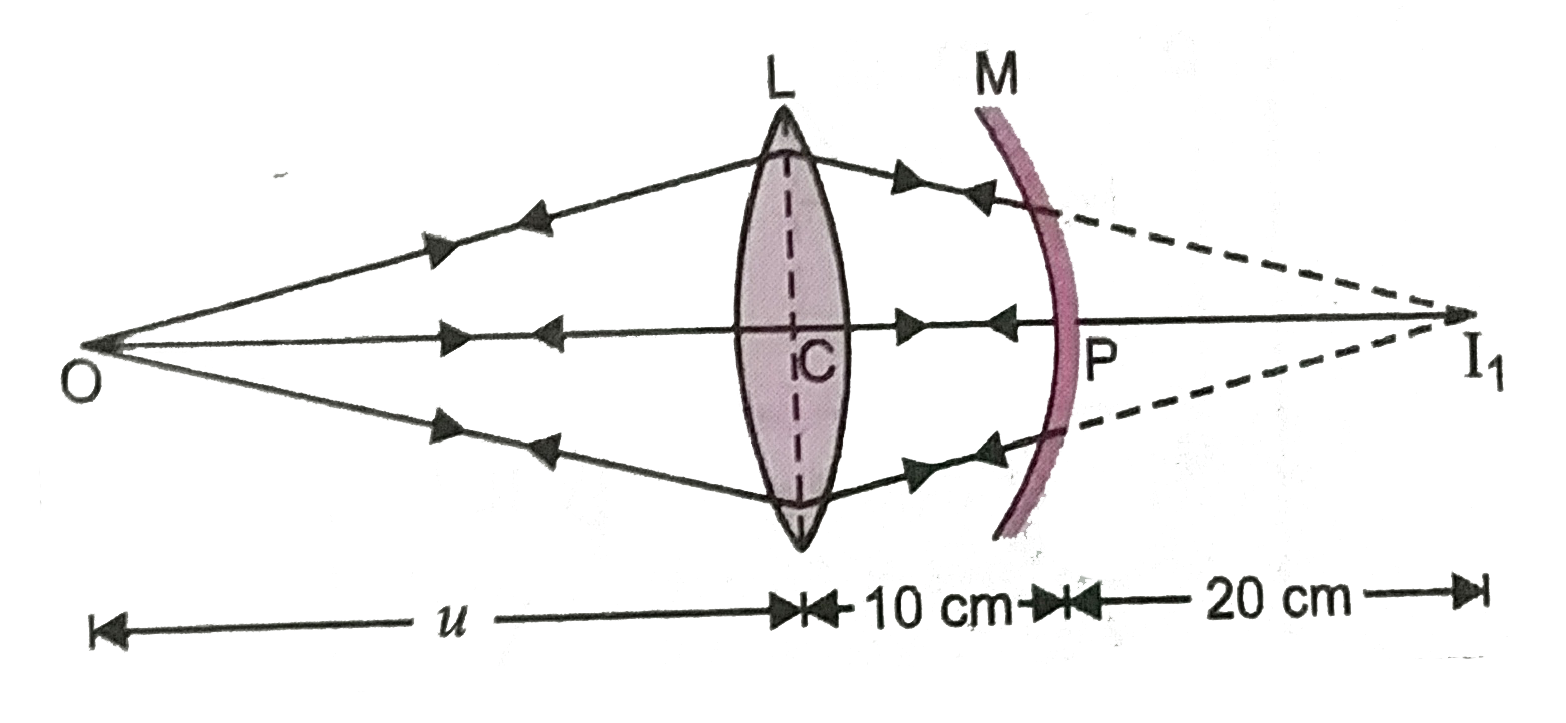
A convex lens of focal length `15 cm`, and a concave mirror of radius of curvature `20 cm` are placed co-axially `10 cm` apart. An object is placed in front of convex lens so that there is no parallax between the object and its image formed by the combination. Find the position of the object.

Text Solution

Verified by Experts

The correct Answer is:
At `30 cm` from lens

The given set up is shown in Fig. Here, focal length of lens, `f = 15 cm` , radius of curvature of concave mirror, `R = 20 cm` and `CP = 10 cm`. Let the object be at `O`, where `CO = u`. As there is no parallax between the object and its image formed by the combination, therefore, final image must be at `O` itself. For this to happens, rays refracted from convex lens `L` must tens to meet at `I_(1)`, the centre of curvature of concave mirror. These rays would fall normally on concave mirror and retrace their path on reflection.

`:. PI_(1) = R = 20 cm`.
For the lens,
`v = CI_(1) = CP + PI_(1) = 10 + 20 = 30 cm`.
From `(1)/(v) - (1)/(u) = (1)/(f)`
`-(1)/(u) = (1)/(f) - (1)/(v) = (1)/(15) - (1)/(30) = (1)/(30)`
`:. u = - 30 cm`, i.e., `CO = 30 cm`
i.e., object must be at `30cm` in front of convex lens.
Promotional Banner

Topper's Solved these Questions

  • OPTICS

    PRADEEP|Exercise Problems for practice|4 Videos
  • OPTICS

    PRADEEP|Exercise Comprehension 1|1 Videos
  • OPTICS

    PRADEEP|Exercise Value based questions|3 Videos
  • MAGNETIC EFFECT OF CURRENT AND MAGNETISM

    PRADEEP|Exercise Competition Focus (Multiple Choice Questions)|2 Videos

Similar Questions

Explore conceptually related problems

A convex lens of focal length 20cm is placed 10cm in front of a convex mirror or radius of curvature 15cm. Where should a point object be placed in front of the lens so that it images on to itself?

A convex lens of focal length 20 cm is placed co-axially with a convex mirrir of radius of curvature 20 cm . The two are kept 15 cm apart from eachother. A point object is placed 60 cm in front of the convex lens. Find the position of the image formed by the combination.

A convex lens of focal length 20cm is placed coaxilly with a convex mirror of radius of curvature 20 cm. The two are kept 15 cm apart. A point object is placed 40 cm in front of the convex lens. Find the position of the image formed by this combination. Draw the ray diagram showing the image formation.

A convex lens, of focal length 25 cm, and a concave mirror, of radius of curvature 20 cm. are placed co-axially 4 cm aprat from each other. An incident beam, parallel to the principal axis, is incident on the convex lens. Find the position and nature of the image formed by this combination.

A convex lens of focal length 20 cm and a convex mirror of focal length 10 cm are placed co-axially 50 cm apart from each other. An incident beam parallel to its principal axis is incideent on the convex lens. Locate the position of final image formed due to the combination.

A concave lens of focal length 20 cm is placed 15 cm in front of a concave mirror of radius of curvature 26 cm and further 10 cm away from the lens is placed an object. The principal axis of the lens and the mirror are coincident and the object is on the axis Find the position and nature of the image.

A convex lens of focal length 20 cm and a concave lens of focal length 10 cm are placed 20 cm apart. In between them an object placed at distance x from the convex lens. What is the value of x (in cm ) so that images from by both the lenses coincides ?

A small object is so placed in front of a convex lens of 5cm focal length that a virtual image is formed at a distance of 25 cm. Find the magnification.

A convex lens of focal length 20 cm and a convex mirror of focal length 10 cm are placed co-axially 50 cm apart from each other. An incident on the convex lens. Locate the position of final image formed due to the combination. (NCERT Solved Example)

A convex lens of focal length 30 cm and a concave lens of focal length 60 cm are placed in combination. If an object is placed 40 cm away from the combination, find the position of the image.

PRADEEP-OPTICS-Exercise
  1. Two lenses of power + 10 D and - 5 D are placed in contact, (i) Calc...

    Text Solution

    |

  2. A point object is placed 60 cm in front of a convex lens of focal leng...

    Text Solution

    |

  3. A convex lens of focal length 15 cm, and a concave mirror of radius of...

    Text Solution

    |

  4. Fig. shows a plane mirror M placed at a distance of 10 cm from a conca...

    Text Solution

    |

  5. A monochromatic light is incident on the plane interface AB between tw...

    Text Solution

    |

  6. The image of a needle placed 45 cm from a lens is formed on a screen p...

    Text Solution

    |

  7. A biconvex thin lens is prepared from glass (mu=1.5), the two bounding...

    Text Solution

    |

  8. A concave convex figure lens made of glas (mu=1.5) has surface of radi...

    Text Solution

    |

  9. A converging beam of light forms a sharp image on a screen. A lens is ...

    Text Solution

    |

  10. Rays of light are falling on a convex lens of focal length 40 cm. As s...

    Text Solution

    |

  11. Which of the following colours has maximum wavelength

    Text Solution

    |

  12. In vaccum, which colour travels fastest ?

    Text Solution

    |

  13. In glass, the velocity of light is minimum for

    Text Solution

    |

  14. The deviation delta of a ray on passing through a prism of small angle...

    Text Solution

    |

  15. What is the relation between angle of prism A, angle of incidence i an...

    Text Solution

    |

  16. When size of scatterer (x) is very much less than the wavelength (lamd...

    Text Solution

    |

  17. A thin prism of 6^@ angle gives a deviation of 3^@. The refractive in...

    Text Solution

    |

  18. An equilateral prism is made of made of material of refractive index s...

    Text Solution

    |

  19. One cannot cannot see through fog, because

    Text Solution

    |

  20. The angle of minimum deviation for prism of angle pi//3 is pi//6. The ...

    Text Solution

    |

