Home
Class 12
PHYSICS
The angular magnification of a telescope...

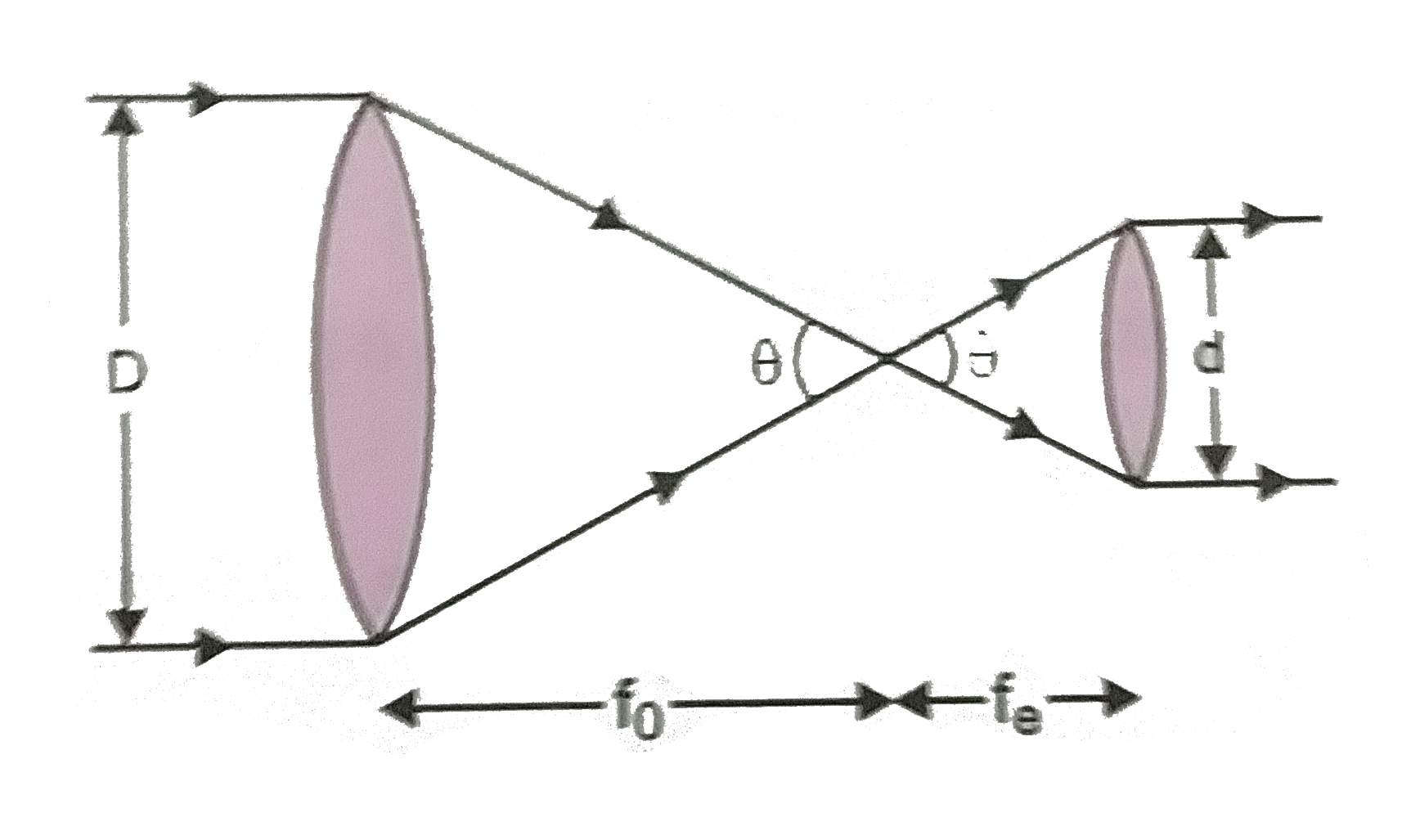
The angular magnification of a telescope is `300` What should be the diameter of the objective, if our eyes at the eye ring, are just able to collect all the light refracted from the objective. Take diameter of pupil of eye `= 3mm`.

Text Solution

Verified by Experts

The correct Answer is:
`90 cm`

Here, `m = 300, D = ?, d = 3mm = 0.3 cm`.

`m = (f_(0))/(f_(e)) = (D// theta)/(d// theta) = (D)/(d)`
`:. D = m xx d = 300 xx 0.3 = 90 cm`
Promotional Banner

Topper's Solved these Questions

  • OPTICS

    PRADEEP|Exercise Problems for practice|4 Videos
  • OPTICS

    PRADEEP|Exercise Comprehension 1|1 Videos
  • OPTICS

    PRADEEP|Exercise Value based questions|3 Videos
  • MAGNETIC EFFECT OF CURRENT AND MAGNETISM

    PRADEEP|Exercise Competition Focus (Multiple Choice Questions)|2 Videos

Similar Questions

Explore conceptually related problems

Is angular magnification of a telescope equal to ratio of diameters of objective and eye lens ?

Assertion : The resolving power of a telescope is more if the diameter of the objective lens is more. Reason : Objective lens of large diameter collects more light.

What is the distance between objective and eye lens of telescope in normal adjustment ?

Angular magnification of telescope if focal length of objective and eye lenses are 10 cm and 10 mm respectively and tube length is 11cm:

At what magnification T of a telescope with a diameter of the objective D = 6.0 cm is the illuminance of the image of an object on the retina not less than without the telescope ? The pupil diameter is assumed do be equal to d_(0) = 3.0 mm . The losses of light in the telescope are negligible.

When a telescope is adjusted for parallel light, the distance of the objective from the eye piece is found to be 80 cm . The magnifying power of the telescope is 19 . The focal length of the lenses are

Human eye is sensitive to light of wavelength 5,500 Å . Calculate the limit resolution of eye if diameter of pupil in the eye is nearly 2 mm.

Estimate the limit of resolution of a human eye, for the light of wavelength 500 nm. (Take diameter of human eye equal to 2 mm).

PRADEEP-OPTICS-Exercise
  1. How would you combine two lenses of focal lengths 25 cm and 2.5 cm to ...

    Text Solution

    |

  2. Two boys one 52 inches tall and the other 55 inches tall, are standing...

    Text Solution

    |

  3. The angular magnification of a telescope is 300 What should be the dia...

    Text Solution

    |

  4. The image of the moon is focussed by a converging lens of focal length...

    Text Solution

    |

  5. A telescope objective lens has a focal length of 100 cm . When the fin...

    Text Solution

    |

  6. A compound microscope has lenses of focal length 10 mm and 30 mm. An o...

    Text Solution

    |

  7. In a compound microscope, the objective and eye piece have focal lengt...

    Text Solution

    |

  8. A reflecting type telescope has a concave reflector of radius of curva...

    Text Solution

    |

  9. The lens of human eye has a diameter of 0.8 cm. How much fainter star ...

    Text Solution

    |

  10. Out of speed, frequency and wavelength, name the parameter (s) which r...

    Text Solution

    |

  11. A plane wave front falls on a convex lens. The emergent wave front is

    Text Solution

    |

  12. Out of electric field vector, vec(E) and magnetic field vector, vec(B)...

    Text Solution

    |

  13. When a wave undergoes reflection at a denser medium, what happens to i...

    Text Solution

    |

  14. In YDSE, when separation between two slits is increased, fringe width

    Text Solution

    |

  15. In Young's double slit experiment, three lights, blue, yellow and red ...

    Text Solution

    |

  16. The phase difference between two points A and B on a wavefront separat...

    Text Solution

    |

  17. what type of wavefront will emerge from (i) a point source and (ii) di...

    Text Solution

    |

  18. In Young's double slit experiment, the intensity of central maximum is...

    Text Solution

    |

  19. What is the ratio of slit widths when amplitudes of light waves from t...

    Text Solution

    |

  20. Which phenomena establish the wave nature of light ?

    Text Solution

    |

