Home
Class 12
PHYSICS
The optical density of turpentine is hig...

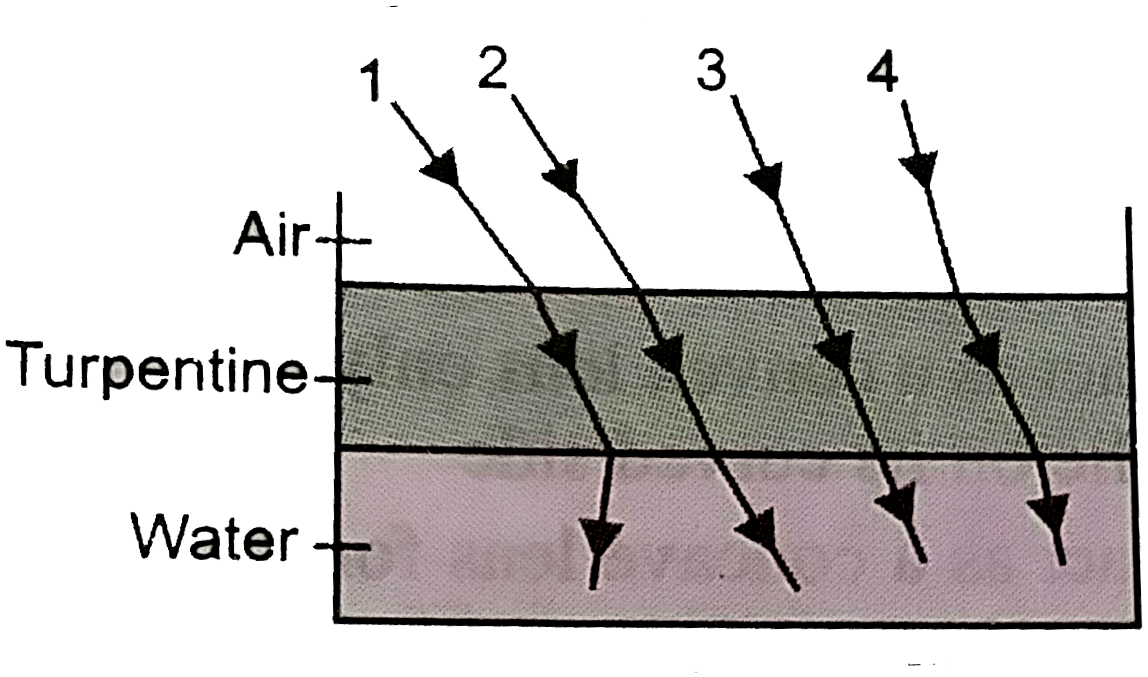
The optical density of turpentine is higher than that of water, while its mass density is lower. Fig. shows a layer of turpentine floating over water in a container. For which one of the four rays incident on turpentine in Fig., the path shows is correct ?
.

A

`1`

B

`2`

C

`3`

D

`4`

Text Solution

Verified by Experts

The correct Answer is:
B

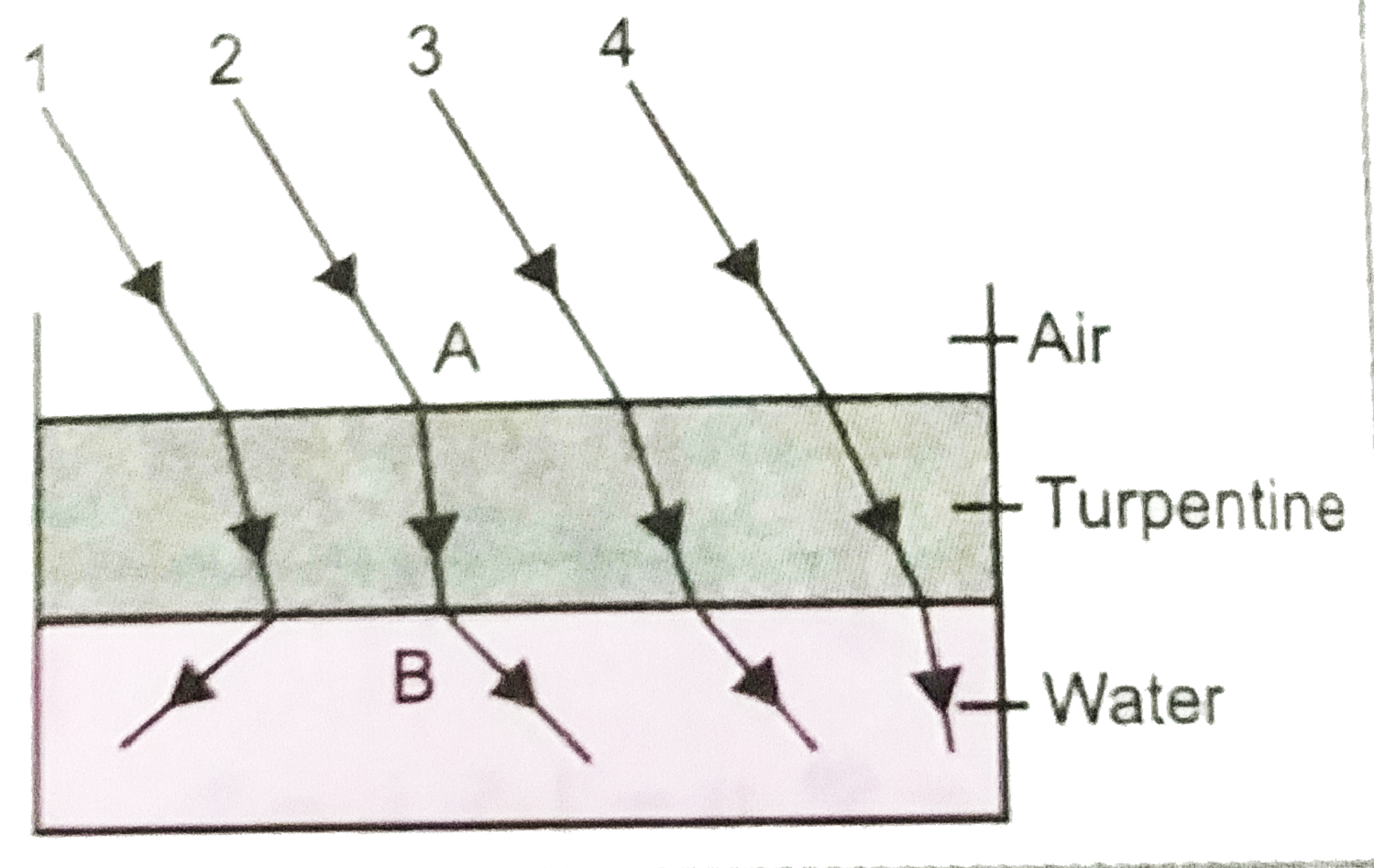
In Fig. the path shown for the ray `2` is correct. The ray suffers two refractions : At `A`, ray goes from air to turpentine, bending towards normal. At `B`, ray goes from turpentine to water (i.e., from denser to rarer medium), bending away from normal.
Promotional Banner

Topper's Solved these Questions

  • OPTICS

    PRADEEP|Exercise Problems for practice|4 Videos
  • OPTICS

    PRADEEP|Exercise Comprehension 1|1 Videos
  • OPTICS

    PRADEEP|Exercise Value based questions|3 Videos
  • MAGNETIC EFFECT OF CURRENT AND MAGNETISM

    PRADEEP|Exercise Competition Focus (Multiple Choice Questions)|2 Videos

Similar Questions

Explore conceptually related problems

A solid sphere of density eta (gt 1) times lighter than water is suspended in a water tank by a string tied to its base as shown in fig. if the mass of the sphere is m then the tension in the string is given by

A water body characterized by nutrient rich water supports abundant growth of phytoplanktons and other water plants on its surface. Over time, the water body gets filled with a large number of such plants and the process is called Eutrophication. In such water bodies, dissolved oxygen content is nil or very less. A portion of a river is covered with a green layer of tiny floating organisms L on its surface and the pond water also contains organisms like tadpole, small fish, Alligator. Which of the following is the correct food chain for the above organisms?

Addition of non-volatile solute to solvent lowers its vapoure pressure. Therefore, the vapour pressure of a solution (i.e, V.P. of solvent in a solution) is lower than that of pure solvent in a solution) is lower than that of pure solvent, at the same temperature. A higher temperature is needed to raise the vapour pressure upto one atmosphere pressure, when boiling point is attined. However, increase in b.pt. is small . for example, 0.1 molal aqueous sucrose solution boils at 10.05^(@)C Sea water, an aqueous solution, which is rich in Na^(+) and Cl^(-) ions, freezes about 1^(@)C lower than frozen water . At the freezing point of a pure-solvent, the reates at which two molecule stick together to form the solid and leave it to return to liquid are equal when solute is present. Few solvent molecules are in contact with surface of solid. However, the rate at which the solvent molecules leave, surface of solid remains unchanged. That is why, temperature is lowered to restore the equalibrium. The freezing depression in a dilute solution is proportional to molality of the solute. The freezing point of a solution containing 50 cm^(3) of ethylene glycol in 50g water is found to be -34^(@)C . Density of ethylene glycol is : Assuming solution is dilute [ K_(f) for H_(2)O = 1.86 K "molality"^(-1) ]

(i) A non uniform cube of side length a is kept inside a container as shown in the figure. The average density of the material of the cube is 2 rho where rho is the density of water. Water is gradually fille din the container. It is observed that the cube begins to topple, about its edge into the plane of the figure passing through pointA, when the height of the water in the container becomes (a)/(2) . Find the distance of the centre of mass of the cube from the face AB of the cube. Assume that water seeps under the cube. (ii) A rectangular concrete block (specific gravity =2.5) is used as a retatining wall in a reservoir of water. The height and width of the block are x and y respectively the height of water in the reservoir is z=(3)/(4)x . the concrete block cannot slide on the horizontal base but can rotate about an axis perpendicular to the plane of the figure and passing through point A (a) Calculate the minimum value of the ratio (y)/(x) for which the block will not begin to overturn about A. (b) Redo the above problem for the case when there is a seepage and a thin film of water is present under the block. Assume that a seal at A prevents the water from flowing out underneath the block.

Addition of non-volatile solute to solvent lowers its vapoure pressure. Therefore, the vapour pressure of a solution (i.e, V.P. of solvent in a solution) is lower than that of pure solvent in a solution) is lower than that of pure solvent, at the same temperature. A higher temperature is needed to raise the vapour pressure upto one atmosphere pressure, when boiling point is attined. However, increase in b.pt. is small . for example, 0.1 molal aqueous sucrose solution boils at 10.05^(@)C Sea water, an aqueous solution, which is rich in Na^(+) and Cl^(-) ions, freezes about 1^(@)C lower than frozen water . At the freezing point of a pure-solvent, the reates at which two molecule stick together to form the solid and leave it to return to liquid are equal when solute is present. Few solvent molecules are in contact with surface of solid. However, the rate at which the solvent molecules leave, surface of solid remains unchanged. That is why, temperature is lowered to restore the equalibrium. The freezing depression in a dilute solution is proportional to molality of the solute. The amount of ice seperated out on cooling a solution containing 50g ethylene glycol in 200g water to -9.3^(@)C is : [ K_(f) for H_(2)O = 1.86 K "molality"^(-1) ]

Addition of non-volatile solute to solvent lowers its vapoure pressure. Therefore, the vapour pressure of a solution (i.e, V.P. of solvent in a solution) is lower than that of pure solvent in a solution) is lower than that of pure solvent, at the same temperature. A higher temperature is needed to raise the vapour pressure upto one atmosphere pressure, when boiling point is attined. However, increase in b.pt. is small . for example, 0.1 molal aqueous sucrose solution boils at 10.05^(@)C Sea water, an aqueous solution, which is rich in Na^(+) and Cl^(-) ions, freezes about 1^(@)C lower than frozen water . At the freezing point of a pure-solvent, the reates at which two molecule stick together to form the solid and leave it to return to liquid are equal when solute is present. Few solvent molecules are in contact with surface of solid. However, the rate at which the solvent molecules leave, surface of solid remains unchanged. That is why, temperature is lowered to restore the equalibrium. The freezing depression in a dilute solution is proportional to molality of the solute. The freezing point of a 5g CH_(3)COOH(aq) per 100 g water is -1.576^(@)C . Then van't Hoff factor ( K_(f) of water = 1.86 K "mol"^(-1) kg ) :

Addition of non-volatile solute to solvent lowers its vapoure pressure. Therefore, the vapour pressure of a solution (i.e, V.P. of solvent in a solution) is lower than that of pure solvent in a solution) is lower than that of pure solvent, at the same temperature. A higher temperature is needed to raise the vapour pressure upto one atmosphere pressure, when boiling point is attined. However, increase in b.pt. is small . for example, 0.1 molal aqueous sucrose solution boils at 10.05^(@)C Sea water, an aqueous solution, which is rich in Na^(+) and Cl^(-) ions, freezes about 1^(@)C lower than frozen water . At the freezing point of a pure-solvent, the reates at which two molecule stick together to form the solid and leave it to return to liquid are equal when solute is present. Few solvent molecules are in contact with surface of solid. However, the rate at which the solvent molecules leave, surface of solid remains unchanged. That is why, temperature is lowered to restore the equalibrium. The freezing depression in a dilute solution is proportional to molality of the solute. 2g of benzoic acid dissolved in 25g of C_(6)H_(6) shows a depression in f.pt, equal to 1.62 K. K_(f) for C_(6)H_(6) in 4.9 K "molality"^(-1) . The percentage of dimerisation is :

A cyclindrical ice block is floating in water 10% of its total volume is outside water. Kerosene oil (relative density=0.8) is poured slowly on top of water in the container. Assume that the oil does not mix with water. Height of the ice cylinder is H. (a) As kerosene is poured, how does the volume of ice block above the water level change? (b) What is the thickness of kerosene layer above the water when 20% of the volume of the ice block is above the water surface? (c) Find the ratio of voume of ice block is kerosene to its volume in water after the kerosene layer rises above the top surface of ice and the block gets completely submerged. Neglect any melting of ice.

A cylindrical body floats in water such that one-fourth of its volume lies above the surface of water. Find the density of the meterial with which the body is made of.

PRADEEP-OPTICS-Exercise
  1. The phenomena involved in the reflected of radiowaves by ionosphere is...

    Text Solution

    |

  2. The direction of ray of light incident on a concave mirror is shown by...

    Text Solution

    |

  3. The optical density of turpentine is higher than that of water, while ...

    Text Solution

    |

  4. A car is moving with a constant speed of 60 km h^-1 on a straight road...

    Text Solution

    |

  5. There are certain materials developed in laboratories which have a neg...

    Text Solution

    |

  6. Consider an extended object immersed in water contained in a plane thr...

    Text Solution

    |

  7. A rectangular block of glass ABCD has a refractive index 1.6. A pin is...

    Text Solution

    |

  8. Between the primary and secondary rainbows, there is a dark band known...

    Text Solution

    |

  9. A magnifying glass is used, as the object to be viewed can be brought ...

    Text Solution

    |

  10. An astronomical refractive telescope has an objective of focal length ...

    Text Solution

    |

  11. Consider a light beam incident from air to a glass slab at Brewster's ...

    Text Solution

    |

  12. Consider sunlight incident on a slit of width 10^(4) Å . The image see...

    Text Solution

    |

  13. Consider a ray of light incident from air onto a slab of glass (refrac...

    Text Solution

    |

  14. In a Young's double slit experiment, the source is white light. One of...

    Text Solution

    |

  15. Figure shows a standard two slit arrangement with slits S(1), S(2). P(...

    Text Solution

    |

  16. Two source S(1) and S(2) of intensity I(1) and I(2) are placed in fron...

    Text Solution

    |

  17. Consider sunlight incident on a pinhole of width 10^(3)Å. The image of...

    Text Solution

    |

  18. Consider the diffraction pattern for a small pinhole. As the size of t...

    Text Solution

    |

  19. For light diverging from a point source

    Text Solution

    |

  20. A source of light lies on the angle bisector of two plane mirrors incl...

    Text Solution

    |

