Home
Class 12
PHYSICS
Consider a ray of light incident from ai...

Consider a ray of light incident from air onto a slab of glass (refractive index n) of width d, at an angle `theta` . The phase difference between the ray reflected by the top surface of the glass and the bottom surface is

A

`(2 pi n d)/(lambda)(1 - (1)/(n^(2))sin^(2)theta)^(1/(2)) + pi`

B

`(4 pi d)/(lambda)(1 - (1)/(n^(2))sin^(2)theta)^(1/(2))`

C

`(4 pi d)/(lambda)(1 - (1)/(n^(2))sin^(2)theta)^(1/(2)) + (pi)/(2)`

D

`(4 pi d)/(lambda)(1 - (1)/(n^(2))sin^(2)theta)^(1/(2)) + 2pi`

Text Solution

Verified by Experts

The correct Answer is:
A

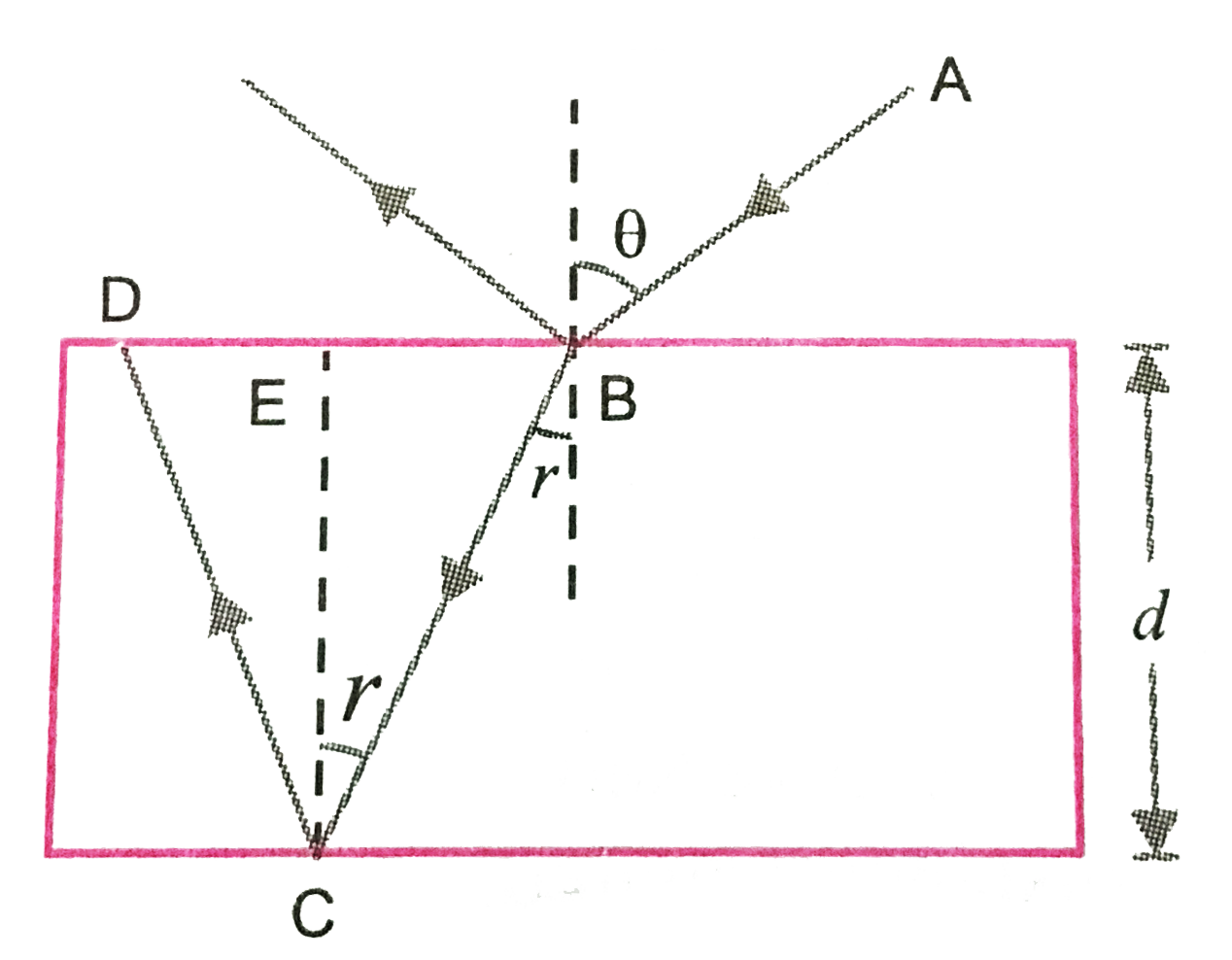
In Fig. a ray of light `AB` is incident from air onto glass slab of width `d` at angle `theta`. It is reflected partially at `B` and refracted partially at `B` along `BC` at `/_r`. At `C`, the ray is partially reflected along `CD` and partially refracted (not shown). To calculate phase difference between rays reflected from `B` and `C`, we find
time difference, `Delta T =` time taken to travel `BC` in glass
`= (BC)/(v) = ((d//cos r))/(c//n) = (n d)/(c cos r)`
From Snell's law, `n = (sin theta)/(sin r)`,
`sin r = (sin theta)/(n)`
`cos r = sqrt(1 - sin^(2) r) = (1 - (sin^(2) theta)/(n^(2)))^(-(1)/(2)`
`:. Delta T = (n d)/(c (1 - (sin^(2) theta)/(n^(2)))^((1)/(2))) = (n xx T d)/(lambda)(1 - (sin^(2)theta)/(n^(2)))^(-(1)/(2)` ....`(c = lambda//T)`
Phase diff. `= Delta phi = (2 pi Delta T)/(T) = (2pi n d)/(T)(1 - (sin^(2)theta)/(n^(2)))^(-(1)/(2)`
As reflection at `C` is from medium of higher refractive index, additional phase diff. of `pi` is introduced.
Hence required phase difference `= (2 pi n d)/(lambda) (1 - (sin^(2) theta)/(n^(2)))^(-(1)/(2)) + pi`
Choice (a) is correct.
Promotional Banner

Topper's Solved these Questions

  • OPTICS

    PRADEEP|Exercise Problems for practice|4 Videos
  • OPTICS

    PRADEEP|Exercise Comprehension 1|1 Videos
  • OPTICS

    PRADEEP|Exercise Value based questions|3 Videos
  • MAGNETIC EFFECT OF CURRENT AND MAGNETISM

    PRADEEP|Exercise Competition Focus (Multiple Choice Questions)|2 Videos

Similar Questions

Explore conceptually related problems

A ray of light is incident on the surface of plate of glass of refractive index 1.5 at the polarising angle. The angle of refraction of the ray will be

A ray of light is incident on a glass slab of refractive index 1.5, making an angle of 40^(@) with the surface. The angle of refraction in glass is

A ray of light incident from air on a glass plate of refractive index n is partly reflected and partly refracted at the two surfaces of the glass. The displacement y_(0) in the figure is

A ray of light incident from air on a glass plate of refractive index n is partly reflected and partly refracted at the two surfaces of the glass. The displacement y_(0) in the figure is

A ray of light is incident on the surface of a glass plate of refractive index 1.6 at polarzing angle. Calculate the angles of reflection and refraction.

A ray of light falls on a glass plate of refractive index mu=1.5 . What is the angle of incidence of the ray if the angle between the reflected and refracted rays is 90^@ ?

A ray of light is incident on a glass slab at an angle of 45^(@) . If refractive index of glass be 1.6, what is the angle of refraction ?

A slab of water is on the top of a glass slab of refractive index 2. At what angle to the normal must a ray be incident on the top sureface of th eglass slab so that it is reflected from the bottom surface as shown in figure ?

A ray incident at a point at an angle of incidence of 60^(@) enters a glass sphere with refractive index sqrt(3) and it is reflected and refracted at the farther surface of the sphere. The angle between the reflected and refracted rays at this surface is:

A ray of light passes throught a plane glass slab of thickness t and refractive index mu = 1.5 . The angle between incident ray and emergent ray will be

PRADEEP-OPTICS-Exercise
  1. Consider a light beam incident from air to a glass slab at Brewster's ...

    Text Solution

    |

  2. Consider sunlight incident on a slit of width 10^(4) Å . The image see...

    Text Solution

    |

  3. Consider a ray of light incident from air onto a slab of glass (refrac...

    Text Solution

    |

  4. In a Young's double slit experiment, the source is white light. One of...

    Text Solution

    |

  5. Figure shows a standard two slit arrangement with slits S(1), S(2). P(...

    Text Solution

    |

  6. Two source S(1) and S(2) of intensity I(1) and I(2) are placed in fron...

    Text Solution

    |

  7. Consider sunlight incident on a pinhole of width 10^(3)Å. The image of...

    Text Solution

    |

  8. Consider the diffraction pattern for a small pinhole. As the size of t...

    Text Solution

    |

  9. For light diverging from a point source

    Text Solution

    |

  10. A source of light lies on the angle bisector of two plane mirrors incl...

    Text Solution

    |

  11. A ray of light travelling in the direction (1)/(2)(hat(i)+sqrt(3)hat(j...

    Text Solution

    |

  12. The ratio of the speed of an object to the speed of its real image of ...

    Text Solution

    |

  13. The graph in Fig. shows plot of variation of v with change in u for a ...

    Text Solution

    |

  14. A beam of light from a source L is incident normally on a plane mirror...

    Text Solution

    |

  15. In a concave mirror, an object is placed at a distance d1 from the foc...

    Text Solution

    |

  16. A short linear object of length b lies along the axis of a concave mir...

    Text Solution

    |

  17. A car is fitted with a convex side-view mirror of focal length 20 cm. ...

    Text Solution

    |

  18. A rod of length 10 cm lies along the principal axis of a concave mirro...

    Text Solution

    |

  19. Consider a concave mirror and a convex lens (refractive index 1.5) of ...

    Text Solution

    |

  20. Two identical glass rods S(1) and S(2) (refractive index=1.5) have one...

    Text Solution

    |

