Home
Class 12
PHYSICS
A ray of light travelling in the directi...

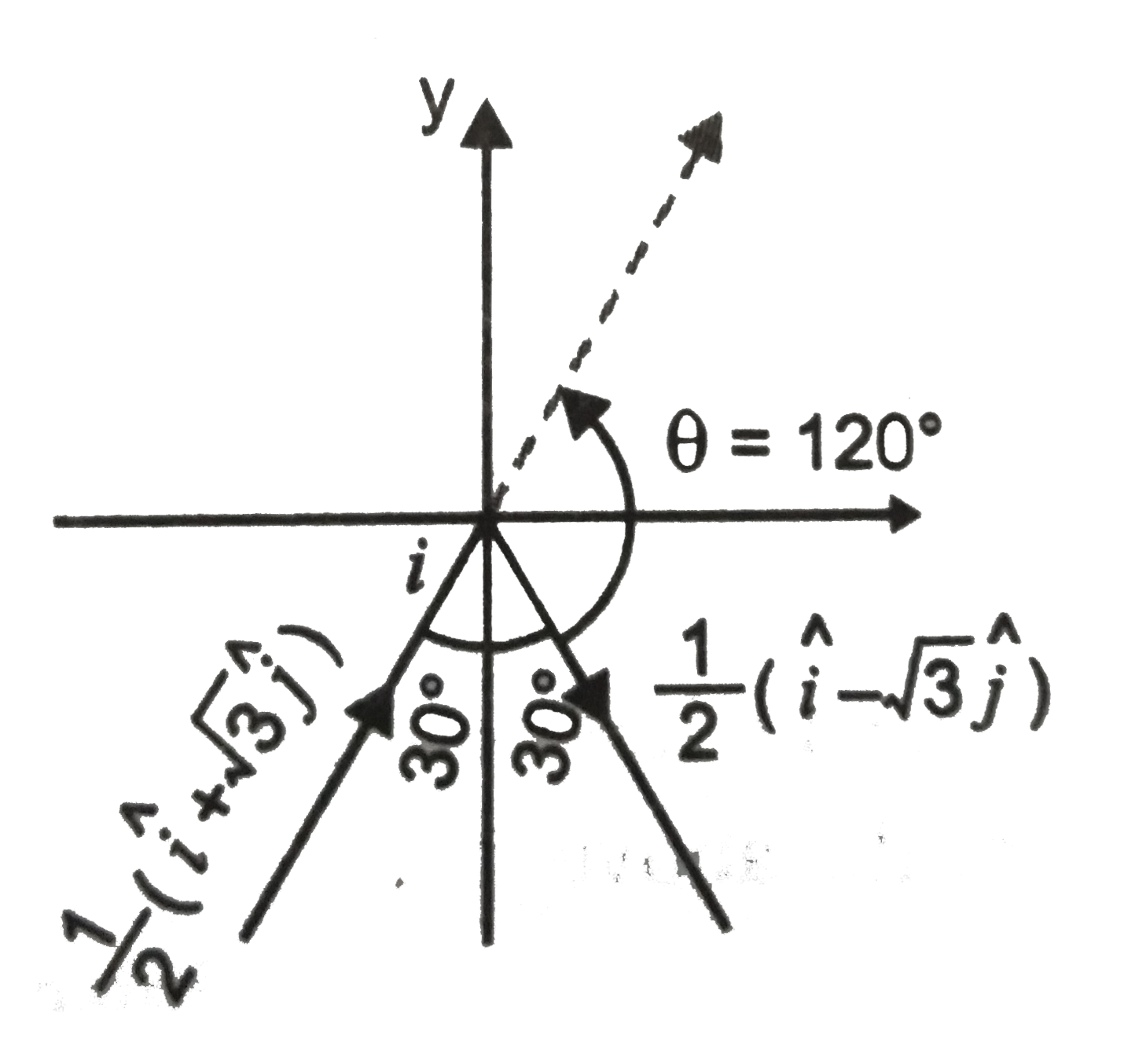
A ray of light travelling in the direction `(1)/(2)(hat(i)+sqrt(3)hat(j))` is incident on a plane mirror. After reflection, it travels along the direction `(1)/(2)(hat(i)-sqrt(3)hat(j))` . The anglel of incidence is

A

`30^(@)`

B

`45^(@)`

C

`60^(@)`

D

`75^(@)`

Text Solution

Verified by Experts

The correct Answer is:
A

Here, `vec(A) = (1)/(2)(hat(i) + sqrt(3) hat(j))`
and `vec(B) = (1)/(2)(hat(i) - sqrt(3) hat(j))`
`:. A = B = sqrt(1^(2) + (sqrt(3))^(2)) = 2 and vec(A).vec(B) = 2`
`cos theta = (vec(A).vec(B))/(A B) = (-2)/(2 xx 2) = -(1)/(2)`
`theta = 120^(@)`, Fig.

Angle of incidence,
`i = (180^(@) - theta)/(2) = (180^(@) - 120^(@))/(2) = 30^(@)`
Promotional Banner

Topper's Solved these Questions

  • OPTICS

    PRADEEP|Exercise Problems for practice|4 Videos
  • OPTICS

    PRADEEP|Exercise Comprehension 1|1 Videos
  • OPTICS

    PRADEEP|Exercise Value based questions|3 Videos
  • MAGNETIC EFFECT OF CURRENT AND MAGNETISM

    PRADEEP|Exercise Competition Focus (Multiple Choice Questions)|2 Videos

Similar Questions

Explore conceptually related problems

A ray of light travelling in the direction (1)/(2) (hati,+sqrt3hatj) is incident on a plane mirror. After reflection, it travels along the direction (1)/(2) (hati-sqrt3hatj) . The angle of incidence is

A ray of light travelling in the direction 1/2 (hati+sqrt(3)hatj) is incident on a plane mirror. After reflectiion, it travels along the direction 1/2(hati+sqrt(3)hatj) . The angle of incidence is

The expression (1/(sqrt(2))hat(i)+1/(sqrt(2))hat(j)) is a

Find the projection of (8hat(i)+hat(j)) in the direction of (hat(i)+2hat(j)-2hat(k))

The vector (1/sqrt2 hat i + 1/sqrt2 hat j) is a unit vector?

Find the component of vector A = 2hati + 3 hat j along the direction (hati - hat j ) .

The component of vector A= 2hat(i)+3hat(j) along the vector hat(i)+hat(j) is

The direction cosines of a vector hat(i) + hat(j) + sqrt(2)hat(k) are :

The unit vector along vec(A)= 2 hat i + 3 hat j is :

PRADEEP-OPTICS-Exercise
  1. For light diverging from a point source

    Text Solution

    |

  2. A source of light lies on the angle bisector of two plane mirrors incl...

    Text Solution

    |

  3. A ray of light travelling in the direction (1)/(2)(hat(i)+sqrt(3)hat(j...

    Text Solution

    |

  4. The ratio of the speed of an object to the speed of its real image of ...

    Text Solution

    |

  5. The graph in Fig. shows plot of variation of v with change in u for a ...

    Text Solution

    |

  6. A beam of light from a source L is incident normally on a plane mirror...

    Text Solution

    |

  7. In a concave mirror, an object is placed at a distance d1 from the foc...

    Text Solution

    |

  8. A short linear object of length b lies along the axis of a concave mir...

    Text Solution

    |

  9. A car is fitted with a convex side-view mirror of focal length 20 cm. ...

    Text Solution

    |

  10. A rod of length 10 cm lies along the principal axis of a concave mirro...

    Text Solution

    |

  11. Consider a concave mirror and a convex lens (refractive index 1.5) of ...

    Text Solution

    |

  12. Two identical glass rods S(1) and S(2) (refractive index=1.5) have one...

    Text Solution

    |

  13. Two identical thin planoconvex glass lenses (refractive index 1.5) eac...

    Text Solution

    |

  14. A diverging lens with magnitude of focal length 25 cm is placed at a d...

    Text Solution

    |

  15. An observer can see through a pin-hole the top end of a thin rod of he...

    Text Solution

    |

  16. For a given incident ray as shown in Fig., the condition of total inte...

    Text Solution

    |

  17. Considering normal incidence of ray, the equivalent refractive index o...

    Text Solution

    |

  18. The graph in Fig. shows how the inverse of magnification 1//m produced...

    Text Solution

    |

  19. Consider the ray diagram for the refraction given Fig. The maximum va...

    Text Solution

    |

  20. A luminous object is placed at a distance of 30 cm from the convex len...

    Text Solution

    |

