Home
Class 12
PHYSICS
Considering normal incidence of ray, the...

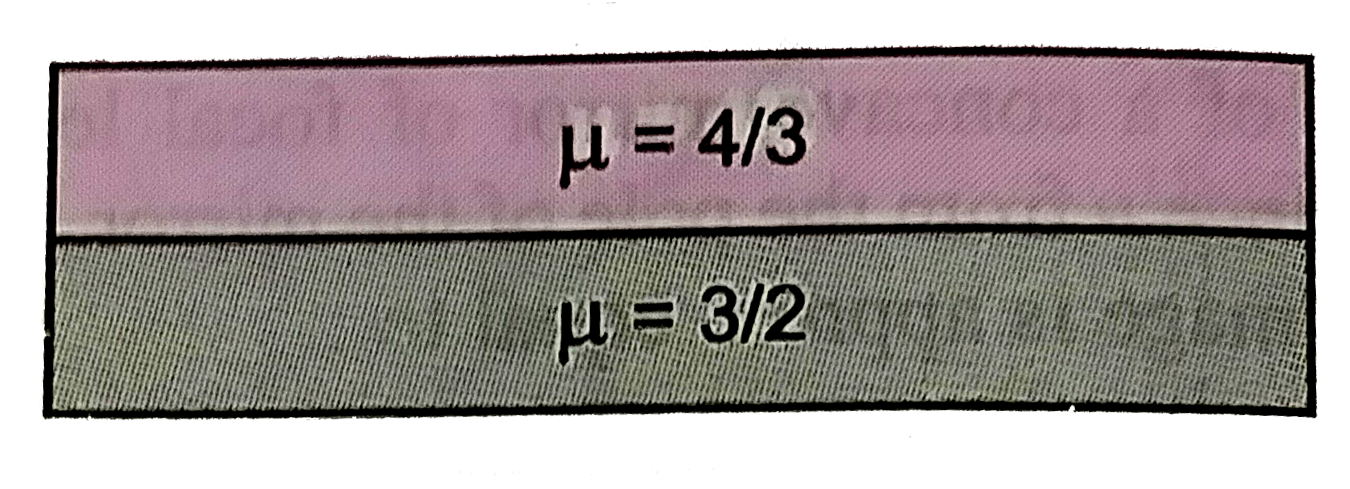
Considering normal incidence of ray, the equivalent refractive index of combination of two slabs shown in Fig. is.
.

A

`1.8`

B

`1.43`

C

`2`

D

none of the above

Text Solution

Verified by Experts

The correct Answer is:

B

`mu_(eff) = (t_(1) + t_(1))/((t_(1))/(mu_(1)) + (t_(2))/mu_(2)) = (10 + 15)/((10)/(4//3) + (5)/(3//2)) = (25)/(7.5 + 10) = 1.43`
Promotional Banner

Topper's Solved these Questions

  • OPTICS

    PRADEEP|Exercise Problems for practice|4 Videos
  • OPTICS

    PRADEEP|Exercise Comprehension 1|1 Videos
  • OPTICS

    PRADEEP|Exercise Value based questions|3 Videos
  • MAGNETIC EFFECT OF CURRENT AND MAGNETISM

    PRADEEP|Exercise Competition Focus (Multiple Choice Questions)|2 Videos

Similar Questions

Explore conceptually related problems

Considering normal incident of ray, find equivalent refractive index of combination of two slabs shown in figure.

Lateral displacement of ray passing through a glass slab A ray of light is incident on a parallel sided glass slab of refractive index n and thickness t as shown in Fig. 34-2. Find the lateral displacement of the ray as it passes through the slab.

A ray of light is incident on a glass slab at grazing incidence. The refractive index of the material of the slab is given by mu =sqrt(1+sqrty) . If the thickness of the slab is d, determine the equation ofthe trajectory of the ray inside the slab and the coordinates of the point where the ray exits from the slab. Take the origin to be at the point of entry of the ray.

When a ray of light is incident normally on one refracting surface of an equilateral prism (Refractive index of the material of the prism =1.5

A ray of light is incident normally on one face of a prism as shown in figure. The refractive index of the material of the prism is (5)/(3) and the prism is immersed in water of refractive index (4)/(3) , then

A light ray is incident on a plane glass slab of thickness ‘t’ at an angle of incidence ‘i’ as shown in the figure. If mu is the refractive index of glass. Then find time taken by the light ray to travel through the slab.

A light ray is incident on a glass sphere of reflective index mu = sqrt3 at an angle of incidence 60^(@) as shown in Fig. Find the angles r, r^(') e and the total deviation after two refractions.

PRADEEP-OPTICS-Exercise
  1. An observer can see through a pin-hole the top end of a thin rod of he...

    Text Solution

    |

  2. For a given incident ray as shown in Fig., the condition of total inte...

    Text Solution

    |

  3. Considering normal incidence of ray, the equivalent refractive index o...

    Text Solution

    |

  4. The graph in Fig. shows how the inverse of magnification 1//m produced...

    Text Solution

    |

  5. Consider the ray diagram for the refraction given Fig. The maximum va...

    Text Solution

    |

  6. A luminous object is placed at a distance of 30 cm from the convex len...

    Text Solution

    |

  7. The effective focal length of the lens combination shown in Fig. is -6...

    Text Solution

    |

  8. A ray of light falls on the surface of a spherical glass paper weight ...

    Text Solution

    |

  9. Light incident on a surface separating two media is partly reflected a...

    Text Solution

    |

  10. A slab of transparent material is made as shown in Fig. Monochromatic ...

    Text Solution

    |

  11. The focal length of a thin lens in vacuum is f. If the material of the...

    Text Solution

    |

  12. A glass prism of refractive index 1.5 is immersed in water (refractive...

    Text Solution

    |

  13. The radius of curvature of curved surface of a thin plano-convex lens ...

    Text Solution

    |

  14. The refracting angle of a prism is A, the refractive index of the mate...

    Text Solution

    |

  15. A beam of light consisting of red, green and blue colours is incident ...

    Text Solution

    |

  16. A plano convex lens has focal length f = 20 cm. If its plane surface i...

    Text Solution

    |

  17. In an optics ecperiment, with the position of the object fixed, a stud...

    Text Solution

    |

  18. The focal length of thin biconvex lens is 20 cm. When an object is mov...

    Text Solution

    |

  19. A thin convex lens made from crown glass (mu = 3//2) has focal length ...

    Text Solution

    |

  20. In Fig., there are two convex lenses L(1) and L(2) having focal length...

    Text Solution

    |
