Home
Class 12
PHYSICS
A luminous object is placed at a distanc...

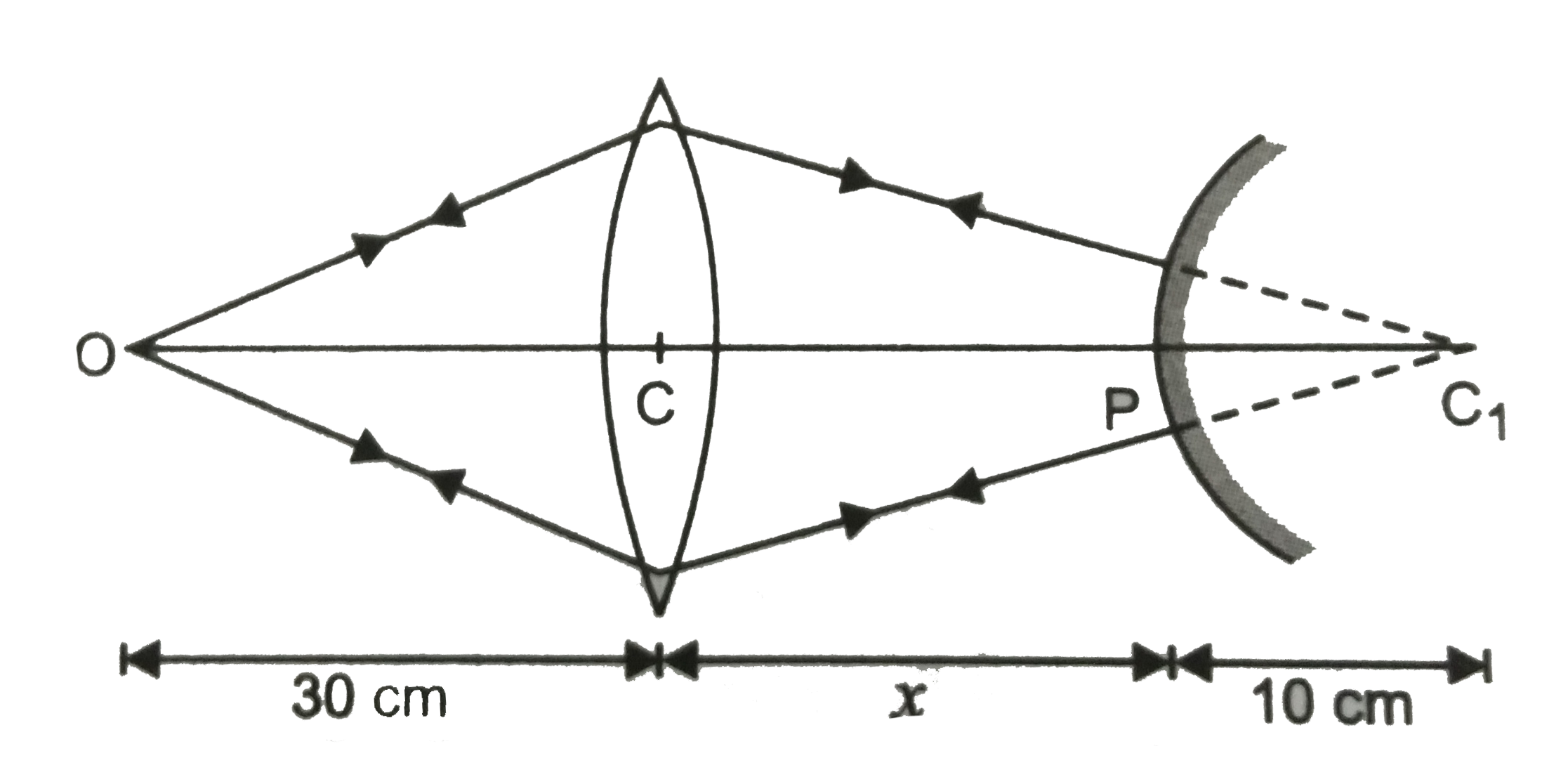
A luminous object is placed at a distance of `30 cm` from the convex lens of focal length `20 cm`. On the other side of the lens, at what distance from the lens a convex mirror of radius of curvature `10 cm` be placed in order to have an upright image of the object coincident with it ?

A

`12 cm`

B

`30 cm`

C

`50 cm`

D

`60 cm`

Text Solution

Verified by Experts

The correct Answer is:
C


Here, `u = OC = - 30 cm, f = 20 cm`.
`(1)/(v) = (1)/(f) + (1)/(u) = (1)/(20) - (1)/(30) = (1)/(60)`
`v = 60 cm`.
To obtain upright image of `O` at `O` itself,
`v = OC_(1) = x + 10`
`:. x = v - 10 = 60 - 10 = 50 cm`
Promotional Banner

Topper's Solved these Questions

  • OPTICS

    PRADEEP|Exercise Problems for practice|4 Videos
  • OPTICS

    PRADEEP|Exercise Comprehension 1|1 Videos
  • OPTICS

    PRADEEP|Exercise Value based questions|3 Videos
  • MAGNETIC EFFECT OF CURRENT AND MAGNETISM

    PRADEEP|Exercise Competition Focus (Multiple Choice Questions)|2 Videos

Similar Questions

Explore conceptually related problems

A luminous object is placed at a distance of 30 cm from the convex lens, of focal length 20 cm. On the other side of the lens, at what distance from thelens a convex mirror of radius of curvature 10 cm be placed in order to have an image of the object coincident with it

An object is placed at a distance of 30 cm from a convex lens of focal length 20 cm.

An object is placed at a distance of 20 cm from a convex lens of focal length 10 cm . The image is formed on the other side of the lens at a distance

An object is placed at a distance of 10 cm from a convex lens of focal length 12 cm. Find the position and nature of the image.

A luminous object is placed at a distance of 40 cm from a converging lens of focal length 25 cm. The image obtained in the screen is

An object 4 cm high is placed at a distance of 10 cm from a convex lens of focal length 20 cm. Find the position, nature and size of the image.

PRADEEP-OPTICS-Exercise
  1. The graph in Fig. shows how the inverse of magnification 1//m produced...

    Text Solution

    |

  2. Consider the ray diagram for the refraction given Fig. The maximum va...

    Text Solution

    |

  3. A luminous object is placed at a distance of 30 cm from the convex len...

    Text Solution

    |

  4. The effective focal length of the lens combination shown in Fig. is -6...

    Text Solution

    |

  5. A ray of light falls on the surface of a spherical glass paper weight ...

    Text Solution

    |

  6. Light incident on a surface separating two media is partly reflected a...

    Text Solution

    |

  7. A slab of transparent material is made as shown in Fig. Monochromatic ...

    Text Solution

    |

  8. The focal length of a thin lens in vacuum is f. If the material of the...

    Text Solution

    |

  9. A glass prism of refractive index 1.5 is immersed in water (refractive...

    Text Solution

    |

  10. The radius of curvature of curved surface of a thin plano-convex lens ...

    Text Solution

    |

  11. The refracting angle of a prism is A, the refractive index of the mate...

    Text Solution

    |

  12. A beam of light consisting of red, green and blue colours is incident ...

    Text Solution

    |

  13. A plano convex lens has focal length f = 20 cm. If its plane surface i...

    Text Solution

    |

  14. In an optics ecperiment, with the position of the object fixed, a stud...

    Text Solution

    |

  15. The focal length of thin biconvex lens is 20 cm. When an object is mov...

    Text Solution

    |

  16. A thin convex lens made from crown glass (mu = 3//2) has focal length ...

    Text Solution

    |

  17. In Fig., there are two convex lenses L(1) and L(2) having focal length...

    Text Solution

    |

  18. A point source S is placed at the bottom of a transparent block of hei...

    Text Solution

    |

  19. A ray of light travelling in a transparent medium f refractive index m...

    Text Solution

    |

  20. A lens haivng focal length and aperture of diameter d forms an image o...

    Text Solution

    |

