Home
Class 12
PHYSICS
Assuming human pupil to have a radius of...

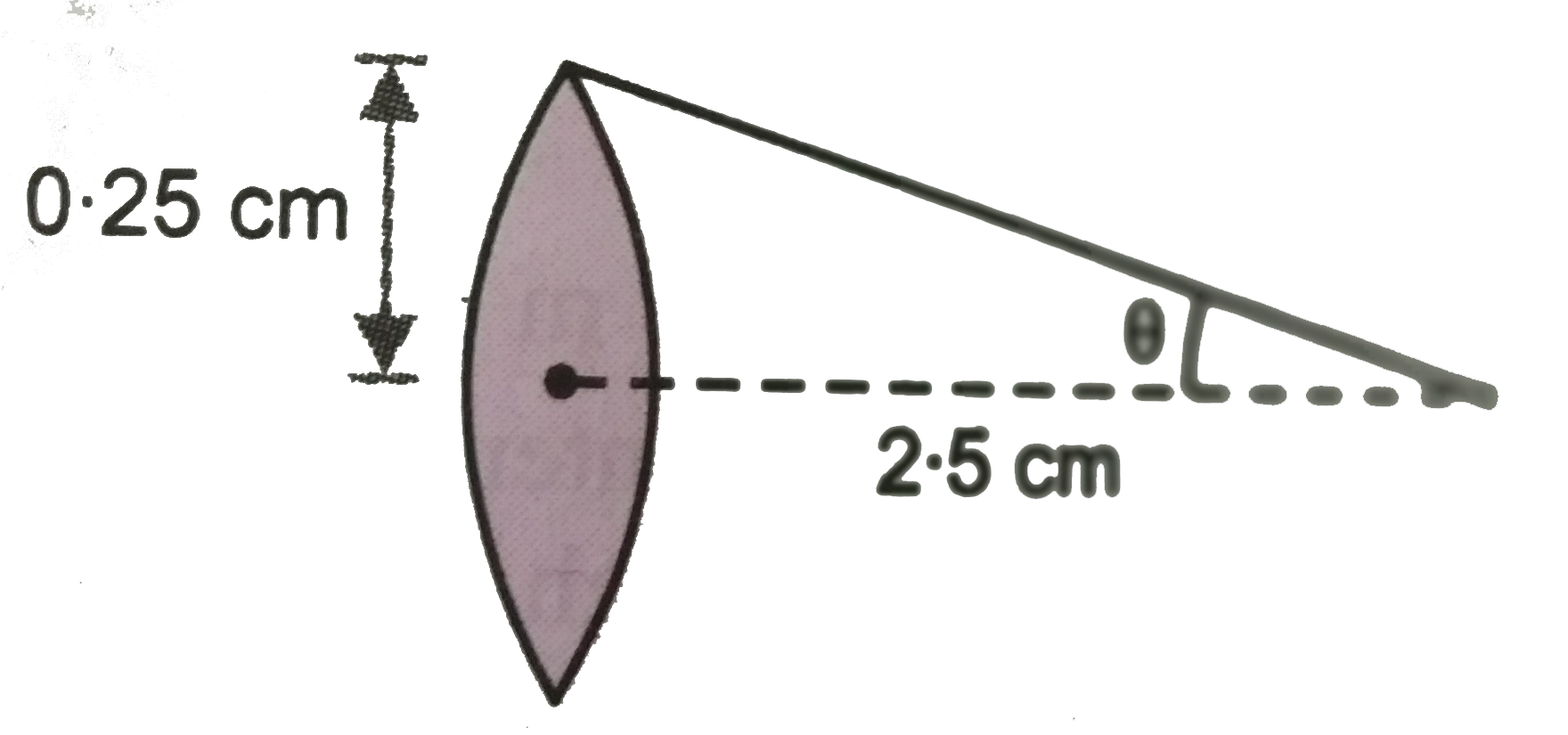
Assuming human pupil to have a radius of 0.25 cm and a comfortable viewing distance of 25 cm, the minimum separation between two objects than human eye can resolve at 500nm wavelength is :

A

`1mu m`

B

`30 mu m`

C

`100 mu m`

D

`300 mu m`

Text Solution

Verified by Experts

The correct Answer is:
B

Limit of resolution, `d = (1.22 lambda)/(2 mu sin theta)`

Now, `theta = (arc)/(radius) ~~ sin theta = (0.25)/(25) = (1)/(100)`
`:. d = (1.22 xx 500 xx 10^(-9))/(2 xx 1 xx ((1)/(100)))`
`:. d = 3.05 xx 10^(-5)m = 30.5 mu m ~~ 30 mu m`
Promotional Banner

Topper's Solved these Questions

  • OPTICS

    PRADEEP|Exercise Problems for practice|4 Videos
  • OPTICS

    PRADEEP|Exercise Comprehension 1|1 Videos
  • OPTICS

    PRADEEP|Exercise Value based questions|3 Videos
  • MAGNETIC EFFECT OF CURRENT AND MAGNETISM

    PRADEEP|Exercise Competition Focus (Multiple Choice Questions)|2 Videos

Similar Questions

Explore conceptually related problems

Assuming that the human pupil has a radius of 0.25 cm and a comfortable viewing distance of 25 cm. The minimum separation between two point object that the human eye can resolve for the light of wavelength 500 nm is

The diameter of human eye lens is 2 mm . What should be the minimum separation between two points situated at 50 m from eye, to resolve tham. Take wavelength of light = 5000 Å .

A telescope has an objective lens of 10 cm, diameter and is situated at a distance of one kilometer from two objects. The minimum distance between these two objects, which can be resolved by the telescope, when the mean wavelength of light is 5000 A, is of the order of (in mm):

A telescope has an objective lens of 10cm diameter and is situated at a distance of one kilometre from two objects. The minimum distance between these two objects, which can be resolved by the telescope, when the mean wavelength of light is 5000 Å , of the order of

An eye can distinguish between two points of an object if they are separated by more than 0.22 mm when the object is placed at 25 cm from the eye. The object is now seen by a compound microscope having a 20 D objective and 10 D eyepiece separated by a distance of 20 cm. The final image is formed at 25 cm from the eye. What is the minimum separation between two points of the object which can now be distinguished?

The diameter of the pupil of human eye is 2.5 mm. Assuming the wavelength of light used is 5000Å . What must be the minimum distance between two point like objects to the seen clearly if they are a distance of 5 m from the eye?

There is a telescope whose objective has a diameter D = 5.0 cm . Find the resolving power of the objective and the minimum separation between two points at a distance l = 3.0km from the telescope, which it can resolve (assume lambda = 0.55 mu m) .

PRADEEP-OPTICS-Exercise
  1. Two slits in Young's experiment have width in the ratio 1 : 25. The ra...

    Text Solution

    |

  2. The maximum intensity in young's double-slit experiment is I(0). Dist...

    Text Solution

    |

  3. Assuming human pupil to have a radius of 0.25 cm and a comfortable vie...

    Text Solution

    |

  4. For a parallel beam of monochromatic light of wavelength 'lambda' diff...

    Text Solution

    |

  5. A parallel beam of fast moving electrons is incident normally on a nar...

    Text Solution

    |

  6. A parallel beam of monochromatic light of wavelength 5000Å is incident...

    Text Solution

    |

  7. Two Polaroids P(1) and P(2) are placed with their axis perpendicular t...

    Text Solution

    |

  8. At the first minimum adjacent to the central maximum of a single-slit ...

    Text Solution

    |

  9. In a diffraction pattern due to single slit of width 'a', the first mi...

    Text Solution

    |

  10. Two point white dots are 1mm apart on a black paper. They are viewed b...

    Text Solution

    |

  11. A beam of unpolarised light of intensity I0 is passed through a polaro...

    Text Solution

    |

  12. A beam of light of wavelength 600 nm from a distant source falls on...

    Text Solution

    |

  13. Two beams A and B, of plane polarized light with mutually perpendicula...

    Text Solution

    |

  14. A ray of light travelling in a transparant medium falls on a surface s...

    Text Solution

    |

  15. A spherical surface of radius of curvature R separates air (refractive...

    Text Solution

    |

  16. A diminished image of an object is to be obtained on a screen 1.0 m fr...

    Text Solution

    |

  17. A short linear object of length b lies along the axis of a concave mir...

    Text Solution

    |

  18. An astronomical telescope has an angular magnification of magnitude 5 ...

    Text Solution

    |

  19. A planet is observed by an astronomical refracting telescope having an...

    Text Solution

    |

  20. Four light waves are represented by (i) y=a1sin omegat (ii) y=a2 s...

    Text Solution

    |

