Home
Class 12
PHYSICS
A transparent thin film of uniform thick...

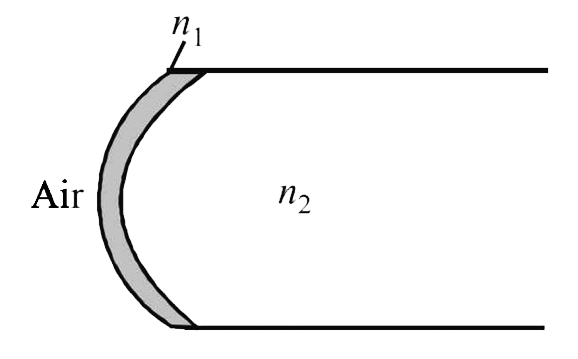
A transparent thin film of uniform thickness and refractive index `n_(1)``=1.4` is coated on the convex spherical surface of radius R at one end of a long solid glass cylinder of refractive index `n_(2)``=1.5`, as shown in the figure. Rays of light parallel to the axis of the cylinder traversing through the film from air to glass get focused at distance `f_(1)` from the film, while rays of light traversing from glass to air get focused at distance `f_(2)` from the film, Then `

A

`|f_(1)| = 3 R`

B

`|f_(1)| = 2.8 R`

C

`|f_(2)| = 2 R`

D

`|f_(2)| = 1.4 R`

Text Solution

Verified by Experts

The correct Answer is:

A, C

As thickness of film is uniform, the effective power of the film is zero. Therefore, we can consider refraction at glass air interface.
In case I : Refraction from air to glass
`-(mu_(1))/(u) + (mu_(2))/(v) = (mu_(2) - mu_(1))/(R )`
`-(1)/(oo) + (1.5)/(f_(1)) = (1.5 - 1)/(R )` or `f_(1) = 3 R`
In case II : Refraction from denser to rarer
`-(mu_(2))/(u) + (mu_(1))/(v) = (mu_(1) - mu_(2))/(R )`
`-(1.5)/(oo) + (1)/(f_(2)) = (1 - 1.5)/(R )` or `f_(2) = 2 R`
Choice (a) and ( c) are correct.
Promotional Banner

Topper's Solved these Questions

  • OPTICS

    PRADEEP|Exercise Problems for practice|4 Videos
  • OPTICS

    PRADEEP|Exercise Comprehension 1|1 Videos
  • OPTICS

    PRADEEP|Exercise Value based questions|3 Videos
  • MAGNETIC EFFECT OF CURRENT AND MAGNETISM

    PRADEEP|Exercise Competition Focus (Multiple Choice Questions)|2 Videos

Similar Questions

Explore conceptually related problems

Rays of light get refracted while passing from air to glass because

A ray of light 10^(-9) second to cross a glass slab of refractive index 1.5. The thickness of the slab will be

A ray of light is incident on the surface of plate of glass of refractive index 1.5 at the polarising angle. The angle of refraction of the ray will be

The refractive index of glass for light going from air to glass is 3/2 . The refractive index for light going from glass to air will be:

A double convex thin lens made of glass (refractive index mu = 1.5 ) has both radii of curvature of magnitude 20 cm . Incident light rays parallel to the axis of the lens will converge at a distance L such that

A ray of light is incident on the surface of a glass plate of refractive index 1.6 at polarzing angle. Calculate the angles of reflection and refraction.

A ray of light falls on a glass plate of refractive index mu=1.5 . What is the angle of incidence of the ray if the angle between the reflected and refracted rays is 90^@ ?

PRADEEP-OPTICS-Exercise
  1. A plano-covex lens is made of a material of refractive index n. When a...

    Text Solution

    |

  2. A transparent slab of thickness d has a refractive index n(z) that inc...

    Text Solution

    |

  3. A transparent thin film of uniform thickness and refractive index n(1)...

    Text Solution

    |

  4. A Young's double slit experiment is performed with white light.

    Text Solution

    |

  5. Three observers A, B and C measure the speed of light coming from a so...

    Text Solution

    |

  6. An astronomical telescope of ten-fold angular magnification has a leng...

    Text Solution

    |

  7. Mark the correct options :

    Text Solution

    |

  8. A narrow beam of white light slab having parallel faces.

    Text Solution

    |

  9. Which of the following (referred to a sphericla mirror) do (does) not ...

    Text Solution

    |

  10. A ray of light from a denser medium strikes a rarer medium at an angle...

    Text Solution

    |

  11. Photograph of the ground are taken form an air-craft ,flying at an alt...

    Text Solution

    |

  12. Light guidance in an optical fibre can be understood by considering a ...

    Text Solution

    |

  13. When waves from two herent sources, having amplitudes a and b superimp...

    Text Solution

    |

  14. When waves from two herent sources, having amplitudes a and b superimp...

    Text Solution

    |

  15. When waves from two herent sources, having amplitudes a and b superimp...

    Text Solution

    |

  16. When waves from two herent sources, having amplitudes a and b superimp...

    Text Solution

    |

  17. Power (P) of a lens is given by reciprocal of focal length (f) of the ...

    Text Solution

    |

  18. Power (P) of a lens is given by reciprocal of focal length (f) of the ...

    Text Solution

    |

  19. Power (P) of a lens is given by reciprocal of focal length (f) of the ...

    Text Solution

    |

  20. Power (P) of a lens is given by reciprocal of focal length (f) of the ...

    Text Solution

    |
