Home
Class 12
PHYSICS
A ray of light from a denser medium stri...

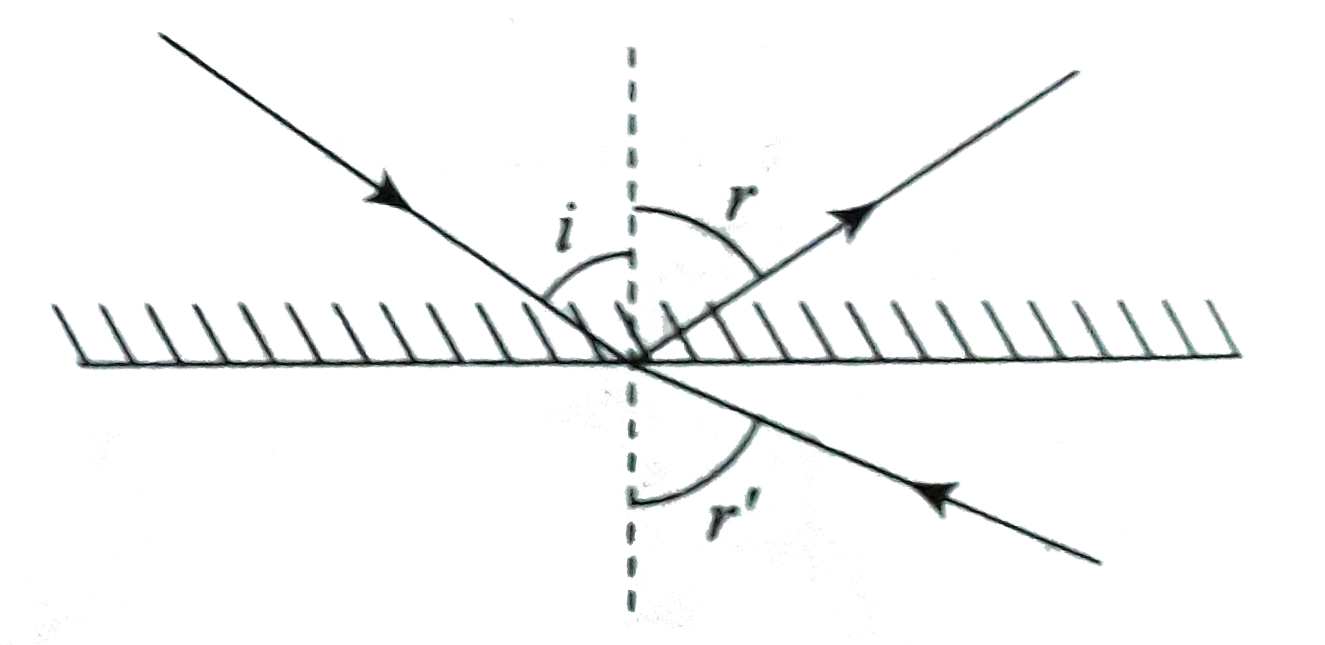
A ray of light from a denser medium strikes a rarer medium at an angle of incidence I (see figure ). The reflected and refracted rays make an angle of `90^(@)` with each other. The angles of reflection and refraction are r and `r^(')` . The critical angle is

A

`sin^(-1)(tan r)`

B

`sin^(-1)(tan i)`

C

`sin^(-1)(tan r')`

D

`tan^(-1)(sin i)`

Text Solution

Verified by Experts

The correct Answer is:

A, B

Imagine the entire path of beam is reversed. Therefore, the wave incident at `/_r'` gets polarised on reflection. According to Brewster's law, Fig.
`mu = tan r' = tan (90^(@) - r) = cot r`
But `mu = (1)/(sin C) =cot r = (1)/(tan r)`
`:. sin C = tan r, C = sin^(-1)(tan r)`
As `r = i`
`:. C = sin^(-1)(tan r) = sin^(-1)(tan i)`
Promotional Banner

Topper's Solved these Questions

  • OPTICS

    PRADEEP|Exercise Problems for practice|4 Videos
  • OPTICS

    PRADEEP|Exercise Comprehension 1|1 Videos
  • OPTICS

    PRADEEP|Exercise Value based questions|3 Videos
  • MAGNETIC EFFECT OF CURRENT AND MAGNETISM

    PRADEEP|Exercise Competition Focus (Multiple Choice Questions)|2 Videos

Similar Questions

Explore conceptually related problems

A ray of light from a denser medium strike a rarer medium at an angle of incidence I (see Fig). The reflected and refracted rays make as angle of 90degrees with each other. The angles of reflection and refraction are r and r The critical angle is

A ray of light from a denser medium strikes a rarer medium at angle of incidence i . The refrected and the refracted rays make an angle of 90^@ with each other. The angles of reflection and refraction are r and r^' respectively. The critical angle is (i) sin^-1(tanr) (ii) sin^-1(tani) (iii) sin^-1(tanr) (iv) tan^-1(tani)

A ray of light from a denser medium strikes a rarer medium at an angle of incidenc i. The reflected and refracted rays make an angle of pi//2 with each other. If the angles of reflection and refraction are r and r^(') , then the criticall angle will be

A ray of light passes from a denser medium to a rarer medium at an angle of incidence i. The reflected and refracted rays make an angle of 90^@ with each other. The angle of reflection and refraction are resepectively r and r'. The critical angle is given by :

A ray of light from a denser medium strikes a rarer medium at an angle of incidence i. if the reflected and the refracted rays are mutually perpendicular to each other, what is the value of the critical angle ?

A ray of light from a rarer medium strikes a denser medium at angle of incidence 60°. The reflected and refracted rays are perpendicular to each other. The refractive index of denser medium and angle of deviation respectively are

A ray of light from a denser medium strikes a rarer medium at an angle of incidence i = tan^( -1)(1//2) . If the reflected and the refracted rays are mutually perpendicular to each-other, what is the value of the critical angle in degree?

If a ray of light in a denser medium strikes a rarer medium at an angle of incidence i, the angles of reflection and refraction are respectively, r and r' If the reflected and refraction rays are at right angles to each other, the critical angle for the given pair of media is

Light from a denser medium 1 passes to a rarer medium 2. When the angle of incidence is theta the partially reflected and refracted rays are mutually perpendicular. The critical angle will be

PRADEEP-OPTICS-Exercise
  1. A narrow beam of white light slab having parallel faces.

    Text Solution

    |

  2. Which of the following (referred to a sphericla mirror) do (does) not ...

    Text Solution

    |

  3. A ray of light from a denser medium strikes a rarer medium at an angle...

    Text Solution

    |

  4. Photograph of the ground are taken form an air-craft ,flying at an alt...

    Text Solution

    |

  5. Light guidance in an optical fibre can be understood by considering a ...

    Text Solution

    |

  6. When waves from two herent sources, having amplitudes a and b superimp...

    Text Solution

    |

  7. When waves from two herent sources, having amplitudes a and b superimp...

    Text Solution

    |

  8. When waves from two herent sources, having amplitudes a and b superimp...

    Text Solution

    |

  9. When waves from two herent sources, having amplitudes a and b superimp...

    Text Solution

    |

  10. Power (P) of a lens is given by reciprocal of focal length (f) of the ...

    Text Solution

    |

  11. Power (P) of a lens is given by reciprocal of focal length (f) of the ...

    Text Solution

    |

  12. Power (P) of a lens is given by reciprocal of focal length (f) of the ...

    Text Solution

    |

  13. Power (P) of a lens is given by reciprocal of focal length (f) of the ...

    Text Solution

    |

  14. An intially parallel cyclindrical beam travels in a medium of refracti...

    Text Solution

    |

  15. An intially parallel cyclindrical beam travels in a medium of refracti...

    Text Solution

    |

  16. An intially parallel cyclindrical beam travels in a medium of refracti...

    Text Solution

    |

  17. Most materials have the refractive index, n gt 1. So, when a light ray...

    Text Solution

    |

  18. Most materials have the refractive index, n gt 1. So, when a light ray...

    Text Solution

    |

  19. A man wants to distinguish between two pillars located at a distance o...

    Text Solution

    |

  20. A beautiful person with two normal eyes wants to see full width of her...

    Text Solution

    |
